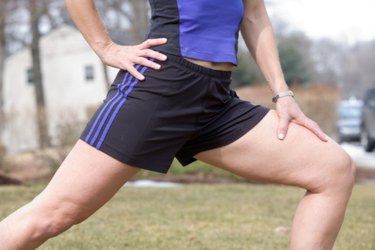
Big thighs and a nice round butt depend on the owner of said characteristics; if you have them you do not want them, and if you do not have them you want them. The trick to slim down your thunder thighs is to actively tone them down through various exercises. Just running or using an elliptical will not do. Combine strength exercises for the lower body and a clean diet for transformation of those thunder thighs to sleek, sexy and toned legs.
Exercise
Step 1
Do full squats. Greg Glassman, founder of CrossFit, believes the air squat is the most basic, fundamental, functional and important move for the human body to master. The squat is functional, works multiple muscles at the same time, improves core strength, posture and of course tones and strengthens the thighs. To do a proper squat, start by standing in front of a low height chair or bench, 18 to 20 in. is a good starting height. Place your feet slightly wider than hip width apart, and angle your feet at a 30-degree angle outward. As you begin to move your hips back and lower down keep your chest up nice and high, maintaining a natural lumbar curve in your lower back, keep your knees in line with your toes, but do not allow them to pass the toes, and keep all of your weight on your heels not your toes. Squat all the way down to the chair, pause, then stand back up. Once you can do 20 squats in a row at this height without having to stop, and with good form, work your way down to about a 12-in. squat depth. The goal is to get your hips below your knee crease.
Step 2
Do lunges. The lunge is another multi-muscle exercise to help tone your thighs. The Georgia State University Department of Kinesiology lists "quadriceps (the muscles on the front of the upper leg), hamstrings (the muscles on the back of the upper leg), gluteals, hip flexors and calf muscles" as the prime movers of the lunge, all forming the thigh. Place colored tape on the ground, about 3 ft. in length, when learning the proper lunge. Start with your feet hip-width apart and one foot on either side of the tape. Take a step out with your right foot, making sure to keep both feet on their own sides of the tape. Begin lowering your left knee to the ground. Do not allow your front knee to come past your toe, you want to form two 90-degree angles when performing this movement. Keep your chest up nice and high, and once you tap the ground with your knee push back to standing position by driving your front foot into the ground and back. To make sure you are doing the exercise properly have a friend or family member watch you.
Step 3
Add weights to your exercises. Once you get comfortable and proficient with these exercises it is time to add weight or some other sort of resistance to the movement. The American Council on Exercise states "strength training favorably affects an individual's overall body composition, resulting in a greater proportion of lean tissue relative to fat tissue. This training adaptation helps to enhance both functional performance capabilities and physical appearance." Improving your overall body composition by decreasing your body fat will give you the sleek, lean look.
Step 4
Cardio train. The best exercise regimen includes a balance of strength training and cardiovascular exercise. But do not get in the habit of only doing one type of exercise. Keep your body guessing by using different machines or doing different activities to get your heart rate up. This can be running, walking, rowing, playing sports or doing an aerobics class at a gym.
Making the Changes
Step 1
Take your measurements with a flexible measuring tape measure, or have a friend or family member measure for you, from four different areas on your right leg. Begin by taking a step out with your right leg, but keep all of your weight on your left. Measure the circumference of you leg 4 in. above your knee. Write this down in a small notebook. Measure the circumference of your leg another 4 in. higher than your starting point, and write down this number. Take one more measurement at the widest width of you thigh and again write this number down. Now stand with both feet together. The last measurement will be around your hips. Place the measuring tape around the largest area of your hips and write this number down.
Step 2
Do not crash diet. Diets below 1,100 calories per day cause more harm than benefits. Not to mention about 30 percent of the weight you lose on these types of diets is muscle. Washington University Physicians states "when we go on a diet, the body's ancient survival mechanisms kick in, refusing to use up valuable stored fat, making it more difficult to burn calories by lowering our metabolic rate and decreasing our energy level and requirements." You want to burn the fat in your thighs, not hold on to it, so make sure you have a healthy balanced diet.
Step 3
Eat only natural carbohydrates. Stay away from processed carbs like bread, cereals, pastas, juices and sodas. These sources of carbohydrates are high in sugar and can easily lead to an excess of calories throughout the day. Any excess of calories, from any source, lends itself to weight gain. Get your carbohydrates from fruits and vegetables instead.
Step 4
Eat fat. Sounds cliché, however good fat actually helps the body burn and lose fat. Dr. Ann Louise Gittleman, certified nutritionist, states "good fat is essential for both permanent weight loss and overall health." Good fats are found in nuts, seeds, avocados and olive oil. Stay away from baked goods, chips, butter, gravies and creamy sauces which contain bad fats, trans and saturated fats.
Step 5
Eat protein. The Harvard School of Public Health states "lack of protein can cause growth failure, loss of muscle mass, decreased immunity, weakening of the heart and respiratory system, and death." So do not cut protein out your diet, protein is good for you. The HSPH recommends getting at least .8 grams of protein per kilogram, about 2 lbs., of bodyweight. Get your protein from lean sources like skinless chicken, turkey, salmon, tuna and other types of fish.
Step 6
Track diet and exercise. Use the same notebook you used for your measurements and track your exercise and diet. Write down everything you eat and when and how you exercise. Retake your measurements after one month to see how much progress you have made. This will also help ensure you are getting enough calories and macronutrients each day. Use Nutriweb, an oline calculator, to help determine your needed calorie intake per day. To lose weight decrease the number by 250 to 500 calories or make sure to burn this amount of calories when exercising to lose about 1 lb. per week.
Tips and Warnings
- Try doing sets of 10 or 20 of the exercises for a few days before doing more reps.
- Please consult a doctor or physician before implementing any new diet or fitness regimen.
Things You'll Need
- Flexible measuring tape
- Notebook
- Pen
References
- Greg Glassman: Squat Clinic
- The University of Georgia Department of Kinesiology: Lower Body Strength
- American Council on Exercise: One of the More Common Perceptions in Some Fitness Circles Is That Strength Training Individuals Lose Weight Because One Pound of Muscle Can Burn Approximately 30-50 Calories Per Day. Is This Claim Valid?
- Washington University Physicians: What's the Skinny on Fat?
- Dr. Ann Louise: Diet/ Detox


Member Comments