Massage Therapy for Plantar Fibromatosis
Plantar fibromatosis, also known as Ledderhose's disease after the doctor that first described it, occurs when non-cancerous tumors form in the plantar fascia at the base of the foot 12. These small bumps are made up of excess collagen or fibrotic tissue and can be painful if pressed. While extreme cases can require surgical intervention, massage therapy can help alleviate some of the symptoms in less-serious cases.
If you are experiencing serious medical symptoms, seek emergency treatment immediately.
What to Avoid
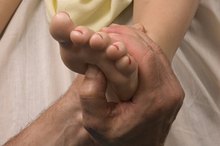
When giving a massage to someone with plantar fibromatois, you’ll want to avoid putting direct pressure on the small tumors because that can prove painful. Instead of working these deposits directly, a massage therapist should work the surrounding tissue to decrease any referred pain or tension brought about by the tumors. A successful massage for this condition will also work the ankle and toe joints with range of motion and stretching exercises.
Bilateral Work
What Are the Treatments for Tendinitis of the Foot?
Learn More
The nodules associated with this condition can cause a lot of pain when walking, and it is likely that the massage recipient will have adjusted their gait to avoid putting pressure on the sensitive areas. Such gait adjustments always create muscle strain, and not just in the leg that has the problem. Massage for a recipient with this condition should focus on both of the lower extremities to help alleviate this strain.
Eastern Massage Techniques
Instead of using traditional Swedish techniques to address this problem, a sufferer should consider Eastern massage styles such as shiatsu and reflexology. These techniques focus on energetic pathways throughout the body, and both methodologies contain a number of important points to work on and around the foot. While avoiding putting too much pressure on any of the nodules, the therapist will dig into these points to restore the proper flow of energy to the region and reduce pain.
Talk to Your Doctor
Taping Techniques for Morton's Neuroma
Learn More
Before visiting a massage therapist to help treat your plantar fibromatosis, discuss the condition with your doctor 2. Also, when you arrive at the massage therapist’s office, notify them of the condition so they can come up with an appropriate treatment plan.
Related Articles
What Are the Treatments for Tendinitis of the Foot?
Learn More
Taping Techniques for Morton's Neuroma
Learn More
Tips for Relieving MTP Joint Pain
Learn More
Vitamin D Deficiency & Plantar Fasciitis
Learn More
The Best Shoes for Obese People
Learn More
About Pressure Points for a Foot Massage
Learn More
Differences Between Shiatsu & Swedish Massage
Learn More

Deep Tissue Massage While Pregnant
Learn More
How to Stretch the Foot Arch
Learn More
Foot Massage & Lymphatic Drainage
Learn More
References
- Dupuytren Society: Ledderhose's Disease
- PD Labs: lantar Fibromatosis
- Guo J, Li L, Gong Y, et al. Massage alleviates delayed onset muscle soreness after strenuous exercise: a systematic review and meta-analysis. Front Physiol. 2017;8:747. doi:10.3389/fphys.2017.00747
- Gholami-Motlagh F, Jouzi M, Soleymani B. Comparing the effects of two Swedish massage techniques on the vital signs and anxiety of healthy women. Iran J Nurs Midwifery Res. 2016;21(4):402‐409. doi:10.4103/1735-9066.185584.
- Guo J, Li L, Gong Y, et al. Massage alleviates delayed onset muscle soreness after strenuous exercise: a systematic review and meta-analysis. Front Physiol. 2017;8:747. doi:10.3389/fphys.2017.00747
- Lillehei AS, Halcón LL, Savik K, Reis R. Effect of inhaled lavender and sleep hygiene on self-reported sleep issues: A randomized controlled trial. J Altern Complement Med. 2015;21(7):430-8. doi:10.1089/acm.2014.0327
- Lakhan SE, Sheafer H, Tepper D. The effectiveness of aromatherapy in reducing pain: a systematic review and meta-analysis. Pain Res Treat. 2016;2016:8158693. doi:10.1016/j.ctcp.2017.01.001
- Petrofsky JS, Laymon M, Lee H. Effect of heat and cold on tendon flexibility and force to flex the human knee. Med Sci Monit. 2013;19:661-7. doi:10.12659%2FMSM.889145
- Koren Y, Kalichman L. Deep tissue massage: What are we talking about? J Bodyw Mov Ther. 2018;22(2):247-251. doi:10.1016/j.jbmt.2017.05.006
- Robinson N, Lorenc A, Liao X. The evidence for shiatsu: a systematic review of shiatsu and acupressure. BMC Complement Altern Med. 2011;11:88. doi:10.1186/1472-6882-11-88
- Juntakarn C, Prasartritha T, Petrakard P. The effectiveness of Thai massage and joint mobilization. Int J Ther Massage Bodywork. 2017;10(2):3-8. doi:10.3822/ijtmb.v10i2.350
- Netchanok S, Wendy M, Marie C, Siobhan O. The effectiveness of Swedish massage and traditional Thai massage in treating chronic low back pain: a review of the literature. Complement Ther Clin Pract. 2012;18(4):227-34. doi:10.1016/j.ctcp.2012.07.001
- Smith CA, Levett KM, Collins CT, Dahlen HG, Ee CC, Suganuma M. Massage, reflexology and other manual methods for pain management in labour. Cochrane Database Syst Rev. 2018;3:CD009290. doi:10.1002/14651858.CD009290.pub3
- International Institute of Reflexology. History of reflexology.
- Trofa DP, Obana KK, Herndon CL, et al. The evidence for common nonsurgical modalities in sports medicine, part 1: kinesio tape, sports massage therapy, and acupuncture. J Am Acad Orthop Surg Glob Res Rev. 2020;4(1):e19.00104. doi:10.5435/JAAOSGlobal-D-19-00104
- National Center for Complementary and Integrative Health. Massage therapy: What you need to know. Updated May 2019.
- American Massage Therapy Association. Massage therapy industry fact sheet.
- National Center for Complementary and Integrative Health. Paying for complementary and integrative health approaches. Updated June 2016.
Writer Bio
James Mulcahy is a New York City-based licensed massage therapist with more than 1,500 hours of training in anatomy, myology and pathology. He currently works as a freelance writer and has contributed to Huffington Post, New York Press, British Airway’s High Life, Metromix and many other publications.