
The Advantages of Swimming Sprints Vs. Distance
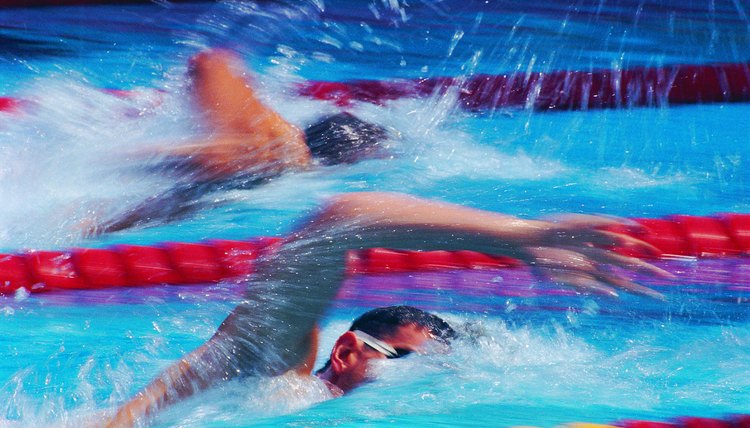
Both distance swimmers and sprinters demonstrate strength and power in the pool. Distance swimmers rely on endurance training, though, to be able to swim longer races, while sprinters fall back on conditioning to swim short, intense sets. Each has its merits, and though endurance workouts may seem harder because of the distance involved, sprints are just as tough because they stretch the limits of your cardiovascular fitness.
Energy
Distance swimming uses aerobic metabolism. This means you are constantly fueling your body with oxygen, and your muscle cells contract repeatedly. Sprinting involves using anaerobic metabolism, where muscle cells rely on other reactions that do not require oxygen to fuel muscle contraction. As a result, this is why you must expend more energy while sprinting, but also feel a greater amount of fatigue. Your performance over time deteriorates because your muscle contractions are impaired. Sprint training helps you get used to this kind of fatigue and perform well in spite of it.
Building Strength
Great technique can only take you so far -- in order to sprint, you need incredible strength. Swimming at top speeds forces you to work harder, and thus requires top muscles. Those short intervals build up muscles all over, but can help with specific muscle groups depending on the stroke. With freestyle, for example, it particularly build muscles in the shoulders, arms and back. Because of this muscle buildup, you're able to perform endurance swim sets with more speed and strength behind each stroke.
Training
Whether you're a competitive swimmer or not, sprint training changes up your routine. Consistently swimming the same endurance sets will not only consistently work out the same muscles, but also become tiring after a while. It can get tedious to swim the same laps over and over again, but mixing in sprint sets work those muscles harder and faster, keeping you energized. Even if you're primarily a distance swimmer, sprinting trains you physically and mentally to swim at a faster pace. This focus on efficiency versus speed will help carry over to whatever stroke or race you swim.
Workouts
Sprint workouts can be grueling, so pepper your workout schedule with sprint sets at first, then progressively add more. Start with five sets of 100 yards or meters at a comfortable interval, gradually decreasing your swim time by five seconds each 100 yards or meters. If your base time is two minutes, 15 seconds, then your next time should be 2:10, and so on. For a more rigorous sprint workout, swim 10 sets of 100 yards or meters, speeding up on the last 25 yards or last half of the second meter lap. Follow this up with 10 sets of 50 yards or meters, speeding up in the second half as you make your final push towards the wall.
References
Writer Bio
Nadia Osman is a California-based writer. She has covered travel, real estate, fashion, fitness and other topics for various online publications. Osman holds a B.A. in history from UC Irvine.