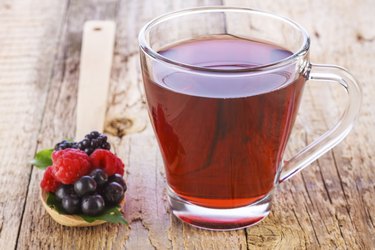
Blueberry tea is made from the dried leaves of the blueberry bush. It has a faintly grassy taste and is sometimes flavored with dried blueberries to give it a sweeter, fruitier flavor and a deep purple color. Blueberry leaves are rich in antioxidants, which have a number of different health benefits, including lowering fat levels and potentially protecting against hepatitis C.
Supplies Antioxidants
Video of the Day
Blueberry leaves are rich in polyphenols, a type of natural antioxidant. Regardless of whether the leaves are from commercial or wild blueberry bushes, the antioxidant capacity of blueberry tea was shown to be extremely high in a study published in a 2009 issue of the "Journal of Medicinal Food." Scientists conducting the study ensured that the leaves were steeped in hot water in a preparation that was similar to a home-brew of blueberry tea. A study in a 2013 issue of the "Journal of Medicinal Food" concluded that the antioxidant content in blueberry tea was sufficiently high that it showed great potential in helping treat the physiological symptoms of neurodegenerative disease, such as reduced brain function and mental impairment.
Video of the Day
Reduces the Risk of Diabetes
Blueberry tea ingredients, both the leaves and the berries, contain anthocyanins, which are antioxidants found in dark-colored fruits, such as blueberries. Anthocyanins are water-soluble, so their health benefits will be present in blueberry tea. A 2012 issue of the "American Journal of Clinical Nutriton" included a study showing that increased anthocyanin intake, as a supplement and in the form of anthocyanin-rich foods such as blueberries, led to a lower risk of type-2 diabetes in both men and women.
Contains Gallic Acid
Blueberry tea naturally contains gallic acid, a natural antioxidant. According to an article in a 2013 issue of "Molecules," gallic acid has anti-inflammatory and anti-allergy properties. Like anthocyanins, gallic acid is water-soluble, so it is present in blueberry tea. Researchers found that gallic reduced the amount of inflammation associated with allergic reactions, leading them to conclude that gallic acid may be useful as a natural anti-inflammatory agent for allergies, especially when used along with dexamethasone, an anti-inflammatory drug. Gallic acid, when taken with dexamethasone, was significantly more effective as an anti-inflammatory than when it was taken alone.
Making Blueberry Tea at Home
When making teas at home, the amount of tea you use as well as the temperature of the water and the length of time it is allowed to steep will affect the nutrition content, as well as the taste, of the tea. For blueberry tea, a 2-teaspoon serving is generally used, and for optimal antioxidant benefits, steep the tea in roughly 8 ounces of water for 30 minutes. The water should be almost boiling, roughly 203 degrees Fahrenheit. If you like, you can double or triple the amount of leaves and water used to make a larger pot. Blueberry tea can be drunk hot or cold.
- MedlinePlus: Blueberry
- Journal of Medicinal Food: Blueberry (Vaccinium Virgatum) Leaf Extracts Protect Against Aβ-Induced Cytotoxicity and Cognitive Impairment
- Journal of Medicinal Food: Antioxidant Capacity and Polyphenolic Content of Bllueberry (Vaccinium Corymbosum L.) Leaf Infusions
- Molecules: Anti-Inflammatory and Anti-Allergic Activities of Pentaherb Formula, Moutan Cortex (Danpi) and Gallic Acid
- American Journal of Clinical Nutrition: Dietary Flavonoid Intakes and Risk of Type 2 Diabetes in US Men and Women