Early Signs and Symptoms of Eye Shingles
Shingles is caused by a type of herpes virus, called varicella zoster, the same virus that causes chickenpox. After someone has chickenpox, the virus can lie dormant in the body's nervous system for years before reactivating as shingles. According to a November 2002 article in "American Family Physician," about 25 percent of shingles outbreaks occur in or around the eye, a condition called herpes zoster ophthalmicus 13. Knowing early signs and symptoms of eye shingles is important because treatment during the first stages can lessen pain and prevent vision loss.
If you are experiencing serious medical symptoms, seek emergency treatment immediately.
Flulike Symptoms and Pain
In many cases, eye shingles start by causing flulike symptoms, including fever, body aches, chills, headaches and fatigue. Often these symptoms are followed by pain on 1 side of the head or in 1 eye before any sign of a rash appears. The pain is often described as a burning or tingling sensation at first, followed by mild to severe pain. Pain follows a branch of the trigeminal nerve, which runs from the lower jaw to the forehead.
- In many cases, eye shingles start by causing flulike symptoms, including fever, body aches, chills, headaches and fatigue.
- Often these symptoms are followed by pain on 1 side of the head or in 1 eye before any sign of a rash appears.
Rash
Symptoms of Head Shingles
Learn More
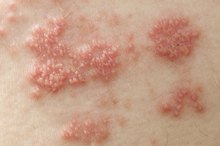
Before a shingles outbreak involves the eye, a red skin rash may form on 1 side of the head, eyelids or scalp. The rash looks like a cluster of blisters, which ooze clear fluid before eventually crusting over. A shingles rash may alternate between feeling itchy and painful. You can have shingles in they eye without developing a skin rash, but having the rash allows doctors to diagnose the problem without further testing.
- Before a shingles outbreak involves the eye, a red skin rash may form on 1 side of the head, eyelids or scalp.
- A shingles rash may alternate between feeling itchy and painful.
Eye Problems
Shingles of the eye can cause different symptoms that vary in severity. Symptoms are in 1 eye only and can include pain, blurry vision, redness or uveitis, which is an inflammation of the drainage structures of the eye. Inflammation can also develop in the interior surface of the eye, the retina. Both of these conditions can result in vision loss.
- Shingles of the eye can cause different symptoms that vary in severity.
- Both of these conditions can result in vision loss.
Early Treatment for Shingles
On What Parts of Your Body Are Shingles Found?
Learn More
It is important to see your doctor if you have symptoms of eye shingles. Oral and topical medicines can treat the symptoms. Therapy works best if started within 48 to 72 hours of developing a shingles skin rash. Without treatment, people with eye shingles can develop scarring in the eye that may result in vision loss.
- It is important to see your doctor if you have symptoms of eye shingles.
Related Articles

Symptoms of Head Shingles
Learn More
On What Parts of Your Body Are Shingles Found?
Learn More

Knee Pain From Shingles
Learn More

What Is the Incubation Period for Shingles?
Learn More

Pain in Lymph Nodes Shingles
Learn More
What Eye Problems are Typical With Crohn's Disease?
Learn More

Early Stages of Shingles
Learn More

What Happens If Shingles Are Not Treated with Medicine?
Learn More
Melatonin & Shimmering Eye Sensations
Learn More
Shingles & Chest Pain
Learn More
References
- American Family Physician: Evaluation and Management of Herpes Zoster Ophthalmicus
- Review of Optometry: An Overview of Ocular Herpetic Disease
- Western Journal of Emergency Medicine: Herpes Zoster Ophthalmicus
- Transactions of the American Ophthalmological Society: Herpes Zoster Ophthalmicus: Report of Cases and a Review of the Literature
- Centers for Disease Control and Prevention. Shingles (Herpes Zoster) Signs & Symptoms.
- Centers for Disease Control and Prevention. Shingles (Herpes Zoster) Signs & Symptoms.
- John AR, Canaday DH. Herpes Zoster in the Older Adult. Infect Dis Clin North Am. 2017;31(4):811-826. doi: 10.1016/j.idc.2017.07.016
- Yun H, Xie F, Baddley JW, Winthrop K, Saag KG, Curtis JR. Longterm Effectiveness of Herpes Zoster Vaccine among Patients with Autoimmune and Inflammatory Diseases. J Rheumatol. 2017;44(7):1083-1087. doi: 10.3899/jrheum.160685
- Cohen KR, Salbu RL, Frank J, Israel I. Presentation and Management of Herpes Zoster (Shingles) in the Geriatric Population. P T. 2013;38(4): 217-224, 227.
- Galetta KM, Gilden D. Zeroing in on zoster: A tale of many disorders produced by one virus. J Neurol Sci. 2015;358(1-2):38-45. doi: 10.1016/j.jns.2015.10.004
- Blank LJ, Polydefkis MJ, Moore RD, Gebo KA. Herpes zoster among persons living with HIV in the current antiretroviral therapy era. J Acquir Immune Defic Syndr. 2012;61(2):203-7. doi: 10.1097/QAI.0b013e318266cd3c
- Mallick-searle T, Snodgrass B, Brant JM. Postherpetic neuralgia: epidemiology, pathophysiology, and pain management pharmacology. J Multidiscip Healthc. 2016;9:447-454. doi: 10.2147/JMDH.S106340
- Johnson RW, Bouhassira D, Kassianos G, Leplège A, Schmader KE, Weinke T. The impact of herpes zoster and post-herpetic neuralgia on quality-of-life. BMC Med. 2010;8:37. doi: 10.1186/1741-7015-8-37
- Sampathkumar P, Drage LA, Martin DP. Herpes zoster (shingles) and postherpetic neuralgia. Mayo Clin Proc. 2009;84(3):274-80.
- Pereira LB. Impetigo - review. An Bras Dermatol. 2014;89(2):293-9. doi: 10.1590/abd1806-4841.20142283
- Gershon AA, Breuer J, Cohen JI, et al. Varicella zoster virus infection. Nat Rev Dis Primers. 2015;1:15016. doi: 10.1038/nrdp.2015.16
- Naveen KN, Pradeep AV, Kumar JS, Hegde SP, Pai VV, Athanikar SB. Herpes zoster affecting all three divisions of trigeminal nerve in an immunocompetent male: a rare presentation. Indian J Dermatol. 2014;59(4):423. doi: 10.4103/0019-5154.135548
- Opstelten W, Zaal MJ. Managing ophthalmic herpes zoster in primary care. BMJ. 2005;331(7509):147-51. doi: 10.1136/bmj.331.7509.147
- Jeon Y, Lee H. Ramsay Hunt syndrome. J Dent Anesth Pain Med. 2018;18(6):333-337. doi: 10.17245/jdapm.2018.18.6.333
- Kim SH, Choi SM, Kim BC, et al. Risk Factors for Aseptic Meningitis in Herpes Zoster Patients. Ann Dermatol. 2017;29(3):283-287. doi: 10.5021/ad.2017.29.3.283
- Saxena A, Khiangte B, Tiewsoh I, Jajoo UN. Herpes zoster encephalitis presenting as multiple cerebral hemorrhages - a rare presentation: a case report. J Med Case Rep. 2013;7:155. doi: 10.1186/1752-1947-7-155
- Teo HK, Chawla M, Kaushik M. A Rare Complication of Herpes Zoster: Segmental Zoster Paresis. Case Rep Med. 2016;2016:7827140. doi: 10.1155/2016/7827140
- American Academy of Dermatology. Cellulitis: Overview.
- American Academy of Ophthalmology. Herpes Zoster Ophthalmicus.
- Centers for Disease Control and Prevention. Shingles (Herpes Zoster): Clinical Overview. Feb 21, 2018.
- Mayo Clinic. Postherpetic Neuralgia. Sept 16, 2015.
Writer Bio
Kim Parr is a private practice optometrist. She attended Western Kentucky University, then Southern College of Optometry, graduating cum laude in 1999. She completed a residency with the Indian Health Service before buying her own practice in 2002.