What does fact checked mean?
At Healthfully, we strive to deliver objective content that is accurate and up-to-date. Our team periodically reviews articles in order to ensure content quality. The sources cited below consist of evidence from peer-reviewed journals, prominent medical organizations, academic associations, and government data.
The information contained on this site is for informational purposes only, and should not be used as a substitute for the advice of a professional health care provider. Please check with the appropriate physician regarding health questions and concerns. Although we strive to deliver accurate and up-to-date information, no guarantee to that effect is made.
Is Eggplant Good for Gout?
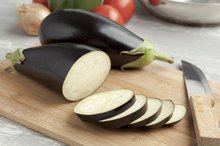
Gout sufferers experience periods of intense pain and swelling of their joints, usually in the big toe 1. Your diet can play a role in alleviating flare-ups and preventing future attacks 1. Because it's low in purines -- a potential trigger for gout -- eggplant should not cause or worsen gout.
If you are experiencing serious medical symptoms, seek emergency treatment immediately.
Gout Causes
Gout is primarily caused by elevated levels of uric acid in the blood, or hyperuricemia. It can also be caused by medications or medical conditions that raise uric acid levels 1. Uric acid found in the blood is primarily the result of the body breaking down purines, a type of nitrogen-based compound found in many foods.
Purine Rich Foods
Are Radishes Good for Gout?
Learn More
The level of purines in food varies. On the high end are organ meats, fish roe and red wine. Eggplant, on the other hand, is low in purines, so it makes a welcome addition to gout-friendly diets.
Gout Attacks
An acute gout attack resulting in severe pain and joint inflammation can only be treated with medication. Although eating low-purine foods, such as eggplant, will not alleviate the pain or swelling, following a low-purine diet may help control attacks in the future.
Related Articles
Are Radishes Good for Gout?
Learn More
Broccoli for Gout
Learn More

Gout and Shrimp
Learn More
Foods That May Cause Joint Pain
Learn More
List of Foods That Reduce Uric Acid
Learn More
What Happens to Sugar Levels in the Blood While Fasting?
Learn More
Alkaline Diet to Treat Gout
Learn More

What Causes Gout and Bursitis?
Learn More
List of Foods High in Uric Acid
Learn More
Eggplant & Inflammation
Learn More
References
- National Institute of Arthritis and Musculoskeletal and Skin Diseases
- The Merck Manual for Health Care Professionals. "Gout." Accessed March 25, 2016. http://www.merckmanuals.com/professional/musculoskeletal_and_connective_tissue_disorders/crystal-induced_arthritides/gout.html
- National Institute of Arthritis and Musculoskeletal and Skin Diseases. "Questions and Answers About Gout." Accessed March 25, 2016. http://www.niams.nih.gov/Health_Info/Gout
Writer Bio
Joe Stone is a freelance writer in California who has been writing professionally since 2005. His articles have been published on LIVESTRONG.COM, SFgate.com and Chron.com. He also has experience in background investigations and spent almost two decades in legal practice. Stone received his law degree from Southwestern University School of Law and a Bachelor of Arts in philosophy from California State University, Los Angeles.