Mole Removal on the Scalp
Moles are growths on the skin caused by clusters of skin cells called melanocytes. They can show up anywhere on the body, including highly visible places like your face, neck and scalp. Most are removed for cosmetic reasons, however, some should be removed for health reasons. Those created over time due to sun exposure are linked to the formation of dysplastic, or atypical, moles. If they are large, itch, bleed or have irregular borders, these could be signs of a melanoma.
Significance
According to the American Academy of Dermatology, skin moles usually appear at birth or during early childhood. Most people have 20 to 40 moles by the time they are adults. Those with fair skin or work outdoors develop more and are at greater risk for the development of melanoma. Mole removal is common, as this can prevent deadly cancer from spreading throughout the body.
- According to the American Academy of Dermatology, skin moles usually appear at birth or during early childhood.
- Mole removal is common, as this can prevent deadly cancer from spreading throughout the body.
Effects
What to Do if a Mole Becomes Itchy & Painful
Learn More
The effects of scalp moles, as well as moles on the rest of your body, vary from person to person. Some wish to remove benign moles for aesthetic reasons, especially if they are visible. Some moles may itch or become irritated due to certain clothing fabrics, jewelry or activities. According to the American Academy of Dermatology, the highest risk moles are those that look abnormal, change colors or bleed, and must be removed to avoid the potential spread of cancerous cells.
- The effects of scalp moles, as well as moles on the rest of your body, vary from person to person.
Types
Excision, and excision followed by cauterization are the most common methods of scalp mole removal. According to Cosmeticsurgery.com, laser removal is possible, but it is often ineffective as moles have a high recurrence rate with this form of treatment. Laser lights cannot penetrate your skin deep enough to remove the entire mole. For excision, a doctor shaves off the mole with a scalpel, then closes the wound with dissolvable stitches. Sometimes, doctors will excise the mole and cauterize it afterwards. This burns away the area around the mole to help close it and prevent infection.
- Excision, and excision followed by cauterization are the most common methods of scalp mole removal.
- For excision, a doctor shaves off the mole with a scalpel, then closes the wound with dissolvable stitches.
Recovery
Side Effects of Mole Removal
Learn More
The recovery time after mole removal depends on the type of procedure performed and how much tissue is removed. When a potentially malignant moles is removed, doctors usually cut off some tissue around and underneath the mole to prevent abnormal cell growth from returning or becoming cancerous. According to the American Academy of Dermatology, antibiotic ointment is applied after treatment to prevent infection and the wound is covered for several days to promote fast healing.
Considerations
According to Nevus.org, scalp mole removal comes with few complications 2. However, any abnormal symptoms such as:
- wound discharge
- bleeding
- fever
- severe pain
- redness
- swelling should be reported to a doctor immediately
Occasionally, moles may return after removal, but this should not be cause for concern unless the original mole was atypical.
Related Articles
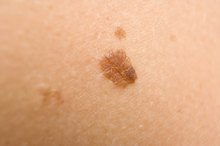
What to Do if a Mole Becomes Itchy & Painful
Learn More
Side Effects of Mole Removal
Learn More

Why Is a Mole Raising Up on Skin?
Learn More

Age Spots and Moles
Learn More
Examples of Harmless Skin Moles
Learn More
How to Remove Skin Tags With a Wart Remover
Learn More

Small Bumps All Over the Legs That Are Flesh Colored
Learn More

Earlobe Wart
Learn More

How to Get Rid of Stitch Scars on the Face
Learn More
How to Get Rid of Scars From Impetigo
Learn More
References
- Cosmetic Surgery: Mole Removal
- Nevus.org: About a Nevus
- American Cancer Society. How to Spot Skin Cancer. Updated 07/06/17. https://www.cancer.org/latest-news/how-to-spot-skin-cancer.html
- Canadian Cancer Society. Signs and Symptoms of melanoma skin cancer. http://www.cancer.ca/en/cancer-information/cancer-type/skin-melanoma/signs-and-symptoms/?region=on
- American Cancer Society. Key statistics for melanoma skin cancer. Updated August 14, 2019.
- Children's Hospital of Philadelphia. Congenital nevus (mole).
- U.S. National Library of Medicine Genetics Home Reference. Are moles determined by genetics? Updated December 2017.
- National Cancer Institute. Genetics of skin cancer (PDQ) - health professional version. Updated January 3, 2020.
- American Society of Clinical Oncology. Melanoma: symptoms and signs. Updated January 2019.
- Skin Cancer Foundation. Melanoma warning signs. Updated April 2019.
- National Cancer Institute. Melanoma risk assessment tool.
- American Cancer Society. How to Spot Skin Cancer. Updated 07/06/17.
- Canadian Cancer Society. Signs and Symptoms of melanoma skin cancer.
Writer Bio
David Friedman began writing professionally in 2004. His work appears in the "Daily Illini" and various websites. Friedman is a certified personal trainer through the American College of Sports Medicine and has Bachelor of Science in exercise science from University of Illinois at Urbana-Champaign.