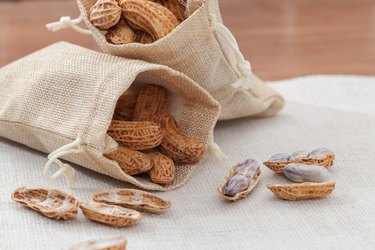
Boiled peanuts are a traditional and healthy snack food in many parts of the South. Most Southerners say that appreciation of boiled peanuts is an acquired taste, not necessarily something you'll savor on your first tasting. If you give them a chance, however, you may find them addictive.
Tip
Boiled peanuts have all the health benefits of roasted peanuts, with more antioxidants. They also make you feel full, so they're not only a healthy snack, but they'll also combat your hunger pangs.
Video of the Day
What Are Boiled Peanuts?
Boiled peanuts are common in a swath of the coastal Southeast, stretching along the Atlantic and Gulf coasts from North Carolina to South Carolina, Georgia, northern Florida, Alabama and Mississippi. You'll see signs advertising these boiled nuts along interstates and local roadways in this region. These are green or raw peanuts, legumes actually, that are boiled in salty water, sometimes outdoors over a fire.
Video of the Day
After several hours, the little boiled legumes are ready. The shells become soft, and fans of boiled peanuts bite into the shell, which releases not only the little peanut, but the brine as well. Enjoy the brine and the peanut, and just as with roasted peanuts, spit out the shell. The peanuts taste soft and mushy.
Boiled peanuts contain the same nutrients as roasted peanuts, and even more antioxidants, but they don't keep well. Refrigerate or freeze anything you don't eat, so they don't become slimy and inedible.
Benefits of Eating Peanuts
Peanuts are a healthy food choice. Although usually eaten roasted, eating boiled nuts is another way to get the health benefits of peanuts. Peanuts have lots of vitamins, minerals and fiber. A serving of 100 grams of peanuts, or a half cup, provides, as part of the recommended daily allowance:
- 75 percent of niacin
- 60 percent of folate
- 53 percent of thiamin
- 10 percent of riboflavin
- 55 percent of vitamin E
- 22 percent of dietary fiber
And the list goes on. Even after cooking peanuts, they provide significant percentages of potassium, calcium, copper, iron, magnesium, manganese, zinc and selenium. As you can see, peanuts provide many essential nutrients in a small serving.
Peanuts contain calories, which can add up quickly, but eating them makes you feel full. A half cup of peanuts is about 567 calories.
Read more: Are Peanuts Healthy for Your Heart?
Why Eat Peanuts?
If you're pregnant, folate is an essential nutrient to prevent congenital disabilities and spine damage in your unborn child.
Peanuts are full of protein. A half cup of peanuts provides about 24 grams of protein, which is 47 percent of the recommended daily value of protein you should eat.
Peanuts are a good source of resveratrol. They're also a source of good fat, which can help raise your HDL, or good, cholesterol levels. And they contain isoflavones, antioxidants that may reduce the risk of cancer, diabetes and heart disease. Boiling helps to preserve the most resveratrol in peanuts, compared with dry roasting.
Despite the relatively high caloric value of peanuts, they can be beneficial in weight loss.
Read more: What Is the Nutritional Value of Peanuts?
Good Source of Energy
Peanuts provide a lot of bang for the buck, including lots of energy. In fact, peanuts are considered to be energy dense. For the price, these legumes are one of the best sources of protein you can buy.
A Little Background
Boiled peanuts came to the American South from Africans who were brought over and enslaved. On slave ships coming to America, slaves were fed raw peanuts from Africa, where they were known as ground nuts. In America, many enslaved people grew them in their gardens outside their cabins.
Eventually, boiled peanuts became a favorite of many Southerners. In areas where peanuts are farmed, communities gather to boil surplus peanuts. In many communities, these gatherings have morphed into full-blown boiled-peanut festivals.
The smallest, immature green peanuts, known as pops, absorb the most salt during boiling. These can be eaten whole, providing even more nutrients. Peanut shells contain more fiber and nutrients than peanuts.
Making Boiled Peanuts
Use a large stock pot. Dissolve 1 cup of salt into 2 gallons of water, add green peanuts and bring to a boil. Cover the pot and maintain a low boil for 45 minutes, making sure the water covers the peanuts. Turn off the heat, and carefully remove a peanut to sample. If it's no longer crunchy, it's ready. If it is, bring the water to a boil again, and cook the peanuts a little longer. Once they're soft and mushy, allow them to cool in the water. When cool, drain and serve.
- AL.com: Love 'Em or Hate 'Em, Boiled Peanuts Are a Southern Specialty
- Journal of Food Science and Technology: Peanuts as Functional Food: A Review
- Parenting First Cry: Eating Peanuts During Pregnancy
- WMBF News: Boiled Peanuts: A South Carolina Delicacy
- Cooking Light: How to Make Boiled Peanuts
- The Peanut Institute: Bioactives
- American Heart Association: HDL (Good), LDL (Bad) Cholesterol and Triglycerides
- Serious Eats: The Real Origins of the Boiled Peanut
- Self Nutrition Data: Peanuts, All Types, Dry Roasted Without Salt