
The Difference Between Gymnastic Mats and Tumbling Mats
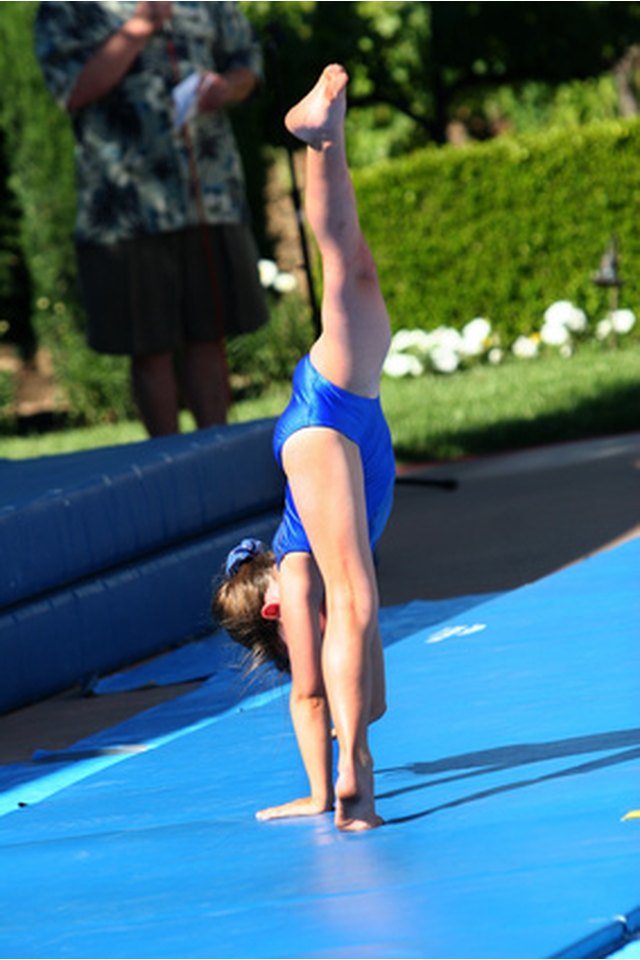
In terms of competition, gymnastics and tumbling are different disciplines. Just like how karate and taekwondo are different martial arts. Tumbling involves a series of acrobatic skills down a long runway like flips, handsprings,handstands, and more. These moves are often seen in cheerleading. In contrast, artistic gymnastics involves vaulting, uneven parallel bars, balance beam and floor for women; and vaulting, parallel bars, pommel horse, rings, high bar and floor for men. The dimensions and properties of mats used for competitive tumbling and gymnastics are dictated by the governing bodies of the sports. For recreational or home use though, the terms gymnastics mats and tumbling mats are interchangeable.
Home/Recreational Use
girl at summer gymnastic camp image by Galina Barskaya from Fotolia.com
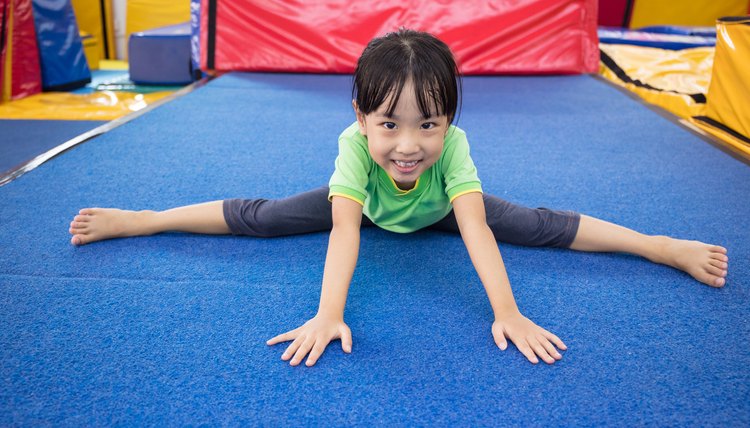
A number of companies sell “gymnastics” mats or “tumbling” mats for home or recreational use. Often called folding mats, or panel mats, these mats fold up into discrete sections for easy storage when not in use. They vary in length and width, but are usually about 1 or 2 inches thick, filled with dense foam and some added PVC that cushions but does not compress with pressure. Panel mats are designed to provide a more comfortable surface for basic skills such as rolls and cartwheels. They are not designed to cushion hard landings or falls. Some even include carrying handles or velcro to add to the portability of a foldable mat.
Floor Exercise
girl at summer gymnastic camp image by Galina Barskaya from Fotolia.com
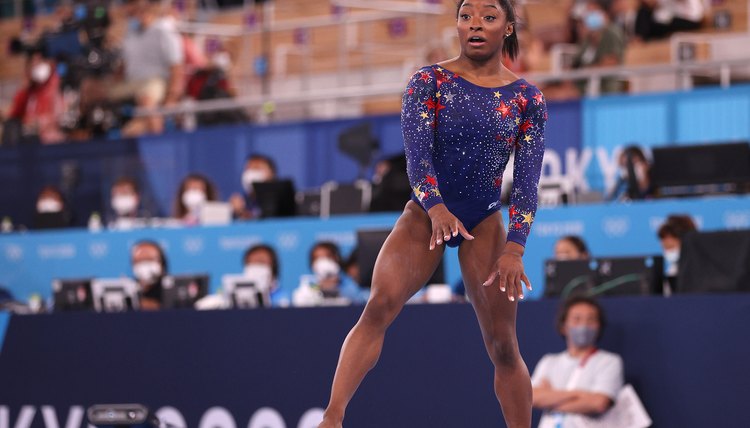
The floor mats used in floor exercise for men’s and women’s artistic gymnastics are a layer of 1 to 2 inch dense, high quality foam over a sprung floor. The foam transmits the spring while providing a more comfortable surface for take-offs and landings. The regulation floor exercise gym mat is about 40 feet long and 40 feet wide.
Gymnastics Landing Mats
The other men’s and women’s events use 4-inch mats all around the equipment for safety and to provide a layer of cushion over a hard gym floor in case of a fall. In addition, these events use an additional 4- or 8-inch-thick mat for landings. These mats are meant to cushion a fall or mostly absorb the shock of a hard landing. No mat, no matter how thick, can completely prevent injuries.
Pit Mat
A pit mat is a training aid that is never used for competition. These mats are about 24 to 32 inches thick, designed to protect the gymnast or tumbler who is learning a new skill using a training drill that does not necessarily land feet first. They absorb the full force of a landing.
Competitive Tumbling
High level competitive tumblers use a long narrow tumbling strip that ends in a thicker landing mat. The gymnastic tumbling mat consists of a spring floor topped with a single or double layer of 1-inch dense foam that transmits the spring but provides some cushioning. Depending on the level of competition, the strip must be from 72 to 85 feet long, and 5 or 6 feet wide. The landing mat is about 12 inches thick, designed to absorb the force of a hard landing.
Where to buy the best gymnastics mats?
One of the biggest FAQs in the gymnastic space is where to get the highest quality mats. You can find all kinds of exercise mats, like air mats, wedge mats, and incline mats, on Amazon. This is a good place for beginners to get mats because they are cheap and in an easy to read format. For those who need expert opinions and the highest quality mats, check Wesellmats.com. They specialize in selling home gymnastics equipment and training mats fit for a professional setting. Some mats even include a warranty for those worried about the cost of owning a gymnastics floor should something go wrong.
Writer Bio
In 20 years as a biologist, Susan T. McClure has contributed articles to scientific journals such as "Nature Genetics" and "American Journal of Physiology." She earned her Ph.D. from the University of Maryland. She enjoys educating people about science and the challenge of making complex information accessible.