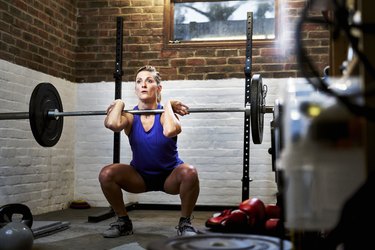
After age 30, your lean body mass begins to decrease at a more rapid pace than it did in your 20s, so it's a great time to take action to slow those losses. Building muscle mass after 30 isn't hard, but it does take finding the right strength-training program and being consistent with it.
Building Muscle Mass After 30
Video of the Day
One of the many changes that come with getting older is a loss of muscle mass. According to the U.S. National Library of Medicine, these losses typically begin after a person turns the big 3-0. By the time people are 75 or 80, most have lost half the muscle mass they had in their 20s, reports a review published in the Lancet Diabetes & Endocrinology in October 2014.
Video of the Day
Loss of lean muscle mass can have many negative effects, including making it harder to control your weight. According to the University of Mexico, the body uses more calories to maintain muscle than it does fat. In fact, muscle mass accounts for 20 percent of total daily energy expenditure, while fat only accounts for 5 percent. Therefore, the more muscle you have, the more calories you burn all day long.
Weight gain and obesity are linked to many serious diseases, including Type 2 diabetes, heart disease and even some types of cancer, according to the Centers for Disease Control and Prevention.
Decreased muscle mass also leads to decreased bone stability, resulting in increased risks of fractures and falls as you get older, explained a review published in the Journals of Gerontology in October 2017. So building muscle doesn't just make you look better — it can also help protect you from illness and injury.
Get More Active
Going into the gym and lifting weights is the way many people choose to build muscle, but it's not the only way, especially when you're first getting started. Simply becoming more active is a great first step.
Spend less time sitting and more time walking, jogging, riding your bike, hiking, taking the stairs or playing in the park with your dog or your kids. Mow your own lawn and rake your own leaves instead of paying someone else to do it.
All of these activities can begin to build a foundation of muscle strength that you may not have had if you were previously sedentary. They also burn calories and fat. But you may also need to add in some dedicated exercise time to meet the amount of physical activity recommended by the U.S. Department of Health and Human Services.
According to the guidelines, adults need to do at least 150 to 300 minutes of moderate-intensity or 75 to 150 minutes of vigorous-intensity cardio activity each week, plus two total-body strength-training sessions each week. Finding other dedicated cardio and strength-training activities you enjoy will help you hit the target and achieve your muscle-building goals.
Take an Exercise Class
If you're the type of person who likes exercise classes, your options are limitless. The benefits of group classes are:
- An instructor telling you what to do
- Lots of variety in each class
- Many different types of classes to choose from to keep things interesting
- Classmates to help keep you accountable
- The opportunity to make new friends, which will give you even more incentive to get to class
Wondering which activity is tailor-made for you? Following are a few options to consider:
Barre exercise: Combines ballet-inspired moves with yoga, Pilates and functional training.
Vinyasa yoga: A physically challenging type of yoga that involves dynamic, flowing sequences linking breath to movement.
Boot camp: High-intensity, military-inspired physical training with a cardio component. Classes usually inspire camaraderie and are sometimes held outside.
Indoor cycling: Much more than just riding a stationary bike inside, these classes involve high-intensity cardio and often include strength-training moves on or off the bike.
Pilates: A low-impact workout that targets the muscles of the core, as well as all the other muscles in the body. It is either done on a mat or on a machine called a reformer.
Tip
Consistency is everything when it comes to building muscle. Dropping into a class or the gym here and there isn't going to cut it. Schedule your workouts into your calendar just like you would a meeting and only skip them if absolutely necessary.
Work Out at Home
If you are a self-motivated type, you can save a lot of money and time by doing strength-training exercises at home. You don't even need much space or equipment — using only your own body weight can help you build strength and mass.
Here some examples of exercises you can do at home with no or minimal equipment to target all the major muscle groups:
- Push-ups
- Triceps dips
- Downward dog holds and shrugs
- Supermans
- Wall walks
- Dolphin kicks
- Glute bridges
- Squats
- Lunges
- Plank
- V-ups
An easy way to organize a home workout for building muscle at age 30 is in a circuit. You choose several exercises for your upper body, lower body or total body. How many exercises you choose depends on how much time and energy you have to work out.
You can choose to work on your upper body one day and lower body the next, or you can hit all your major muscle groups in one session. Perform one set of each exercise in a row with little to no rest in between. At the end of the round, rest for a minute or two and then repeat for your desired number of rounds.
You can do each set for a number of reps or for a certain amount of time. For example, you can aim for 10 to 15 reps of each exercise, or you can set an interval timer and do each exercise for 30 or 45 seconds. This type of workout will keep your heart rate elevated because you're not resting for long between sets.
This is an efficient way to build muscle and cardiovascular endurance. To add in even more cardio, intersperse intervals of jumping rope, jumping jacks, sprints or high knees in between the strength-training sets.
Read more: Your Ultimate Guide to Gaining Lean Muscle
Join a Gym
Some people don't like to work out at home, don't have the space or they want access to weight lifting and cardio equipment — or a pool and sauna at some of the more upscale fitness clubs. Many gyms also have a full schedule of group exercise classes for variety. Joining a gym expands your muscle-building options exponentially.
What is your goal? Do you just want to get all-over fit, or do you want to develop explosive strength or size? It's not too late for any of those goals. Certainly, there are plenty of bodybuilders who started at 30.
For developing overall fitness, you can start with machines. These are often organized in a circuit, and by using many different machines, you'll get a full-body workout without having to think of which exercise you're doing next. Changing weights is easy using the weight stack, so you can start out light and gradually increase the resistance as you get stronger.
Free weights add in another layer of skill. While machines provide support for your body during the exercises and move in a limited range of motion, free weights — as the name implies — move freely through space and in many different directions. This requires more work from your muscles — not only your major muscle groups, but your smaller stabilizer muscles as well. It's a good idea to start to add in some free-weight moves once you feel comfortable using the machines.
Free weights is a broad category including any weight not limited by range of motion, including dumbbells, barbells, kettlebells and medicine balls. Some common exercises performed with free weights include:
- Bench presses
- Back squats
- Flyes
- Kettlebell swings
- Medicine ball tosses
- Biceps curls
- Triceps extensions
- Rows
- Deadlifts
- Military presses
Most gyms have cable machines too. These machines fall somewhere between circuit machines and free weights. They have cables attached to pulleys and weight stacks and can move in a wide range of motion, although they are stationary in the sense that they are attached to the cable apparatus. You can do almost any free-weight exercise using a cable machine — the benefit is that you have all the weight you need at the shift of a pin in the weight stack.
Fine Tune Your Goals
No matter what type of resistance equipment you choose, start out doing 1 to 2 sets of 12 to 20 repetitions of each exercise, recommends the National Academy of Sports Medicine (NASM). This builds foundational strength. Do this for about a month, performing a variety of exercises targeting all your major muscle groups.
Next, begin to add weight and lower your reps to 8 to 12. You can also add in a third or fourth set here to increase volume. Stay at this stage for another month or longer.
If your goal is simply to get fit, this is your sweet spot. All you need to do is continue to progress the weight and change up the exercises frequently to avoid muscle adaptation.
If your goal is hypertrophy — mass gains — or maximum strength, here is where you will deviate from the foundations. To gain size, stay within a rep range of 6 to 12, recommends NASM. Lift heaver weights and take longer rest breaks of one to two minutes between sets.
According to an article published in NASM's American Fitness in fall 2017, if your goal is maximum strength, you should reduce your reps to 1 to 5 per set but increase the intensity. This applies to both the weight and the speed of your lifts, which should be faster than lifts for other goals.
Tip
This is only a brief primer for hitting your goals in the weight room, and there is much more that goes into effective programming. Consult a certified personal trainer to help you maximize your gains and keep growing.
Make Healthy Lifestyle Choices
The actual exercises you do to build muscle mass after 30 are only part of the work. A sedentary lifestyle is also often coupled with other unhealthy habits, such as a poor diet and lack of sleep. In order to gain muscle and perform well in your workouts, you need proper nutrition and plenty of sleep.
Eat a diet containing lean protein, fresh fruits and vegetables, whole grains and healthy oils from olives and nuts. Limit your intake of processed, refined foods and added sugars. Be sure to get enough calories to support your activity level and muscle growth, but not so many that you gain fat.
Rest is key for your body to repair muscle damage for bigger, stronger muscles. The National Sleep Foundation recommends all adults get seven to nine hours of sleep per night. Depending on how hard you train, you may need more or less. Listen to your body; if you're feeling fatigued and run down and your workouts aren't feeling as good, you may need more rest, less exercise or both.
- U.S. National Library of Medicine: "Aging Changes in Body Shape"
- The Lancet Diabetes & Endocrinology: "Age-Related and Disease-Related Muscle Loss: The Effect of Diabetes, Obesity, and Other Diseases"
- University of Mexico: "Controversies in Metabolism"
- Centers for Disease Control and Prevention: "Adult Obesity Causes & Consequences"
- Journals of Gerontology: "Longitudinal Changes in Muscle Mass and Strength, and Bone Mass in Older Adults: Gender-Specific Associations Between Muscle and Bone Losses"
- U.S. Department of Health and Human Services: "Physical Activity Guidelines for Americans, 2nd Edition"
- National Academy of Sports Medicine: "Essentials of Personal Fitness Training"
- National Academy of Sports Medicine: "Back to the Basics: Hypertrophy"
- American Fitness: "Built to Order: Strength and Size Require Different Approaches"
- National Sleep Foundation: "How Much Sleep Do We Really Need?"