How to Get Rid of a Cold Sore on the Tongue
The tongue can be one of the most annoying places to develop a sore; you need your tongue to eat, drink and speak, all of which become difficult and frustrating when a painful sore shows up. Before treating your sore, make sure it's actually a cold sore; canker sores, which are more common inside the mouth than cold sores, are round or oval with a white or yellow center and a red border, according to the Mayo Clinic 12. Cold sores, caused by a strain of the herpes virus, are fluid-filled blisters on a raised, red area.
If you are experiencing serious medical symptoms, seek emergency treatment immediately.
Determine whether you have a cold sore or a canker sore 2. Cold sores usually occur around the mouth or lips, whereas canker sores tend to occur inside the mouth and near your gums. What appears to be a cold sore on your tongue may actually be a canker sore 2.
How to Remove Bumps on Tongue
Learn More
Apply a small amount of ointment to the sore and let it sit for a few minutes before eating or drinking. Although it may be difficult to keep the ointment on the sore, a little application is better than nothing. Over-the-counter ointments for cold sores include lidocaine and benzocaine; for canker sores, try an ointment containing benzocaine, amlexanox or fluocinonide.
Practice good oral hygiene. Brush your teeth and rinse with mouthwash several times a day to keep your mouth clean and reduce germs. If you have canker sores, your doctor can prescribe a mouth rinse that contains dexamethasone or tetracycline to lessen pain and speed up healing. According to the National Institutes of Health, avoiding hot and spicy foods can also reduce pain and irritation in the mouth.
How to Relieve a Sore Mouth From the Side Effects of Amoxicillin
Learn More
See your doctor or dentist if sores don't go away after a few weeks or reoccur frequently. Large cold sore outbreaks can be treated with oral antiviral medications that target the herpes simplex virus; for canker sores, prescription treatments or tests for underlying conditions may be necessary 2.
Related Articles

How to Remove Bumps on Tongue
Learn More

How to Relieve a Sore Mouth From the Side Effects of Amoxicillin
Learn More

Vaseline Lip Therapy on a Cold Sore
Learn More
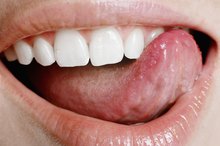
How to Get Rid of Tongue Sores
Learn More
Grapefruit Seed Extract for Cold Sores
Learn More

Small, White Bumps on the Tip of the Tongue
Learn More
How to Get Rid of Swollen Taste Buds
Learn More
Why a Canker Sore Won't Heal
Learn More
How to Heal Tongue Sores
Learn More

Side Effects of Zinc Lozenges
Learn More
References
- Mayo Clinic: Cold sore
- Mayo Clinic: Canker sore
- MedlinePlus: Mouth ulcers
- Edgar, N., Saleh, D., and R. Miller. Recurrent Aphthous Stomatitis: A Review. Journal of Clinical and Aesthetic Dermatology. 2017. 19(3):26-36. PMID: 28360966
- Ziaudeen, S., and R. Ravindran. Assessment of Oxidant-Antioxidant Status and Stress Factor in Recurrent Aphthous Stomatits Patients: Case Control Study. Journal of Clinical and Diagnostic Research. 2017. 11(3):ZC01-ZC04. doi: 10.7860/JCDR/2017/22894.9348
- Weller, Richard P. J. B., Hamish J.A. Hunter, and Margaret W. Mann. Clinical Dermatology. Chichester (West Sussex): John Wiley & Sons Inc., 2015.
- Edgar, N., Saleh, D., and R. Miller. Recurrent Aphthous Stomatitis: A Review. Journal of Clinical and Aesthetic Dermatology. 2017. 19(3):26-36.
Writer Bio
Sarah Barnes has been a professional writer and editor since 2004. She has been published in newspapers and regional magazines in the Wichita, Kansas area. Barnes holds a Bachelor of Arts in journalism from a Midwestern university.