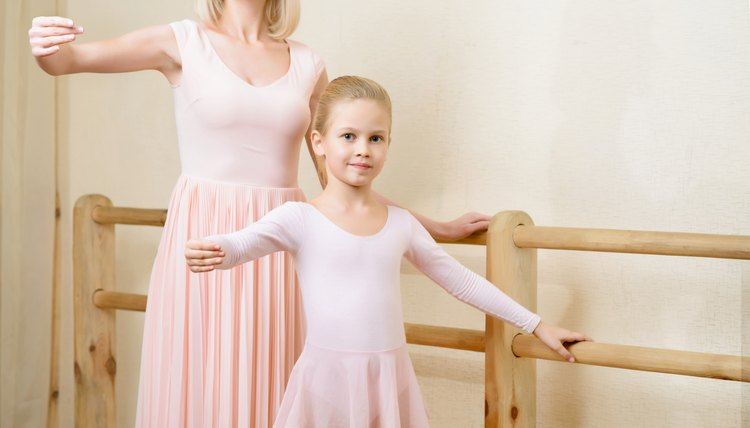
A ballet dancer using pointe shoes for the first time can feel triumphant if she is adequately prepared, or awkward and even frightened of injury if unprepared. Core strength, foot strength and maturity of the foot's skeletal structure are important elements when deciding whether a dancer is ready for pointe shoes. Experts agree that in preparation for becoming a pointe dancer, or for maintenance after she has achieved this level, she must train the pertinent muscles of her body in order to have a successful pointe experience.
At What Age is a Dancer Ready for Pointe Shoes?
Ballet dancers who are allowed to wear pointe shoes before their bodies are ready can experience injuries and even permanent structural damage to their bodies. For a dancer who trains regularly, according to Caryl Maxwell, director of schools of dance for the National Dance Education Organization, "a good rule of thumb is the age of 12." Though age is an important factor when determining if a dancer is ready to use pointe shoes, the level of the dancer's strength and training preparation is more important. Maxwell says the dancer should exhibit "solid core strength, fully stretched knees and a high demi-pointe," in order to be ready for pointe shoes. Even then a specialist should be consulted, because the age at which the foot structure matures varies for each person.
Core Strength
Abdominal strength is essential for a ballet dancer's pointe preparation, according to Mickey Cassella, director of physical and occupational therapy at Boston Children's Hospital and director of physical therapy services for Boston Ballet. Signs that a student's core strength has not developed adequately for pointe include dancing with loose knees and attempting to balance her body by leaning back, according to Dance Teacher Magazine. Peff Modelski, a registered dance educator and pointe consultant, says that she often recommends "repair work" for young students who have danced with pointe shoes too early or are inadequately prepared. Carole Ann Clark, ballet teacher at Arlington Center for Dance in Arlington, Virginia, recommends pilates exercises to build core strength and flexibility prior to dancing in pointe shoes, reports Dance Teacher. Clark says, "You can't spin a wet noodle."
Foot-Strengthening Exercises
Acquiring needed foot strength is essential to being an effective and safe pointe dancer. Marcia Dale Weary, artistic director of Central Pennsylvania Youth Ballet, recommends dancers practice thousands of repetitions of tendus and releves in flat ballet shoes before dancing in pointe shoes.
Suki Schorer of the School of American Ballet recommends particular exercises for feet strengthening. In first position, face the barre, roll up slowly to full pointe, roll down to three-quarter pointe, press back up to pointe, roll down to flat, demi-plie in first, and straighten the legs, according to "Dance Magazine." Repetitions of eight in first and second positions is recommended. After a base strength is built by completing these exercises, completing them one leg at a time is recommended, "with the nonworking foot in the coupe back position." These exercises help the dancer develop the flexibility needed for controlled rolling through her shoes. (See Reference 2)
Warning
Ballet dancers with second toes longer than their first toes should ask their podiatrist and a pointe shoe consultant about ways to prevent foot injuries. In a 2007 study published in the Journal of the American Podiatric Medical Association, led by Haluk H. Oztekin, M.D., from the Department of Orthopaedics and Traumatology, Baskent University, Izmir, Turkey, it was discovered that ballet dancers with equal-length or shorter second toes had lower pain scores and less joint inflammation in their feet compared with dancers with longer second toes. Dance Magazine recommends that dancers without straight metatarsals should develop extra strength in the feet to overcome the disadvantage of a smaller base.
References
- “Dance Teacher”; Pointe in Time; Jennifer Brewer; May 2004
- "Dance Magazine"; The Next Level: Improving Pointe Work; Janice Barringer; May 1, 2008
- "Journal of the American Podiatric Medical Association": Second-Toe Length and Forefoot Disorders


Member Comments