
3 Foam-Rolling Mistakes You Might Be Making
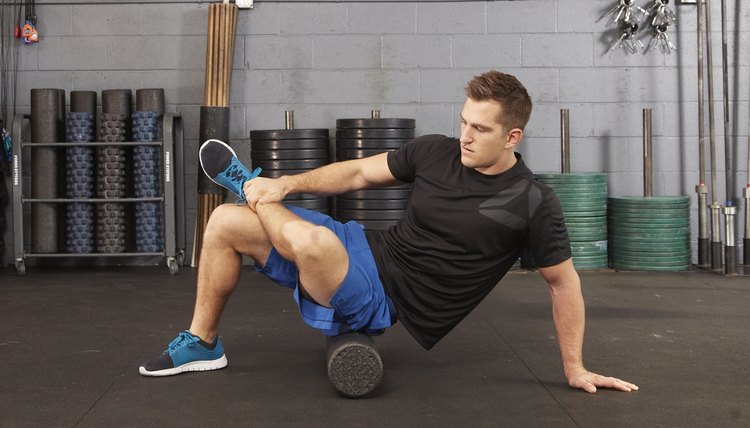
The foam roller can be your best friend after a tough workout -- unless you're doing it wrong.
If you haven’t tried foam rolling, it’s worth a shot, even if it means contorting your body to hit all the right angles on your quads or rear end, sometimes gritting your teeth and squeezing your eyes shut between movements. Though it may make you look like a glutton for punishment, research says you’re doing yourself a favor -- that is, if you’re doing it right.
Originating in the 1920s, the simple therapeutic device we see in gyms and even our living rooms was used as a way to mimic massage, says Kyle Stull, an instructor with the National Academy of Sports Medicine. But while foam rolling has existed for a while, most of the research on it has only been done during the past five years.
In a March 2011 study published in the Journal of Strength & Conditioning Research, 26 healthy college-age individuals were randomly assigned to either a planking or foam-rolling group and asked to complete various tasks, such as vertical jumps, sprints and agility tests. Results showed that fatigue after the workout was significantly less for subjects who foam rolled over those who performed planking.
Practically speaking, this decreased fatigue may allow individuals to extend their workout time and volume, which could lead to performance enhancements.
But Stull says people have turned foam rolling “into a random act of getting on something round and rolling around rather arbitrarily.” So what are we doing wrong, and -- more importantly -- how do we fix it? Here are three ways to get the most out of your foam-rolling session.
It’s going to feel better because the nervous system is getting an influx of information and doesn’t feel pain at the moment. But it’s not changing the tissue, so the pain comes back.
Kyle Stull, instructor with the National Academy of Sports Medicine
Mistake 1: You Rush the Roll
In early 2014, researchers published an article in Medicine & Science in Sports & Exercise that surveyed people who claimed they knew how to foam roll. The researchers monitored the pace of the subjects and how long they would roll.
“What they found is that people would roll through a muscle and cover the entire muscle in about a second,” Stull says. Subjects often rolled from the base of the quadriceps right above the knee to the base of the hip in a second. But going too quick can overexcite pain receptors, he says.
But when used correctly foam rollers have been shown to be worth the investment, according to the study. The researchers split 20 participants into groups to perform back squats. Only one group did foam-rolling exercises for 20 minutes following each test. The researchers assessed thigh girth, range of motion, muscle soreness, muscle contractions, vertical jump, perceived pain while foam rolling and force placed on the foam roller.
The results? Foam rolling substantially reduced muscle soreness, improved muscle activation and increased range of motion as compared with the control group.
Since foam rolling can be controlled by how much body weight you apply to a given area, Stull says, “Ideally, you would be finding a tight muscle and holding pressure until that pressure is reduced, relaxed or completely goes away.” Stull hesitates to use the word “tight,” but says foam rolling has benefits in releasing locked-up muscles. “Let’s say your calf feels tight. Do an inch [of muscle] per second,” he says. “If you feel an area that you would rate a seven or eight (on a pain scale of one to 10), stop and hold for 20 to 30 seconds.”
While the word “stop” may seem counterintuitive while rolling, Stull means that once you’ve hit a trigger point, you should keep weight on it until the tension dissipates. Trigger points will be pretty easy to spot: They’ll likely cause pain when discovered, and they sometimes make a popping sound or disrupt the gliding motion.
“People who do roll fast say they feel better, but it’s like a bumped elbow,” he says. “When we bump our elbow, what do we do? We rub it, which confuses the nervous system. It makes the elbow feel better, but it’s not changing the tissue,” he explains.
The same goes for rolling out your IT band. “It’s going to feel better because the nervous system is getting an influx of information and doesn’t feel pain at the moment, but it’s not changing the tissue, so the pain comes back.”
Mistake 2: You Don't Listen to Your Body
“Sometimes people spend too much time on a specific area, which can reduce tolerance,” says Scott Greenberg, a physical therapist at the University of Florida Shands Rehab Center. “Your body will tell you how it likes it or it doesn’t like it. If you do it one day and wake up next day extremely sore, take a day off. Try one body segment at a time and see how your body feels following that particular session and build your program accordingly.”
Greenberg says there’s a lot of debate about what’s occurring under the skin and in the muscle while you’re foam rolling. “Are you loosening tissue? Are you increasing blood flow? Are you desensitizing tissues or just breaking up adhesions? We don’t truly, definitively know what’s going on,” he says. But he also says there are several studies that have supported the idea that foam rolling helps delay muscle soreness, leading to a quicker recovery after a workout.
Hopping on a roller after a tough workout can help muscles bounce back quicker, increase circulation and flush out metabolic waste, such as lactic acid. “Some research shows that it doesn’t necessarily decrease muscle soreness, but it speeds up the muscle-recovery process,” Stull says. But “the biggest thing they have proven is circulation.”
Mistake 3: You Only Roll When You're Sore
Stull suggests rolling twice a day and holding pressure on the tense spots to allow the muscle to relax. The body will adapt, and the more you foam roll, the more likely the muscle will loosen. While there is no direct correlation to show that foam rolling reduces chance of injury, it does help loosen muscles prior to a workout and attracts blood flow to the area, which can improve muscle flexibility and reduce tightness. And loose and flexible muscles are less likely to tear or pull.
If time is limited during an exercise session, Stull favors pre-workout rolling because the motion gets more blood flow, increases range of motion and improves tissue mobility. Greenberg agrees. “It’s a great way to warm up the tissue prior to activity. Do I think it should take place of a dynamic warm-up? No: It’s an adjunct to a warm-up.”
Another strategy to try out is known as Active Release Technique, which involves staying in one position while bending at a joint. This technique encourages muscle fibers and connective tissues to slide across each other the way they are supposed to, Stull says. For example, while putting weight on the iliotibial (IT) band on the outer part of your leg, bend the knee of the activated leg behind you a few times. This active release reduces tension and increases range of motion, resulting in a more effective foam-rolling session.
When treating pain, Stull says “foam rolling shouldn’t be used as a Band-Aid.” If you feel the need to foam roll to get through a run, Stull says, there may be something else going on that’s worth looking into. Common running-related pains include runner’s knee (irritated cartilage under the kneecap), Achilles tendinitis (a tightened tendon connecting two major calf muscles to the back of the heel), plantar faciitis (inflammation in the arch of the foot), hamstring issues, shin splints, IT band tension and stress fractures.
The treatments for these issues can vary from compression socks to icing to stretching to TheraBands to -- you guessed it -- foam rolling. But if you have (or suspect you have) one of these injuries, it’s best to consult with your doctor or physical therapist for specific treatment options.
Explore In Depth
References
- McCall, P. American Council on Exercise. How and when to use foam rollers and myofascial release in an exercise program. Updated December 2016.
- Manusov E. Evaluation and diagnosis of low back pain. Prim Care. 2012;39(3):471-9. doi:10.1016/j.pop.2012.06.003
- Junker D, Stöggl T. The training effects of foam rolling on core strength endurance, balance, muscle performance and range of motion: A randomized controlled trial. J Sports Sci Med. 2019;18(2):229-238.
- Cheatham S, Kolber M, Cain M, Lee M. The effect of self-myofascial release using a foam roll or roller massager on joint range of motion muscle recovery and performance: A systematic review. Int J Sports Phys Ther. 2015;10(6):827-38.
- Harvard Health Publishing Harvard Medical School. Should you add foam rolling to your workout routine?. Updated December 2018.
- McGrath, C. American Council on Exercise. Why you should be foam rolling. Updated October 2013.
- Chaudhry, H. Three-dimensional mathematical model for deformation of human fasciae in manual therapy. J Am Osteopath Assoc. Aug 2008.
- Penney, S. Foam Rolling - Applying the Technique of Self-myofascial Release. NASM.
- Sanjana F. Effect of MELT method on thoracolumbar connective tissue: The full study. J Bodyw Mov Ther. Jan 2017.
Resources
Writer Bio
Whitney D. Smith has a bachelor of science in journalism from the University of Florida and is currently a master's candidate of mass communication at UF, where she specializes in science and health communication. She has been writing health and fitness articles for more than six years and has been published in Women's Health Magazine Online, University of Florida publications, and New York Times Regional Media Group newspapers and magazines in Florida.