
What does fact checked mean?
At SportsRec, we strive to deliver objective content that is accurate and up-to-date. Our team periodically reviews articles in order to ensure content quality. The sources cited below consist of evidence from peer-reviewed journals, prominent medical organizations, academic associations, and government data.
The information contained on this site is for informational purposes only, and should not be used as a substitute for the advice of a professional health care provider. Please check with the appropriate physician regarding health questions and concerns. Although we strive to deliver accurate and up-to-date information, no guarantee to that effect is made.
The Prime Mover for the Back Squat Exercise
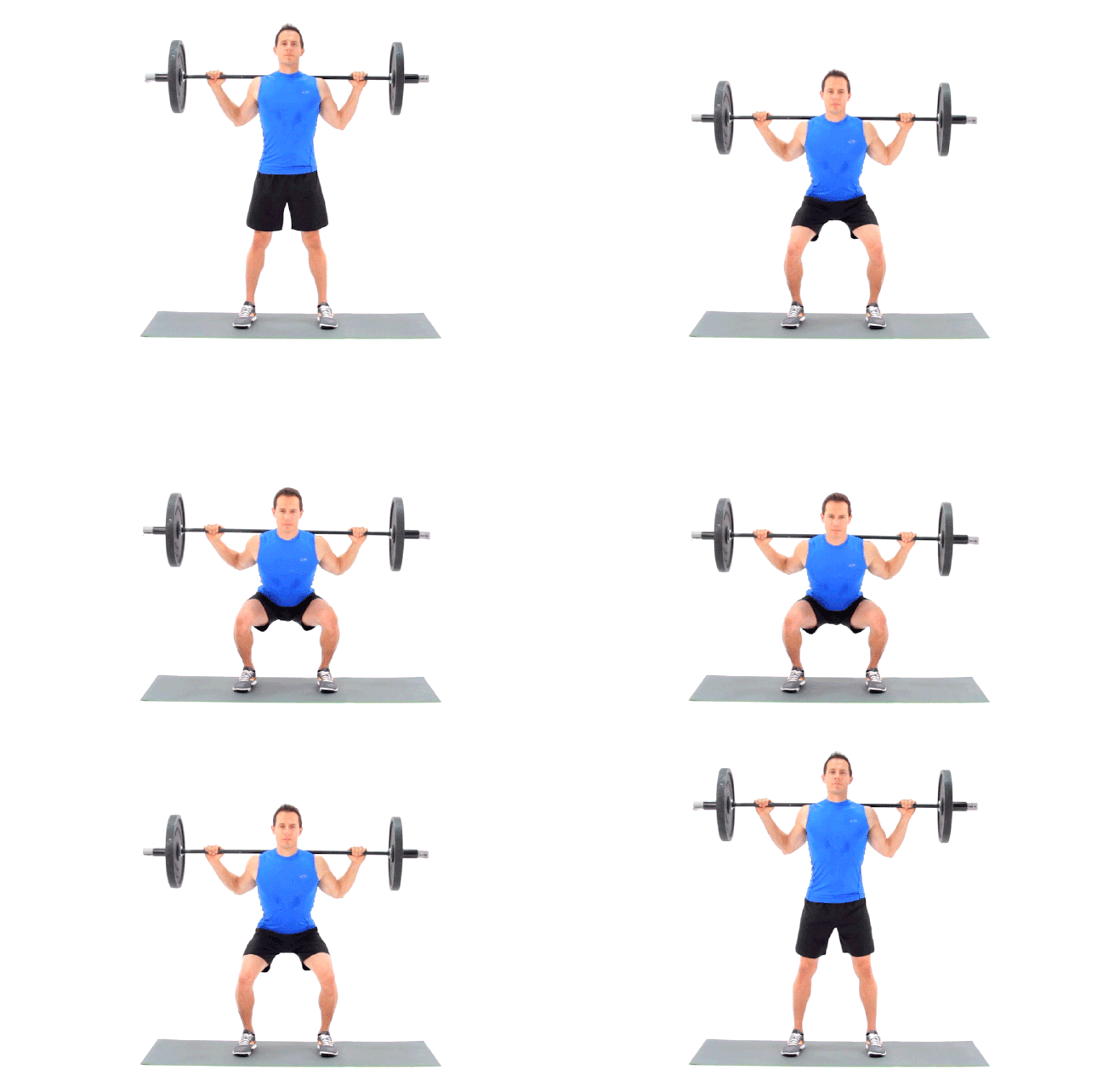
The back squat is one of the most effective exercises for developing lower body strength and power. To properly perform a back squat, stand with your feet shoulder-width apart and position a loaded barbell across your upper back and shoulders, securing it in place with an overhand grip. Stabilize your torso, straighten your back, look straight ahead and bend your hips and knees to lower yourself until your thighs are parallel with the floor. Press through your heels to return to the starting position.
Main Squeeze
The gluteus maximus and the quadriceps are the prime movers for back squats. During the upward phase of the squat, the glutes are responsible for the hip extension and the quads for the knee extension.
Second String
The hamstrings assist the glutes in hip extension. An adductor magnus on the inner thigh of each leg prevents your legs from flaring outward during the exercise. Upper body muscles are also targeted during the back squat. They include the abs and erector spinae, which work together to stabilize and support the torso throughout the exercise.
References
- ExRx.net: Barbell Squat
- American Council on Exercise: Barbell High Back Squat
- Strength Training Anatomy, Second Edition; Frederic Delavier
- Sands WA, Wurth JJ, Hewitt JK MD. National Strength and Conditioning Association’s (NSCA) Basics of Strength and Conditioning Manual. National Strength and Conditioning Association. 2012.
- Lorenzetti S, Ostermann M, Zeidler F, et al. How to squat? Effects of various stance widths, foot placement angles and level of experience on knee, hip and trunk motion and loading. BMC Sports Sci Med Rehabil. 2018;10:14. doi:10.1186/s13102-018-0103-7
- Myer GD, Kushner AM, Brent JL, et al. The back squat: A proposed assessment of functional deficits and technical factors that limit performance. Strength Cond J. 2014;36(6):4-27. doi:10.1519/SSC.0000000000000103
- Schoenfeld B. Squatting kinematics and kinetics. Journal of Strength and Conditioning. 2010; 24(12):3497-2506.
- Barbell back squat. Collegiate Strength & Conditioning Coaches Association. 2016.
- Conceição F, Fernandes J, Lewis M, Gonzaléz-badillo JJ, Jimenéz-reyes P. Movement velocity as a measure of exercise intensity in three lower limb exercises. J Sports Sci. 2016;34(12):1099-106. doi:10.1080/02640414.2015.1090010
- Rhea MR, Kenn JG, et al. Joint-angle specific strength adaptations influence improvements in power in highly trained athletes. Human Movement. 2017;17(1):43-49.
Writer Bio
Jen Weir writes for several websites, specializing in the health and fitness field. She holds a Bachelor of Science in exercise science from Montana State University, is an NSCA-certified strength and conditioning specialist and maintains a personal trainer certification from the American College of Sports Medicine.