Dowager's hump is a more informal term used to describe a medical condition of the back called kyphosis. This condition is a type of scoliosis that is characterized by rounding in your upper spine — curving in a C-shape. The severity of the condition and the spinal flexibility you sustain depend on the type of kyphosis you have.
Postural kyphosis is generally less serious than Scheuermann's kyphosis, which can lead to less mobility and significant deformity, according to the American Academy of Orthopaedic Surgeons, or AAOS. Core-strengthening exercises can be beneficial to people who have a dowager's hump, under the supervision of their doctor.
Video of the Day
Video of the Day
Read more: How to Fix the Worst Posture Mistakes
1. Abdominal Press
Some people who have postural kyphosis may benefit from pain relief by strengthening their abdominal muscles. Exercises like the abdominal press may provide some amount of correction to a dowager's hump over time, but the AAOS reports that significant changes are not likely.
HOW TO DO IT: Lie down on your back with your feet flat on your feet and your knees bent. Your back should be in a relaxed, neutral position. Tighten your stomach muscles, and raise one of your legs so that the ankle of your raised leg is approximately level with your other knee.
Place your hand on the knee of your raised leg, and press down on your knee. Keep your abdominals tensed, and use this tension to resist the pressure of your hand, to keep your raised knee in place and steady. Hold the position for three seconds before relaxing.
2. Back Extension
Strengthen muscles that extend your back to help counteract a forward-bent spine. Back extensions can be done on a bench or short table. Try back extension on a stability ball if you want more of a challenge.
HOW TO DO IT: Lie on your stomach on the table, hooking your feet around the end of the table to stabilize yourself. Clasp your hands behind your neck with your elbows out, and lie so your waist and upper body hang off the table. Bend down so that your upper body forms a 90-degree angle with your legs — you'll essentially be upside down with your head at the floor. Slowly bend yourself back up so that your entire body is once again horizontal.
3. Bridge
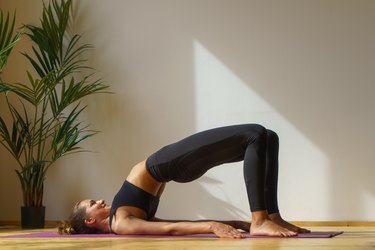
The bridge is another core-strengthening exercise that helps your dowager's hump and abdominal muscles and can be done at home without any specific exercise equipment. The exercise starts with your spine in a neutral position while you lie on your back.
HOW TO DO IT: Tighten your stomach muscles and lift your hips off the floor. Keep your feet and shoulders flat on the floor. Hold the position for a count of three seconds, then relax.
4. Forward Lunges
Lunges strengthen the hamstring muscles in your legs, which according to the AAOS, may also be beneficial to people with kyphosis — but like core exercises, lunges may offer more pain relief than actual structural changes. Forward lunges work not only the hamstrings, but muscles in the stomach and buttocks as well.
HOW TO DO IT: Stand up straight with your feet together. Your back should be tensed or braced to prepare for the stretch. Take a step forward with one leg, stepping down with your heel before your toe — both of your knees should be bent at 90-degree angles with your leading foot flat on the floor and hind foot's heel pointing in the air with your toes on the floor. Your hips will tilt down slightly. Complete the lunge by pushing off from the floor with your front foot to return to a standing position.
Read more: Swayback Posture Exercises
5. Quadruped Lifts
The quadruped is a core exercise that is performed while on your hands and knees as if you were going to crawl. This posture stretches your spine in the opposite direction of a Dowager's hump, similar to a spinal extension. It also strengthens your abdominal muscles.
HOW TO DO IT: Keep your hands on the floor so that they are directly underneath your shoulders. Your back and shoulders should be as straight as possible with your head down so that you are facing the floor. Take one hand off the floor and reach in front of you with your arm straight. At the same time, extend your opposite leg straight out behind you.
If you're using your right arm, extend your left leg. Tighten your stomach muscles as you lift your limbs. Hold for a count of three, return your arm and leg to your original position. Repeat the stretch, using your other arm and leg.