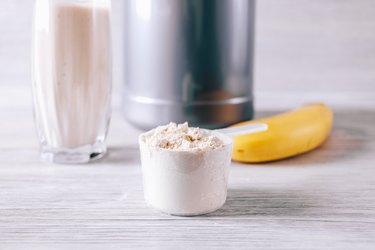
Whey protein powder is a popular option for supplemental protein intake that's readily available at health food and vitamin supply stores.
Whey protein is made of dairy — and along with casein, whey is one of two proteins that comprises milk. It's the liquid that remains once milk is processed to make cheese or yogurt. Whey powder is used as a food additive in baked goods, processed cheese products, sauces, dressings, prepared meat products, beverages and confections. It can work as an extender and binder in food products.
Video of the Day
Video of the Day
Once it's separated from milk, whey can be further processed into various whey protein supplements, including whey protein concentrate and whey protein isolate.
Whey Protein vs. Isolate
The main difference between whey protein concentrate and whey protein isolate lies in the amount of protein contained per scoop of protein powder. Isolates are processed and filtered to contain about 65 percent protein per three scoops, with the majority of the fat and lactose removed, per MyFoodData.
In contrast, concentrates contain anywhere from 25 to 89 percent protein, with fat and carbohydrates comprising the remaining macronutrients.
In addition to having a lower total carbohydrate content, whey isolate also has lower lactose content. This means that it could be a better choice for those who are lactose intolerant.
Isolates tend to be a more expensive whey protein option due to their high percentage of protein. Whey protein concentrates and blends, which can contain a mixture of whey and casein or other proteins, may be more affordable muscle-building supplements.
If cost isn't a factor and/or you're limiting your fat, carbohydrate or lactose intake, whey protein isolate may be your preferred choice.
Should You Take Whey or Isolate After a Workout?
Containing nine essential amino acids, whey is considered a complete protein that helps to promote the growth of lean muscle mass. Whey is the fast-digesting part of dairy protein — casein digests at a much slower rate and is, therefore, best for promoting satiety — that's easily absorbed by the gut and distributed for use by the muscles, per U.S. Dairy.
Whey isolate protein helps to prevent the breakdown of muscle tissue that can occur during recovery from a workout. Muscle growth occurs as a result of the body's repair of minute tears in muscle fibers following a workout. Most Americans get adequate dietary protein and don't require supplementation but athletes, bodybuilders and people in training for endurance events or seeking to improve their ratio of muscle to fat can benefit from supplemental protein.
Consuming a whey isolate protein drink following a workout preserves muscle and aids in recovery. In a 10-week study of recreational bodybuilders, a group given whey isolate made greater improvements in strength, increased lean mass and reduced fat mass compared to a group given casein, researchers reported in an October 2006 study in the International Journal of Sports Nutrition and Exercise Metabolism.
Whey isolate protein is convenient to buy, mixes well, comes in many flavors and has a long shelf-life in its powdered form. It combines well with milk, juice, fruit and nutritional supplements in your blender for a nutritious post-exercise drink. Adding ice to the blender drink results in a milkshake consistency, and you can add cocoa powder or flavored extracts such as vanilla or peppermint for variety.
In its powdered state, whey protein powder isn't vulnerable to spoiling, so you can carry it along in a shaker bottle to the gym or for an outdoor workout, and add water when you're ready to drink it.
Tip
Whey isolate should be used as a supplement, not as a primary source of nutrition. Although whey provides the advantage of quick protein uptake, it doesn't provide a sustained protein source. Combining protein sources in your post-workout drink — such as whey isolate and casein or egg — offers longer-lasting fuel. Combine whey protein isolate with a carbohydrate, such as a piece of fruit, for the best supply of nutrients for recovery after your workout.
Tips for Choosing a Protein Powder
When choosing a whey protein powder, whether an isolate or a concentrate, look for powders with minimal additives and sweeteners. Some manufacturers add artificial fillers or flavor enhancers that offer no nutritional value and may work against your health and fitness goals.
You can always add your own flavor to smoothies and shakes by blending in whole foods, such as berries and leafy greens. You can also look for powders that have been third-party-certified for safety by an independent agency, such as Informed Choice.
What Is Sweet Whey?
Whey powder comes in a variety of forms. Sweet whey powder is the most common type, making up approximately 70 percent of the whey powder manufactured. It comes from fresh whey, derived from the production of cheeses, such as cheddar and Swiss, that are coagulated using rennet-type enzyme preparations. Sweet whey powder contains all of the protein, lactose, vitamins and minerals from the whey.
Optimum Nutrition Whey Protein Nutrition
Optimum Nutrition 100% Whey Gold Standard is a protein powder comprising mostly whey protein isolate. Each serving has 24 grams of protein.
Whey protein isolate is a pure protein and helps to build muscle by delivering high-quality amino acids to muscle after a workout.
This protein supplement also offers 5.5 grams of branched-chain amino acids. BCAAs help to deliver protein to the muscle at a faster rate and therefore improve recovery time after a workout. Protein has to be broken down into amino acids before it can be used by the body. They need to be broken down in the intestines, absorbed in the blood, and then travel to the liver to be changed into an energy source — this can be a lengthy process. BCAAs, however, can be used directly in the muscles for energy, and skip the processing to the liver, per the 2018 version of Metagenomics.
Optimum Nutrition whey nutrition facts vary according to the flavor you choose. The general nutritional profile for one scoop (32.4 grams) is 130 calories, 1.5 grams fat, 0.5 grams saturated fat, 5 grams carbohydrates, 0 grams fiber, 3 grams sugar and 24 grams of protein. This will fluctuate a minor amount according to flavor.
Related Reading
- Informed Choice
- Cleveland Clinic: 7 Tips for Choosing the Best Protein Powder for You
- Healthline: 10 Evidence-Based Health Benefits of Whey Protein
- MyFoodData: "Why Protein Powder Isolate"
- Metagenomics: "Branched Chain Amino Acids"
- International Journal of Sports Nutrition and Exercise Metabolism: "The effect of whey isolate and resistance training on strength, body composition, and plasma glutamine"
- U.S. Dairy: "What Is The Difference Between Whey And Casein Protein?"