How to Read an Abnormal EKG
Electrocardiogram, abbreviated as either EKG or ECG, is used to record the heart's electrical activity 2. The EKG is a valuable tool for doctors, as it can help diagnose heart problems, like heart attacks, arrhythmia and heart failure. Besides identifying heart problems, an EKG can also show how fast the heart is beating, whether the heart's rhythm is steady or irregular and the strength and timing of its the electrical signals. An EKG is recommended for people with signs of heart problems or may be part of a regular health examination, according to the National Institutes of Health.
If you are experiencing serious medical symptoms, seek emergency treatment immediately.
How to Read an Abnormal EKG
Record data with electrodes. A technician will attach twelve electrodes to the skin of your chest, arms and legs. They resemble soft, sticky patches and do not hurt when applied to the skin. The only side effect of the electrodes, according to National Institutes of Health, is a mild rash from irritation. As you lie still on the table, the electrodes will collect your heart's electrical signals, which are sent to the EKG machine, and the results are displayed on either a graph paper print out or an electronic image on a computer screen. This process takes around ten minutes to complete.
How to Read an EKG for Dummies
Learn More
Read the EKG strip 1. Once all the data is collected, the electrical activity of your heart will be displayed on a graph-lined background. The graph is broken up into two types of squares, small and large. Each small square is one millimeter and is equivalent to 0.04 seconds. One large square is five millimeters, equivalent to 0.2 seconds. In the EKG readout, the top peak is identified as “R.” To calculate an abnormal EKG, count the number of R waves in a six second strip 1. Then, multiply the number of R waves by ten to determine the heart rate.
Determine the abnormality. If you have had a previous EKG, your doctor will compare the two to note any changes. Possible disorders that can be indicated by an abnormal EKG include a lack of blood flow, arrhythmia, heart muscles that are too thick, congenital heart defects, heart valve disease, and inflammation of the sac that surrounds the heart, a condition called pericarditis. In addition, an abnormal EKG can show if the heart beat does not start at the top right of the heart, which it does in a normal heart beat. If the abnormal EKG shows that it takes a long time for the electrical signal to travel through the heart, there may be a heart block or long QT syndrome.
- Record data with electrodes.
- As you lie still on the table, the electrodes will collect your heart's electrical signals, which are sent to the EKG machine, and the results are displayed on either a graph paper print out or an electronic image on a computer screen.
Related Articles
How to Read an EKG for Dummies
Learn More
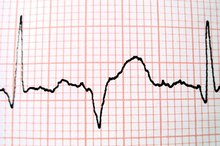
What Are the Four Parts of the EKG Machine?
Learn More

How to Count the Boxes on the EKG Paper to Determine Rate
Learn More
How to Read the Lines on a Heart Monitor
Learn More

Normal Pulse Rate at 13 Years Old
Learn More
How to Hear Your Own Heartbeat Without a Stethoscope
Learn More

How to Measure Heart Rate on a Telemetry Strip
Learn More
What If Blood Pressure Numbers Are Too Close?
Learn More
How to Read a Fetal Monitor Strip
Learn More
How Can I Tell If My Heart Rate Monitor Needs a New Battery?
Learn More
References
- How to Read an EKG Strip
- Electrocardiogram, EKG, or ECG
- American Heart Association. All about heart rate (pulse). Updated July 31, 2015.
- American Heart Association. About arrythmia. Updated September 30, 2016.
- American Heart Association. Why arrhythmia matters. Updated September 30, 2016.
- Henz BD, Leite LR. Atrial fibrillation and cryptogenic thromboembolic events. Arq Bras Cardiol. 2018;111(2):132–133. doi:10.5935/abc.20180141
- Cleveland Clinic. Arrhythmia treatments. Updated on April 23, 2019.
- Kim W, Kim EJ. Heart failure as a risk factor for stroke. J Stroke. 2018;20(1):33–45. doi:10.5853/jos.2017.02810
- American Heart Association. Warning signs of heart failure. Updated May 31, 2017.
- Havakuk O, King KS, Grazette L, et al. Heart failure-induced brain injury. J Am Coll Cardiol. 2017;69(12):1609-1616. doi:10.1016/j.jacc.2017.01.022
- American Heart Association. Understand your risk for excessive blood clotting.
- American Heart Association. Problem: Mitral valve prolapse. Updated May 31, 2016.
- American Heart Association. About heart attacks. Updated July 31, 2016.
- Sundbøll J, Horváth-puhó E, Schmidt M, et al. Long-term risk of stroke in myocardial infarction survivors: thirty-year population-based cohort study. Stroke. 2016;47(7):1727-1733. doi:10.1161/STROKEAHA.116.013321
- Centers for Disease Control and Prevention. Conditions that increase risk for a stroke. Updated January 31, 2020.
- Collado FMS, Poulin MF, Murphy JJ, Jneid H, Kavinsky CJ. Patent foramen ovale closure for stroke prevention and other disorders. J Am Heart Assoc. 2018;7(12). doi:10.1161/JAHA.117.007146
- Whitehead L. The family experience of fatigue in heart failure. J Fam Nurs. 2017;23(1):138-156. doi:10.1177/1074840716684232
- Hauber AB, Obi EN, Price MA, Whalley D, Chang CL. Quantifying the relative importance to patients of avoiding symptoms and outcomes of heart failure. Curr Med Res Opin. 2017;33(11):2027-2038. doi:10.1080/03007995.2017.1355782
Writer Bio
Lia Stannard has been writing about women’s health since 2006. She has her Bachelor of Science in neuroscience and is pursuing a doctorate in clinical health psychology.