
My Wrists Hurt While Swimming
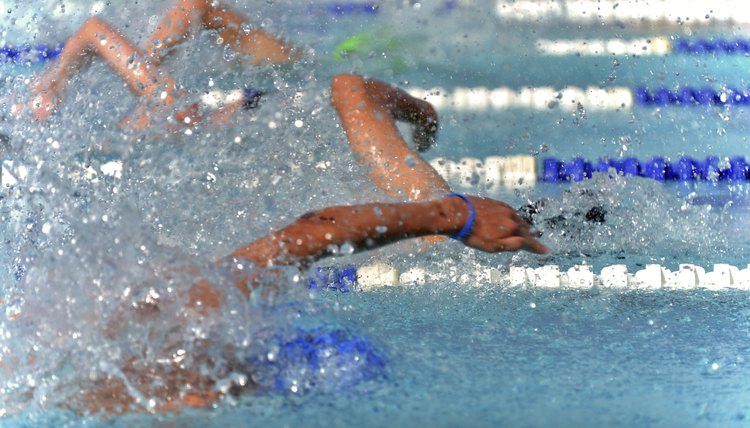
Although swimming is a low-impact form of exercise, the repetitive motions can cause several types of painful overuse injuries, including wrist injuries. Fatigue and failure to use proper swimming techniques further contribute to wrist pain and injuries for swimmers, according to the American Orthopaedic Society for Sports Medicine. Obtaining proper treatment, allowing for adequate rest, performing wrist-strengthening exercises and focusing on prevention will help ease swimming-related wrist injuries and minimize the impact of the injury on your performance.
Swimming Overuse Wrist Injuries
Overuse of the wrist joint during long swimming workouts and training drills can lead to inflammation and pain. Types of overuse wrist injuries include tendon inflammation, or tendinitis; dislocation; nerve injury; tenosynovitis, or inflammation of the protective sheath around the tendon; tunnel syndromes; and overuse stress fractures. Wrist tendinitis, one of the most common sports-related wrist injuries, often manifests itself as tenderness and aching pain provoked by exercise that subsides upon rest, according to Sports Injury Bulletin. If pain or other symptoms arise, obtain a medical evaluation from a sports medicine physician or an orthopedic surgeon.
Treatments for Wrist Pain
Treatment depends upon the cause of pain, as well the severity of the injury. Modify your activity and enlist in the help of a swimming coach to learn proper form and to reduce stress on your wrist joints. Physicians often recommend rest and time out of the water during the initial treatment phase to allow the inflammation to subside. Other treatments for wrist injuries include rest, ice, compression, elevation and anti-inflammatory medication, according to the AOSSM. In some instances, doctors may recommend splints, braces, physical therapy or surgery to correct more serious issues.
Wrist Exercises
Inflexibly of the wrists can cause the radius to touch the wrist bones when the wrist extends while stroking, causing impingement and subsequent pain. Stretch your wrists regularly and perform wrist-strengthening exercises to increase range of motion and strengthen the muscles that hold the wrists in proper alignment, Dr. Kevin Laudner, a kinesiologist at Illinois State University, recommends in a 2014 article for OutsideOnline.com. Try holding a hammer while standing with your arms by your side, tilting the head of the hammer toward the ceiling and then lowering it back down for several repetitions, suggests Laudner. Also try stretching the wrists by periodically moving them back and forth, side to side. See a physical therapist for additional wrist rehabilitation suggestions.
Preventing Wrist Injuries
Wearing wrist guards, stretching regularly and taking frequent breaks can prevent common swimming wrist injuries, according to the AOSSM. Other ways to minimize risk of injury include using proper techniques and avoiding overtraining. Lessen strain on the wrists by using the sidestroke and other similar gliding strokes in which primary propulsion comes from kicking rather than pulling. Because most swimming wrist injuries are relatively minor, conservative treatments often work well and most swimmers can make a quick return to their sport, explains Justin Shaginaw, MPT, ATC, in a 2014 article for Philly.com. Still, do not allow the injury to go untreated as that may cause a decline in performance and possibly lead to surgery in the future, cautions the AOSSM.
References
- American Orthopaedic Society for Sports Medicine: Swimming Injuries
- Philly.com: Common Swimming Injuries and Effective Treatment
- OutsideOnline.com: What Are the Best Exercises to Strengthen Wrists?
- Bass E. Tendinopathy: why the difference between tendinitis and tendinosis matters. Int J Ther Massage Bodywork. 2012;5(1):14-7.
- How can tenosynovitis be treated? Institute for Quality and Efficiency in Health Care (IQWiG). 2018.
- Chatterjee R, Vyas J. Diagnosis and management of intersection syndrome as a cause of overuse wrist pain. BMJ Case Rep. 2016;2016. doi:10.1136/bcr-2016-216988
- Wrist Sprain. What is it? Harvard Health Publishing. Harvard Medical School. 2019.
- Satteson E, Tannan S. De Quervain-Tenosynovitis. StatPearls Publishing. 2019.
- Carpal Tunnel Syndrome: Treating Hand Pain and Numbness. J Orthop Sports Phys Ther. 2019;49(5):361. doi:10.2519/jospt.2019.0502
- Hackney LA, Dodds SD. Assessment of scaphoid fracture healing. Curr Rev Musculoskelet Med. 2011;4(1):16-22. doi:10.1007/s12178-011-9072-0
- Lu H, Chen Q, Shen H. A repeated carpal tunnel syndrome due to tophaceous gout in flexor tendon: A case report. Medicine (Baltimore). 2017;96(9):e6245. doi:10.1097/MD.0000000000006245
- Jennings JD, Zielinski E, Tosti R, Ilyas AM. Septic Arthritis of the Wrist: Incidence, Risk Factors, and Predictors of Infection. Orthopedics. 2017;40(3):e526-e531. doi:10.3928/01477447-20170404-01
- Gregush R, Habusta S. Ganglion Cyst. StatPearls Publishing. 2019.
- Cutts S. Cubital tunnel syndrome. Postgrad Med J. 2007;83(975):28-31. doi:10.1136/pgmj.2006.047456
- Akhondi H, Panginikkod S. Wrist Arthritis. StatPearls Publishing. 2019.
- Caridi JM, Pumberger M, Hughes AP. Cervical radiculopathy: a review. HSS J. 2011;7(3):265-72. doi:10.1007/s11420-011-9218-z
- Paavola M, Kannus P, Järvinen TA, Järvinen TL, Józsa L, Järvinen M. Treatment of tendon disorders. Is there a role for corticosteroid injection?. Foot Ankle Clin. 2002;7(3):501-13.
- Adams JE, Habbu R. Tendinopathies of the Hand and Wrist. J Am Acad Orthop Surg. 2015 Dec;23(12):741-50.
- Dale AM, Harris-Adamson D, Rempel D, e al. Prevalence and incidence of carpal tunnel syndrome in US working populations: pooled analysis of six prospective studies. Scand J Work, Environ & Health. 2013;39(5):495-505. DOI: 10.5271/sjweh.3351.
- Goldfarb CA, Puri SK, Carlson MG. Diagnosis, Treatment, and Return to Play for Four Common Sports Injuries of the Hand and Wrist. J Am Acad Orthop Surg. 2016 Dec;24(12):853-862.
- Shehab R, Mirabelli MH. Evaluation and Diagnosis of Wrist Pain: A Case-Based Approach. Am Fam Physician. 2013 Apr 15;87(8):568-73.
Writer Bio
Sunny Griffis, a certified performance technologist, is a fitness coach who has been a professional writer since 1998. Her work can be seen in online and print publications such as "Family Fun," "Cappers," "Rutherford Woman Magazine" and "Healthy Family Magazine." She holds a Bachelor of Arts in metaphysics from AIHT, and a CPT certification from NFPT.