
Describe the Sequence of Arm Muscle Movements in Throwing a Javelin
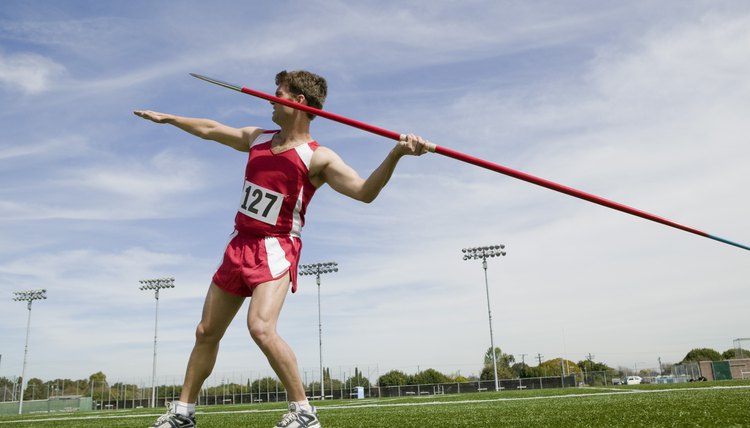
The javelin is a throwing event in the sport of track and field. Success in throwing the javelin requires a combination of power and speed; while the javelin is the lightest of the throwing implements, there is a greater demand on precise movement skills. The arm goes through a specific movement sequence during the throw, and mastery of it results in superior performance.
History
The javelin throw dates back to the time of Hercules. It evolved from a hunting weapon and was part of ancient Olympics as early as 700 B.C. It became a popular sport in Scandinavia in the late 1700s. Once made from wood, today the javelin is made out of aluminum or graphite and weighs between 600 grams and 800 grams. Throwing techniques have changed from a linear movement to an arc.
Features
Throwing distances are based on three variables: throw, angle of release and velocity. Two components, speed and power, are required for improved performance. Power requires the most force in the shortest amount of time. Momentum must be transferred from your lower body, through your core to your upper body. Movement must occur from the most proximal point, your shoulders, through the elbow, hand and fingers, the most distal point.
Phases
There are three phases in the movement in throwing the javelin. First, the run-up or approach occurs as your arm is bent and kept close to your head, keeping the javelin in alignment with little to no arm movement. Next is the transition or withdrawal phase, in which the javelin is brought back in alignment with the shoulder with your palm up. Finally is the delivery and follow-through phase, rotating your shoulder and extending your arm to release the javelin. Using the proximal to distal movement enables your arm to move in a whipping motion for release and follow-through.
Muscles
Your biceps contract to flex your elbow during the carrying phase. Your deltoid, or shoulders, flex to lift your arm up so the javelin can be held higher and raised to your forehead. During the withdrawal phase, your back muscles contract as you bring the javelin back. The non-throwing arm is extended forward as your throwing arm is brought back. This movement stretches your pectoral, or chest, muscles. From there, a stretch reflex, an involuntary contraction of your chest, helps bring your throwing arm forward with increased force. During the delivery phase, your shoulder initiates the movement, transferring movement through your triceps, wrists and fingers to extend your throwing arm forward to release the javelin.
Considerations
While your upper body muscles are directly involved with holding and releasing the javelin, the force is generated throughout your body. Initial force is initiated in your lower body muscles and transferred through your core through to your upper body muscles. Any weakness in the transferring muscles will diminish the force and reduce performance.
References
Writer Bio
Luann Voza teaches both math and science in an elementary school setting and physical education in a college setting. A former fitness-club owner, Voza has taught group fitness classes in step, aerobics, yoga, Pilates and kickboxing. As a bodybuilder, she held the title of Ms. New Jersey Lightweight Division Winner. Voza has a master's degree in exercise physiology and a doctoral degree in education.