What Parts of the Brain Control the Parts of Your Body?
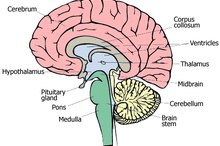
MayoClinic.com describes the brain as “containing billions of nerve cells arranged in patterns that coordinate thought, emotion, behavior, movement and sensation.” Each part of the brain is responsible for a specific function, and they all work together. The main parts of the brain include the cerebrum, cerebellum, limbic system, brain stem and pituitary gland
If you are experiencing serious medical symptoms, seek emergency treatment immediately.
Cerebrum
Bryn Mawr College describes the cerebrum as the largest part of the human brain; it is covered by gray deep folds and wrinkles. Kidshealth.com adds that the cerebrum makes up 85 percent of the brain’s weight. It is the thinking part of the brain and it controls the voluntary muscles. Both short-term and long-term memory live in the cerebrum.
Bryn Mawr College cites that a deep groove separates the cerebrum into two halves, also known as the left and the right hemispheres. The left hemisphere is associated with logic abilities such as math, while the right hemisphere is associated with creativity. Kidshealth.org says that the right half of the cerebrum controls the left side of the body, and vice versa.
- Bryn Mawr College describes the cerebrum as the largest part of the human brain; it is covered by gray deep folds and wrinkles.
- Bryn Mawr College cites that a deep groove separates the cerebrum into two halves, also known as the left and the right hemispheres.
Cerebellum
What the Different Parts of the Brain Do?
Learn More
The cerebellum is explained by scientists as Newhorizons.org as a brain structure that helps the body’s motor and nonmotor regions work effectively 2. It has been compared to a powerful computer. The cerebellum is located at the lower back of the brain. This fist-sized structure contains more nerve cells than all the rest of the brain combined. The cerebellum connects to the cerebrum by approximately 40 million nerve fibers. A major function of the cerebellum is controlling balance.
- The cerebellum is explained by scientists as Newhorizons.org as a brain structure that helps the body’s motor and nonmotor regions work effectively 2.
- This fist-sized structure contains more nerve cells than all the rest of the brain combined.
Limbic System
The limbic system is referred to as the “emotional brain," according to Bryn Mawr College, and it contains the thalamus, hypothalamus and hippocampus. MayoClinic.com defines the thalamus as the gatekeeper for messages passed from the spinal cord and cerebrum. The hypothalamus controls emotions, and regulates temperature by telling the body to sweat when overheated and to shiver when cold. The hippocampus sends memories to be stored in sections of the cerebrum, then recalls them when necessary.
- The limbic system is referred to as the “emotional brain," according to Bryn Mawr College, and it contains the thalamus, hypothalamus and hippocampus.
- The hippocampus sends memories to be stored in sections of the cerebrum, then recalls them when necessary.
Brain Stem
What Do the Parts of the Brain Control?
Learn More
The brain stem sits at the base of the brain and connects the rest of the brain to the spinal cord. Bryn Mawr College explains that the brain stem is made of the midbrain, pons and medulla, and it is responsible for vital functions such as breathing, heart rate and digestion. MayoClinic.com adds that this area is also important for sleep.
Pituitary Gland
According to the University of Maryland Medical Center, the pituitary gland is located at the base of the brain and is connected to the hypothalamus by nerve fibers 5. This pea-sized gland has three lobes and produces several hormones. Most of the pituitary hormones stimulate other glands, such as the adrenal, thyroid and ovaries.
Related Articles
What the Different Parts of the Brain Do?
Learn More
What Do the Parts of the Brain Control?
Learn More
Left Frontoparietal Functions in the Brain
Learn More
Four Main Parts of the Brain
Learn More
Parts of the Brain Involved With Hearing
Learn More
Parts of the Brain That Control Primitive Reflexes
Learn More

Parts of the Brain That Control Sight
Learn More

Parts of the Brain Used While Driving
Learn More

How Your Eyes Send Images to the Brain
Learn More

How Are the Muscular & Nervous Systems Connected?
Learn More
References
- Mayo Clinic: How Your Brain Works
- KidsHealth.org: Your Brain and Nervous System
- Cosgrove KP, Mazure CM, Staley JK. Evolving knowledge of sex differences in brain structure, function, and chemistry. Biol Psychiatry. 2007;62(8):847–855. doi:10.1016/j.biopsych.2007.03.001
- Haridas A, Tomita T. Hydrocephalus in children: Physiology, pathogenesis, and etiology. Updated September 24, 2018.
- National Institutes of Health. Brain diseases. MedlinePlus.
Writer Bio
Rhonda Merritt started freelance writing in 2010. She is a registered nurse specializing in cardiac rehabilitation and cardiac care. Merritt has her personal fitness coach certification and is a certified CPR instructor. She holds a Bachelor of Science in nursing. Merritt graduated from Edinboro University in 1988.