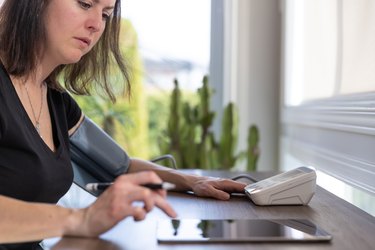
If your doctor told you to monitor your blood pressure at home, it's important to be sure you're taking your blood pressure at the right time for the most accurate results. Blood pressure readings taken after eating may give you a temporary elevated reading.
Video of the Day
Video of the Day
When to Take Your Blood Pressure
According to the American Heart Association (AHA), you may need to monitor your blood pressure at home if you have high blood pressure (also called hypertension) or if your doctor wants to see a series of blood pressure readings over time to determine if you have hypertension.
The AHA recommends using a home blood pressure monitor with an automatic cuff that wraps around your upper arm, inflates and deflates and gives you a reading. It's always a good idea to bring your monitor to an office visit so you can check it against an office reading and make sure you're using it correctly.
"We tell patients to take their blood pressure in the morning and the evening at about the same time every day," says Anupam Kotwal, MD, and endocrinologist and assistant professor of medicine at the University of Nebraska Medical Center in Omaha, Nebraska. "Eating a meal can give you a temporary elevation in blood pressure, so it is best to test before breakfast and before dinner. You can also measure 30 minutes after eating."
What you eat can sometimes affect your blood pressure. "Some people who are salt-sensitive may get a rise in blood pressure from a salty meal," Dr. Kotwal says. "Drinking coffee or alcohol can also raise blood pressure, but in most cases, it is the act of eating and digesting your food that causes a rise in blood pressure, not the type of food."
According to Harvard Health Publishing, the act of eating and digestion causes your digestive system to need more blood. Eating triggers your blood vessels to narrow to force more blood into your stomach and intestine and your heart to beat a bit faster to send blood throughout the rest of your body. This maintains your blood pressure.
Harvard Health also says that for some people, eating can actually cause blood pressure to drop excessively. In fact, it may drop enough to make you feel dizzy. This condition is called postprandial hypotension, and it's most common in older people.
When people with this condition eat, blood still goes to the digestive system, but the heart and blood vessels don't react. The sudden movement of blood to the digestive tract reduces pressure in other blood vessels, causing a drop in blood pressure called hypotension.
Other Tips for Accurate Readings
"The exercise of walking around can raise blood pressure, so you should always rest for about five minutes before taking your blood pressure," says Dr. Kotwal. "Sit in a chair and keep both feet on the ground. Avoid crossing your legs."
The AHA says don't smoke, drink caffeine or exercise for 30 minutes before a blood pressure check. When taking your blood pressure, you should sit in a chair with your back supported. It doesn't matter which arm you use to take your blood pressure. If your monitor doesn't have a built-in recorder, make sure to write down your readings so you can share them with your doctor.
Other tips, from the Centers for Disease Control and Prevention (CDC), for taking your blood pressure include:
- Don't let your arm hang down, as this can increase pressure. Support your arm on a table so that your arm is level with your heart.
- Empty your bladder before you sit down for a blood pressure check.
- Make sure the blood pressure cuff is placed over your bare arm, not over a shirtsleeve.
- Take two or more readings spaced about one to two minutes apart to get the most accurate results.
Ask your doctor what the normal range should be for your blood pressure. Don't worry if you have an occasional high reading, but let your doctor know if you're getting readings that are consistently higher than normal — high blood pressure usually has no symptoms.
- American Heart Association: “Monitoring Your Blood Pressure at Home”
- Anupam Kotwal, MD, endocrinologist, assistant professor of medicine, University of Nebraska Medical Center, Omaha, Nebraska
- Harvard Health Publishing: “Eating Can Cause Low Blood Pressure”
- Centers for Disease Control and Prevention (CDC): “Are You Wrong About Your Blood Pressure?”
Is this an emergency? If you are experiencing serious medical symptoms, please see the National Library of Medicine’s list of signs you need emergency medical attention or call 911.