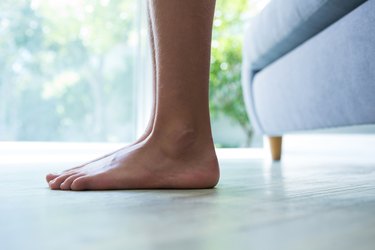
Lack of the arch in the foot is medically described as pes planus — a common condition that is usually not painful. All of us have flat feet when we are born, and the development of the arch usually takes place during childhood. There are two types of flat feet: flexible and inflexible.
If your foot is flat when it's in a resting position but the arch forms when you stand on tiptoe, it is considered a flexible flat foot. This condition does not typically cause pain or require treatment.
Video of the Day
Video of the Day
If the arch is missing when you are standing on your toes, it is inflexible and may be because of tarsal coalition — a condition where two or more of the small bones of the foot fuse together. It usually can only be confirmed with X-ray. In these cases, strengthening exercises can be helpful for supporting and building arches in the feet.
Read more: How To Run With Flat Feet
1. Flat Feet Exercises
Perhaps the best exercise for building arches in the feet is the towel scrunch. With time and decreased demand on your feet, the small muscles become weaker. Since you are no longer jumping or skipping as you did when you were a kid, your muscles lose their ability to give your feet the spring they once had.
HOW TO DO IT: Start out barefoot in your favorite chair and spread a small hand towel on the floor in front of you. Place the ball of your foot on the edge of the towel closest to you and, reaching out with your toes as far as you can, grab the towel and scrunch it back toward you, bunching it up under your foot.
Keep reaching out and grabbing more towel until you run out. At the end of each scrunch, hold the contraction you feel in the arch for just a second before releasing. Do three sets of 10 scrunches with a short hold at the top each day.
2. Stair Raises for Arch Strength
Another way to increase arch strength is toe raises on a stair or raised board. Repeat 10 times, working up to three sets in a row.
HOW TO DO IT: Stand on a step or board at least three to four inches off the ground with only the ball of your foot on the board and the rest of your heel and foot hanging slightly below the toes.
Start with your foot in a neutral position and raise up to your tiptoes, pressing down with your toes. When you lower, resist the urge to drop your heel too far below the stair line; that is really a calf exercise, and your focus is on your arch.
3. Improve Your Flexibility
While working the small muscles that hold the arch in place with flat feet exercises, balance strength with flexibility. A good way to finish your exercise is to stretch the foot by either reaching down with your hand and grabbing your toe, pulling your toes back and up while relaxing your foot or with a can-rolling exercise, which can be both a stretching exercise and a reward for sore feet.
HOW TO DO IT: Begin by sitting in your favorite chair, but instead of a towel, with a small can about the size of a one- or two-serving soup can in front of you. Laying the can on its side so it can roll freely away from you and back, place your arch across the can and roll it out and back.
Use moderate downward pressure and roll the can from the ball of your foot all the way back to your heel. This stretches and massages the bottom of the foot and can be a way to reduce some arch soreness.
Read more: How to Determine Foot Pronation
See a Doctor
Flat feet exercises are meant to strengthen the muscles in the arch and help maintain healthy feet. If you are feeling soreness in the arch or in the heel, you may have a problem with plantar fasciitis or heel spurs. Either of those conditions may require further evaluation.