
How Much Should You Be Curling According to Body Weight?
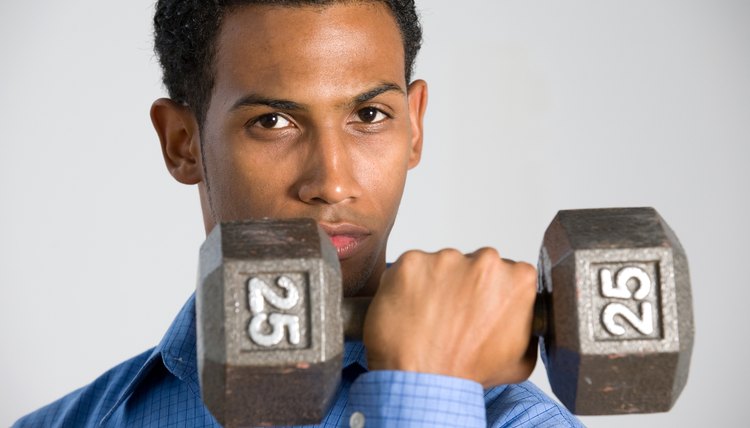
Anyone engaging in a resistance-training or weightlifting program will benefit from being aware of how much weight they should use for different types of lifts. However, differences in body type, muscle structure and training experience lead to differences in ability to curl weight during strength training. While using your body weight to determine how much you should be curling is a decent rule of thumb, max weight should take the background of the lifter into consideration. Experience in bodybuilding and lifting weights should be taken into account into the amount of weight used, not just when curling, but when doing other exercises like bench press as well.
Why is form important during curling?
You’ll find people throughout the gym curling widely varying weights. One reason for this is that many people aren’t curling properly. When you’re throwing your body weight into the movement by jerking your back or moving your arm at the shoulder joints, your curl ceases to be as effective even if you are using heavy weights. Thus, before you consider how much you should be curling to build muscle, you should know how to curl properly with light weights. You should also set a number of repetitions that you can do using the same weight while having proper form. Furthermore, focusing on form on exercises like bicep curl is more important for building muscle mass in your bicep muscles and preventing injury in your muscle groups.
What is the proper curling form?
After a upper body warm-up, grasp a barbell with an underhand grip and let your arms hang down in front of you. Your hands should be spaced shoulder-width apart. This is the starting position. Bend your elbows upward to lift the weight, keeping your back straight, until the barbell touches your chest. You may bend your wrists forward when you reach the top. Return the barbell to the starting position. This is the standard curl that most exercisers are familiar with. You can perform a dumbbell bicep curl in the same way, using each arm independently.
How Much Should You Be Curling According to Body Weight?
The true answer to how much weight you should be curling relative to your body weight will be disappointing to most. Here it is: Curling weight and body weight have little relation. The curl is performed by the muscles in your upper arms, mainly the biceps and the brachialis. People who carry more body strength or have more muscle size in their legs, torso or shoulders, and therefore heavier, don’t have a specific advantage in curling heavier weights. That said, muscle growth occurs all over when you engage in resistance training due to the release of human growth hormone. So a correlation between body weight and curling weight is possible. But it still depends on how often you work your biceps more than how heavy you are.
A Rule of Thumb
Assuming that you fall into a normal level of body fat percentage for your age, you can base how much you should be able to curl on a percentage of your body weight. A man at between 10- and 20-percent body fat, for example, can typically curl around half his body weight with the barbell curl as a one-rep max, and one-fourth his body weight with the dumbbell curl as a one-rep max. So a 140-pound man with a healthy body should be able to curl approximately 70 pounds on a barbell as his one-rep max and 35 pounds on a dumbbell as his one-rep max. However, you should always consult a personal trainer or physician before starting any exercise program.
Writer Bio
This article was written by the CareerTrend team, copy edited and fact checked through a multi-point auditing system, in efforts to ensure our readers only receive the best information. To submit your questions or ideas, or to simply learn more about CareerTrend, contact us [here](http://careertrend.com/about-us).