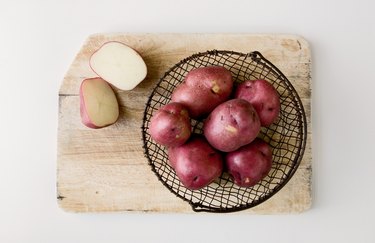
Red potato nutrition includes essential vitamins, minerals and energy you need to fuel your busy day. They're a root vegetable that makes a healthy addition to any well-balanced diet.
You'll get the most nutritional benefits from red potatoes by eating their thin skin, along with the white flesh. Just be sure to wash the outer skin of the potato well before baking or boiling to remove all dirt.
Video of the Day
Video of the Day
Read more: Why Potatoes With More Color Are Healthiest
Red Potato Benefits and Nutrition
A medium, red-skinned potato that's baked measures about 2.25 to 3.25 inches in diameter. There are 151 calories in red potatoes of this size, 4 grams of protein and less than 1 gram of fat, according the USDA. This makes potatoes a good fit for low-fat diets.
One of the red potato benefits is that they're also a whole food, and a vegetable source of starch to eat with dinner, rather than eating processed foods. Be aware of your portion size when consuming potatoes to avoid eating more calories than you need.
Count the Carbs
There are 34 grams of carbs in red potatoes. Dietary fiber accounts for three of these grams of carbohydrate. Fiber helps regulate your digestion, prevents constipation and diarrhea, may lower cholesterol and blood sugar, and helps you feel full after eating.
The majority of the rest of the carbohydrates in red potatoes come from starches. These are complex carbohydrates found in whole foods, as explained by Mayo Clinic. Although potatoes are a vegetable, they are considered a starchy vegetable because of their high carbohydrate content. If you're following a controlled carbohydrate diet plan or have diabetes, be cautious of your portion size to avoid excess carb intake.
Get Your Vitamins
Red potatoes also provide you with a variety of vitamins to maintain your health. A medium red potato provides 22 mg pf vitamin C — 29 percent of the daily value for women and 24 percent for men, according to the National Academies of Sciences. Your body needs vitamin C to form collagen — an essential connective-tissue protein — to fight infections, to help iron and copper absorption and to maintain healthy bones, according to Harvard Health Publishing.
You'll also get 28 percent of the daily value for vitamin B6, 18 to 20 percent for niacin and 12 percent for folate from red potatoes. These B vitamins aid in energy metabolism, cell growth and repair, keeping skin and nerves healthy, and they help prevent certain neural-tube birth defects in babies.
Include Potatoes for Minerals
Red potatoes also contain many essential minerals. A medium potato provides 12 to 15 percent of the daily value for magnesium, 18 percent for phosphorus and 28 to 36 percent of the daily value for potassium, according to the National Academies of Sciences. Your body needs potassium to help regulate blood pressure, fluid balance, nerve impulses and muscle contractions.
The other minerals in red potatoes play a part in many bodily functions, including calcium use, bone health, energy metabolism, red-blood cell formation, immune function and acid-base balance.