How Does a Food Dehydrator Work?
A food dehydrator is a kitchen appliance used for drying food.
Dehydration is a method of food preservation, in which moisture is removed from the food. Drying food extends the shelf life of a food by decreasing growth of bacteria and minimizing spoilage.
Dehydrated foods can be eaten in their dried state or rehydrated for future use. Removing the desired amount of moisture can take several hours. Dehydrated foods may change color, weigh less, and appear irregularly shaped compared to their fresh state.
History
Historically, food dehydration was been done outdoors by placing whole or sliced foods in the sun. More sophisticated solar dehydration apparatuses have since been invented, featuring racks with selected open areas to allow better protection of the food during the dehydration process, which uses the natural movement of air and solar heat to remove water from the foods. These traditional methods create inconstant food products.
Modern dehydrators are much more predictable, because they have a consistent source and temperature for dehydrating. Compared to solar dehydrators, electric dehydrators more evenly circulate warm air.
- Historically, food dehydration was been done outdoors by placing whole or sliced foods in the sun.
- Modern dehydrators are much more predictable, because they have a consistent source and temperature for dehydrating.
Components
Things That Can Be Dehydrated in a Dehydrator
Learn More
Dehydrators operate by using of a heating element, fan, air vents, and food trays.
The heating element, fan and vents work together to circulate air and remove moisture. Heating the food allows for moisture to be released from the food and into the dehydrator.
The fan then pushes excess moisture to the vents, where it is released outside of the dehydrator. Air may circulate vertically or horizontally — air moved horizontally must have a rear-mounted fan; vertical-airflow dehydrators have fans on the top or bottom of the appliance.
- Dehydrators operate by using of a heating element, fan, air vents, and food trays.
- The fan then pushes excess moisture to the vents, where it is released outside of the dehydrator.
Trays
Tray design varies with model size and design; some dehydrators feature removable and stackable trays, others feature rigid box shelves. Electric dehydrators usually have circular drying racks.
Higher-tech dehydrators may even have rotating trays. Trays may be adjustable to allow differences in ventilation. Trays are often multi-tiered to allow different types and sizes of food to be dehydrated simultaneously.
- Tray design varies with model size and design; some dehydrators feature removable and stackable trays, others feature rigid box shelves.
- Trays may be adjustable to allow differences in ventilation.
Temperture
Side Effects of Eating Thawed Then Refrozen Food
Learn More
Most foods are dehydrated at temperatures between 95 and 145 degrees Fahrenheit.
Meats should be dehydrated at higher temperatures than fruits or vegetables to discourage bacteria growth. Temperature and air circulation should be consistent to allow for even dehydrating. Dehydrating foods at too high a temperature will result in uneven drying, leaving foods with dry exteriors and moist interiors.
- Most foods are dehydrated at temperatures between 95 and 145 degrees Fahrenheit.
- Meats should be dehydrated at higher temperatures than fruits or vegetables to discourage bacteria growth.
Uses
Commonly dehydrated fruits include cranberries, cherries, apricots, pineapple, apples, bananas, plums and grapes.
Dried fruit can be added to cereals, breads or trail mixes. Commonly dehydrated vegetables include potatoes, root vegetables, mushrooms, tomatoes, peppers, chilis and herbs.
Dried vegetables can be used in soups or snacks. Dried meat is usually seasoned and turned into jerky.
Common types of jerky include venison, turkey, buffalo and beef. Raw-food enthusiasts sometimes use food dehydrators to create raw granola bars and pureed fruit rolls.
- Commonly dehydrated fruits include cranberries, cherries, apricots, pineapple, apples, bananas, plums and grapes.
- Commonly dehydrated vegetables include potatoes, root vegetables, mushrooms, tomatoes, peppers, chilis and herbs.
Food Texture
Dehydration is complete when fruits appear leathery and are dry throughout.
Dried vegetables may be tough or crunchy and are done when there is no internal moisture. Jerky should also appear leathery and have a tough, chewy texture.
Related Articles
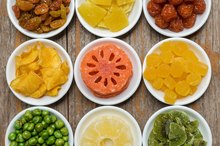
Things That Can Be Dehydrated in a Dehydrator
Learn More
Side Effects of Eating Thawed Then Refrozen Food
Learn More
Bacteria That Grow in the Refrigerator
Learn More
How to Dehydrate Bananas in a Food Dehydrator
Learn More

How to Prevent Bacterial Growth in Food
Learn More

What Are the Effects of Food Contamination?
Learn More
Botulism Risk of Canned Beans
Learn More
What Is a Ready-to-Eat Food?
Learn More
Nutritional Value of Fried Vegetables
Learn More
Four Conditions for Bacterial Growth
Learn More
References
Writer Bio
Kristen McCarty started writing wellness articles for students and faculty in 2007. She has worked as a certified athletic trainer and health educator at the collegiate and secondary school levels. She now writes for LIVESTRONG.COM. She holds a Bachelor of Science in sports medicine concentrating in athletic training from Mercyhurst College and a Masters of Arts in applied physiology from Teachers College-Columbia University.