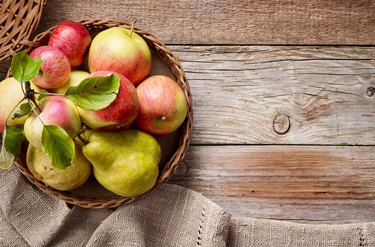
Fruits are one of the most popularly consumed types of foods in America. Although the benefits of antioxidant-rich fruits like berries are well known, commonly consumed fruits, like the pear, apple and banana, have many nutritional benefits as well. The Dietary Guidelines for Americans recommends consuming fruits on a daily basis as these foods are good sources of various vitamins, minerals and antioxidants.
Read more: 19 High-Fiber Foods — Some May Surprise You!
Video of the Day
Video of the Day
The Nutritional Value of Apples
There are a variety of different apples produced around the world. Although you're probably most familiar with popular types of apples like Red Delicious, Golden Delicious, Granny Smith and Fuji, most people have tried a variety of other types of apples including Honeycrisp, Macoun, Cortland, Cripps Pink and Gala apples depending on where you live.
The average Red Delicious apple can range in size from 158 to 260 grams, while the average Granny Smith apple ranges from 144 to 206 grams. According to the USDA, a typical 200-gram apple is usually around 117 calories, with around 0.4 grams of fat, 0.75 grams of protein and about 28 grams of carbohydrates. Around 10 grams of these carbohydrates are sugars. In one 200-gram Granny Smith apple, you can find:
- 5.6 grams of fiber
- 6 percent of the daily value (DV) for potassium
- 6 percent of the DV for vitamin A
- 6 percent of the DV for vitamin K
- 6 percent of the DV for copper
Apples also contain small amounts (between 1 and 4 percent) of most other essential vitamins and minerals, including vitamin A, B-complex vitamins, phosphorus, iron and magnesium. Although there are various types of apples, their nutritional differences are minimal. For instance, the nutritional values for Granny Smith and Red Delicious only differ by a single percent at most.
The Nutritional Value of Pears
Like apples, pears come in a variety of different types. They are roughly the same size as apples, with an average pear ranging between 140 and 230 grams. Pears come in a range of varieties, just like apples.
Just as you wouldn't say a Red Delicious is similar in flavor or texture to a Granny Smith, you wouldn't compare your average pear to an Asian pear. According to the USDA, in 200 grams of your average pear, you'd find 114 calories, 0.2 grams of fat, 0.8 grams of protein and about 30 grams of carbohydrates. More than half of this (about 20 grams) are sugars. In a 200-gram pear, you would find:
- 6.2 grams of fiber
- 18 percent of the DV for copper
- 10 percent of the DV for vitamin C
- 8 percent of the DV for vitamin K
Pears also contain a small amount (between 1 and 4 percent) of a variety of other nutrients, including calcium, iron, potassium, magnesium, phosphorus, manganese, B-complex vitamins, vitamin E.
Unlike apples, differences between pears can be much more extreme. Asian pears have fewer calories than your average pear, with 84 calories per 200-gram pear. While Asian pears have around the same amount of fat and protein, they have just 21.4 grams of carbohydrates per 200-gram pear. This amount contains more fiber (7.2 grams) and less sugar (14.2 grams) compared to your average pear. A 200-gram-sized Asian pear has:
- 6 percent of the DV for potassium
- 12 percent of the DV for copper
- 6 percent of the DV for manganese
- 8 percent of the DV for vitamin C
- 8 percent of the DV for vitamin K
Asian pears also contain small amounts (between 1 and 4 percent) of other nutrients, including magnesium, phosphorus, B-complex vitamins and vitamin E.
The Nutritional Value of Bananas
Bananas have the most calories and macronutrients compared to apples and pears. According to the USDA, there are 178 calories in a 200-gram banana, with 0.6 grams of fat, 2.2 grams of protein and 45.6 grams of carbohydrates. From these carbohydrates, 14.4 grams are sugars and 5.2 grams come from fiber. In 200 grams of banana, you would find:
- 16 percent of the DV for potassium,
- 12 percent of the DV for magnesium
- 18 percent of the DV for copper
- 24 percent of the DV for manganese
- 20 percent of the DV for vitamin C
- 6 percent of the DV for thiamin (vitamin B1)
- 12 percent of the DV for riboflavin (vitamin B2)
- 8 percent of the DV for niacin (vitamin B3)
- 14 percent of the DV for vitamin B5
- 44 percent of the DV for vitamin B6
- 10 percent of the DV for folate (vitamin B9)
Bananas also contain small amounts (between 1 and 4 percent) of other nutrients, including vitamin E, vitamin A, selenium, zinc, phosphorus and iron. Compared to pears and apples, bananas have the most vitamin and minerals.
According to a May 2014 study in the Nutrition Journal, bananas also have more antioxidants compared to apples and pears, making the nutritional benefits of eating bananas quite obvious. However, another May 2014 study in the Journal of Agricultural and Food Chemistry disagreed, showing that apples had more antioxidants than bananas, but that bananas had more than pears.
You should also be aware that bananas tend to be smaller in size compared to apples and pears. Since an average banana ranges between 81 and 152 grams, you'd probably have to consume two small-to-medium sized bananas in order to obtain this amount of nutrients.
Consuming Pears, Apples and Bananas
Regardless of your choice of fruit, all of them are considered to be healthy. According to the Dietary Guidelines for Americans, most people don't consume enough fruits. However, consumption of plant-based foods, like vegetables and fruits, can help reduce your risk of chronic diseases and certain types of cancer.
The Dietary Guidelines recommends consuming about 2 cups of fruit a day. A cup of these fruits is equivalent to about:
- 150 grams of sliced banana
- 140 grams of sliced pear
- 109 grams of sliced apple
This essentially means a large banana and half an apple or pear could easily allow you to meet your daily recommended fruit consumption. Juices, smoothies, canned and dried fruits can all contribute to your daily fruit consumption, too. However, whole, fresh fruits are considered to be the healthiest as they are rich in fiber and lack any added sugars. According to a May 2014 in the Nutrition Journal, whole fruits may also contain more antioxidants than cooked or preserved fruits.
- Nutrition: "Effect of Fruit and Vegetable Antioxidants on Total Antioxidant Capacity of Blood Plasma."
- Health.gov: "Dietary Guidelines for Americans 2015-2020"
- MyFoodData: "Nutrition Comparison of Bananas, Pears, Asian Pears, Red Delicious Apples, and Granny Smith Apples"
- Journal of Agricultural and Food Chemistry: "In Vitro Inhibitory Effect on Digestive Enzymes and Antioxidant Potential of Commonly Consumed Fruits"