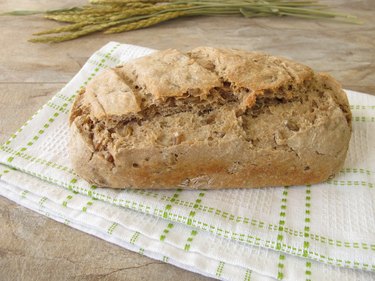
Spelt is an ancient grain that's both delicious and full of health benefits. "It's sweet yet mild, so it can be used for a variety of baked goods. And it'll lend your food a nice nutty flavor," says Jonathan Davis, head baker and SVP of research and development at La Brea Bakery.
Ready to get started incorporating spelt flour in your baked goods? Learn how to replace white flour with this ancient grain and why doing so can benefit your health.
Video of the Day
Video of the Day
Read more: The Best Grains on a Low-Carb Diet
How to Use Spelt Flour in Recipes
"Spelt is a very delicate flour to incorporate into baking and takes some extra attention when adding into recipes," says Davis.
If your recipe calls for whole-wheat flour, a one-to-one substitution is fine. If the recipe asks for white flour, try replacing just a portion of the flour with spelt flour. "The general rule of thumb is that spelt does well in a 50:50 or less ratio where you're looking for a firmer base, like with bread. For baked goods that need less structure, you can play around with a higher percentage of spelt," says Davis.
In quick breads — as well as muffins, pancakes and other yeast-free baked goods — no other changes need to made to the recipe, Caroline Sluyter, the program director of the Whole Grains Council, tells LIVESTRONG.com.
That is, if the recipe calls for 1 cup of all-purpose white flour, you can try using a quarter-cup of spelt and three-quarters of a cup of white flour without making other adjustments. And if you like the way that tastes, you can try using a half-cup of spelt flour and a half-cup of white flour next time you bake that recipe.
"In bread loaves with yeast that need to rise, you can substitute whole spelt flour for half of the all-purpose flour without making other adjustments," says Sluyter. If you want all spelt flour — without any white flour at all — she recommends adding an extra 2 teaspoons of liquid per cup of whole-grain spelt flour. "The dough will likely need an extra 25 to 30 minutes to rest before kneading as well," she notes.
Read more: 10 Myths About Grains — Totally Busted
What Are the Health Benefits of Spelt?
Whole-grain spelt flour is typically labeled "spelt flour," whereas white spelt flour is labeled "white spelt flour." For the most health benefits, stick with the whole-grain and avoid the refined, white version. "The process of refining flour strips away the bran and germ layers of the grain which is where most of the grain's nutrients and flavor are found," explains Sluyter. Not only will the refined version be lower in protein and fiber, but it'll also lack in flavor, she notes.
Compared to white flour, spelt provides some key nutritional benefits. In a quarter-cup of spelt four, you'll get 5 grams of protein and nearly 4 grams of fiber. In contrast, that same amount of all-purpose white flour contains just 3 grams of protein and less than 1 gram of fiber.
"Whole grains are associated with a wide range of health benefits, including reduced risk of stroke, heart disease, type 2 diabetes and certain types of cancer, which makes another great argument for incorporating flours like whole-grain spelt into your kitchen and diet," Sluyter says, citing the American Heart Association.
Indeed, the Dietary Guidelines for Americans recommend that that at least half the grains a person eats be whole grains, so using spelt instead of white flour in your baked goods is a good way to get more whole grains.
And when it comes to flavor, choosing the whole-grain version makes a difference. Spelt tastes earthier than wheat, says Davis, "but aside from the flavor profile, spelt gives off a similar feeling to whole wheat flour," he says. "It's only in its whole-grain form that the characteristic sweet nuttiness of spelt flour shines through," Sluyter adds.
Warning
Like whole wheat or white flour, spelt flour is a source of gluten, so it’s not an option for people with celiac disease or for those who have a gluten sensitivity.
Read more: 13 Powerful Grains and Seeds