
How Do I Train for Flatwater Kayak Racing?
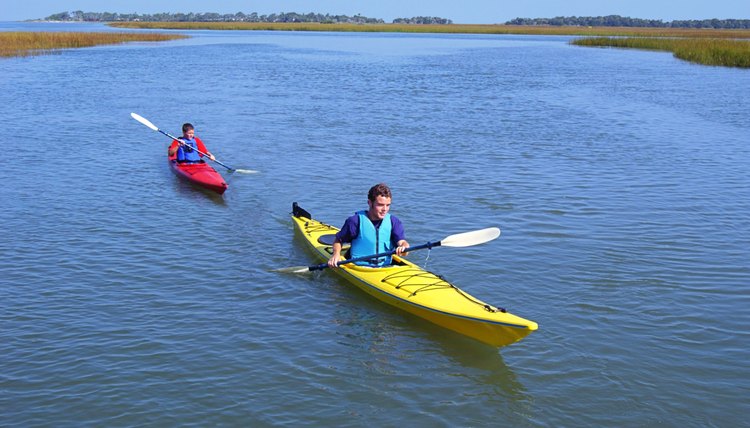
Csaba Szanto's seminal book "Racing Canoeing", reports that flatwater kayaking is a sport that involves speed, strength and endurance in which athletes compete head to head on calm bodies of water. Further, flatwater racing boats are extremely narrow and require extensive balance and stability training. Flatwater kayaking events are either 200, 500 or 1,000 meters, and athletes can compete individually (K1), in teams of two (K2), and in teams of four (K4).
Training The Body's Energy Systems
During exercise, the body receives energy either anaerobically, through stored chemicals in the muscles, or aerobically, through oxygen. The 200 meter event primarily taxes the body's anaerobic energy system, while the 1,000 meter sprint is mostly aerobic. The 500 meter sprint is just slightly more aerobically based than anaerobic. However, each event requires training in all three of the body's energy systems, and Olympic Gold Medalist, Greg Barton, recommends extensive training for each. Training the anaerobic system consists of repeated short, intense bursts of speed anywhere from five to 70 seconds. At about 70 seconds, energy is mostly provided aerobically, therefore aerobic training consists of intervals of 70 seconds up to several hours.
Training for Strength and Power
Szanto suggests that flatwater kayaking requires not only maximal strength, but the ability to accelerate heavy loads quickly as well, which is referred to as power. Training for maximal strength involves around three to five sets of four to six repetitions, using very heavy loads. Strength exercises which translate well to kayaking include: deadlifts, bench presses, squats, and rows. Training for power involves five to six sets of three to six repetitions, using explosive, dynamic technique. Power exercises which apply to kayaking include all kinds of cleans, snatches and jerks.
Training for Balance and Stability
According to Australian Canoeing's "Flatwater Racing Manual," in addition to strength and power, balance and stability are essential to maintaining optimal movement and boat-run while paddling. Exercises which train balance and promote improved proprioception include: one-leg balances, plank, Bosu ball exercises, and incorporating a physio ball into common exercises. Further, lower back and abdominal strength and stability are crucial in connecting the legs with the torso during the stroke, so 10 minutes of core exercises each day will greatly improve the stroke.
Technical Training
According to the USA Canoe/Kayak Technical Template, there are five phases of the kayak stroke, including: set-up, drive, catch, pull, and exit. The set-up is pivotal, as it paves the way for the rest of the stroke. An important cue to remember for the set-up is to "sight the horizon" through the knuckles in the bottom hand. The drive phase involves a powerful downward motion from the set-up to the water. The catch refers to the paddle entering the water and maintaining a solid, square position. The pull, perhaps the most important part of the stroke, involves a powerful drive of the legs against the foot-board, accompanied by a rotation of the hips and torso. The exit should be quick and quiet, and the paddle should be out of the water before it drags behind the paddler's hip.
Periodization
Training for flatwater kayak involves a balance between on-water training, strength and power, balance and stability, and technique. Renowned rowing coach and exercise scientist, Tudor Bompa, coined the term "periodization" to describe the systematic variation of the training stimulus throughout the year. For the competitive kayaker, Bompa recommends high volumes of training focusing on technique and endurance in the off-season, and gradually reducing the volume and technical focus while increasing the intensity as competition approaches.
References
- "Racing Canoeing"; Csaba Szanto; 2004
- "The Barton Mold"; William Endicott; 1992
- "Australian Canoeing: Flatwater Racing Manual"; Australian Canoeing; 2003
- "USA Canoe/Kayak Technical Template"; Mac Hickox; 2009
- "Periodization Training for Sports"; Tudor Bompa; 1999
Writer Bio
Graham Ulmer began writing professionally in 2006 and has been published in the "Military Medicine" journal. He is a certified strength-and-conditioning specialist with the National Strength and Conditioning Association. Ulmer holds a Master of Science in exercise science from the University of Idaho and a Bachelor of Science in psychology from Washington State University.