What does fact checked mean?
At Healthfully, we strive to deliver objective content that is accurate and up-to-date. Our team periodically reviews articles in order to ensure content quality. The sources cited below consist of evidence from peer-reviewed journals, prominent medical organizations, academic associations, and government data.
- PubMed Health; Tips for Losing Weight; Oct. 2009
- PubMed Health; Tips for Losing Weight; Oct. 2009
- American Heart Association; Know Your Fats; March 2011
- MedlinePlus; Dietary Fiber; April 2011
The information contained on this site is for informational purposes only, and should not be used as a substitute for the advice of a professional health care provider. Please check with the appropriate physician regarding health questions and concerns. Although we strive to deliver accurate and up-to-date information, no guarantee to that effect is made.
Soy Nuts Vs. Edamame
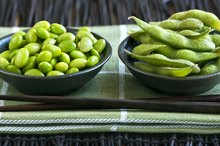
Edamame and soy nuts are both food products made from soy, but they have slightly different nutritional values 1. Edamame is another name for the soybean, while soy nuts, despite the name, are not nuts -- they are made by soaking soybeans and then baking them until they have a nutty, crunchy consistency 1. Although the nutritional characteristics of the two foods are similar, one may be more beneficial than the other based on your nutritional needs.
Calorie Content
Soy nuts and edamame provide a similar amount of calories. A 1/4-cup serving of soy nuts provides 120 calories, while a 1/4-cup serving of edamame provides 100 calories. Even if you are trying to lose weight, this difference is unlikely to significantly affect your progress, as switching from soy nuts to edamame would save you just 140 calories if you consumed 1/4 cup each day 1. That amount is just 4 percent of the calories you need to cut to lose a pound.
- Soy nuts and edamame provide a similar amount of calories.
- Even if you are trying to lose weight, this difference is unlikely to significantly affect your progress, as switching from soy nuts to edamame would save you just 140 calories if you consumed 1/4 cup each day 1.
Fat Content
Symptoms of Allergies to Chickpeas and Soy
Learn More
Soy nuts and edamame contain nearly the same amount of fat. A 1/4-cup serving of soy nuts contains 4 g of fat, while the same-sized serving of edamame contains 3 g of fat. Neither food contains any saturated fat, a type of fat that may increase your risk of heart disease. The American Heart Association suggests consuming a total of 50 to 70 g of protein each day 2.
- Soy nuts and edamame contain nearly the same amount of fat.
- A 1/4-cup serving of soy nuts contains 4 g of fat, while the same-sized serving of edamame contains 3 g of fat.
Carbohydrate Content
Although soy nuts and edamame are both relatively low in carbohydrates, they are both rich in dietary fiber 1. A 1/4-cup of edamame provides 10 g of carbohydrates, with 3 g of dietary fiber. A 1/4-cup of soy nuts provides 9 g of carbohydrates, with 5 g of dietary fiber. Dietary fiber is an essential nutrient that promotes healthy digestion and may aid in weight loss, because it makes you feel full. Soy nuts also contain 3 g of sugar, while edamame contains none.
- Although soy nuts and edamame are both relatively low in carbohydrates, they are both rich in dietary fiber 1.
- A 1/4-cup of soy nuts provides 9 g of carbohydrates, with 5 g of dietary fiber.
Protein Content
Hydrogenated Soybean Oil Allergies
Learn More
Edamame and soy nuts are both rich in protein 1. A 1/4-cup serving of soy nuts contains 12 g of protein, while a 1/4-cup serving of edamame provides 9 g of protein. Protein is a vital nutrient that helps your body build and repair cells and tissues. Soy and quinoa are the only two types of plants that are complete protein sources, meaning they provide all of the essential amino acids.
- Edamame and soy nuts are both rich in protein 1.
- Soy and quinoa are the only two types of plants that are complete protein sources, meaning they provide all of the essential amino acids.
Related Articles
Symptoms of Allergies to Chickpeas and Soy
Learn More
Hydrogenated Soybean Oil Allergies
Learn More
Soy and Hormonal Imbalance
Learn More

Caffeine Content in One Cup of Coffee Vs. One Shot of Espresso
Learn More
The Benefits and Drawbacks of Soy Protein Powder in Women
Learn More
Candida Diet & Soy
Learn More
Skin Rashes and Allergies to Soy
Learn More
Peanuts Vs. Pistachios
Learn More
Can Pistachio Nuts Cause Diarrhea?
Learn More
Are Soy Beans a Starch?
Learn More
References
- Soya.be: What Are Soy Nuts?
- American Heart Association; Know Your Fats; March 2011
- MedlinePlus; Dietary Fiber; April 2011
- Messina M. Soy and Health Update: Evaluation of the Clinical and Epidemiologic Literature. Nutrients. 2016 Dec; 8(12): 754.
- National Institutes of Health National Center for Complementary and Integrative Health. Soy fact sheet.
- Rivas M et al. Soy Milk Lowers Blood Pressure in Men and Women with Mild to Moderate Essential Hypertension. The Journal of Nutrition. 2002 Jul;132(7):1900-2.
- U.S. Department of Agriculture. U.S.D.A. Database for the Isoflavone Content of Selected Foods. Version 2.0.
Writer Bio
Brian Willett began writing in 2005. He has been published in the "Buffalo News," the "Daytona Times" and "Natural Muscle Magazine." Willett also writes for Bloginity.com and Bodybuilding.com. He is an American Council on Exercise-certified personal trainer and earned a Bachelor of Arts in journalism from the University of North Carolina.