
How Your Breathing Could Be Ruining Your Workout

Breathing -- one of the most basic things we do every day -- can change drastically within the course of a workout. Whether we're trudging up the Stairmaster, hoisting kettlebells off the floor or cycling our legs off, breathing usually isn't the first thing we think about. We just do it, sometimes with more force than we’d like to admit. (Cue the treadmill fan, please!)
But experts say our breathing pattern can make a difference in our workout. “How you breathe can affect your exercise,” says Marta Montenegro, exercise physiologist and nutrition specialist in Miami. Depending on the activity -- practicing yoga, lifting weights, running or simply stretching -- breath awareness and proper technique can help you maximize your workout results and reduce your chances of injury.
The manipulation of breathing has a specific outcome: Some to calm you down and [some to] energize you.
Andrea Marcum, a yoga instructor in Los Angeles
1. Not Breathing Correctly Stalls Your Warm Up

Adobe Stock/bernardbodo
Breathing is the foundation of all different workouts, says Andrea Marcum, a yoga instructor in Los Angeles. “It keeps us focused and reminds us to get rich, full, deep breaths.” While heartbeat and other physiological mechanisms are difficult to manipulate, breathing is something we can influence -- and reap benefits in return.
“The manipulation of breathing has a specific outcome,” Marcum says. “Some to calm you down and [some to] energize you.” Coming to a balanced point in breathing can reduce stress and bring the body and mind to a relaxed state. “We are looking for balance in our lives,” Marcum says. “We are a culture of having our foot stuck on the gas. The nervous system is the control system for our body. Our breath brings us to conscious place where we realize relaxation response is as important as stress response.”
One way to find this balance is to lie flat on your back and rest your hands on your belly. “Feel the rise and the fall,” Marcum says of each breath. “Tell yourself silently ‘let’ as you inhale and ‘go’ as you exhale. Follow your own instructions and see if you can feel both physical components of breath.” Try this exercise before diving into your workout for a more focused, powerful sweat session.
2. Improper Breathing Kills Your Strength Gains
Adobe Stock/bernardbodo
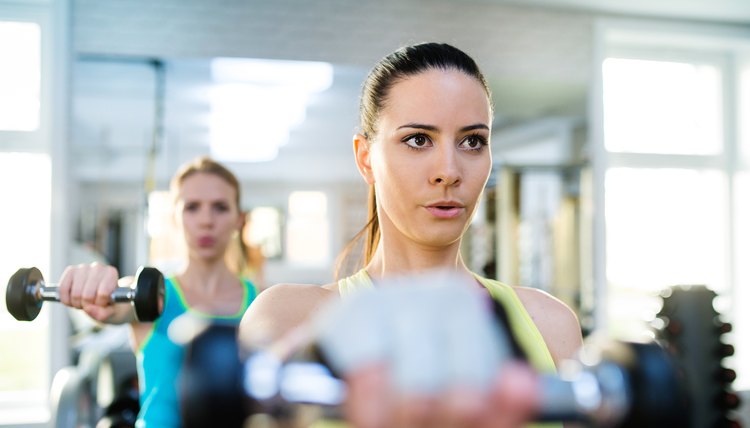
Anyone who lifts weights knows there’s a peak point during a range of motion, such as rising from the bottom of a squat while holding weights, says Montenegro. Muscles exert maximum capacity when you block respiration, she says. But she also warns that you need to know how to contract muscles in order to brace the load during heavy lifting and maintain stability for posture. When you maintain good posture, you utilize more core muscles in your favor.
“Every time you control those muscles, you have a more structured support in your core and you’re going to perform better in whatever you do.” When you hold your breath during a heavy lift, that’s what’s known as the Valsalva maneuver, which inevitably creates a pressure response. This practice can increase blood pressure, which can reduce oxygen flow and even cause fainting, so it should be used with caution by someone who's already very familiar with all the other aspects of weightlifting. “Every repetition takes practice. It’s very easy to stop breathing,” she says.
Montenegro says there are ways to practice this style breathing to get the most out of your weighted squat -- or other heavy lifting. “One of the best exercises to hold your breath and strengthen your core muscles is when you are in a plank position,” Montenegro says. “Suck your tummy in and hold your breath for as long as you can [safely]. Then let your stomach out without rounding your back -- your back should be flat. The movement should just be abdominal area. Inhale. Suck your tummy in. Control your breath. Exhale.” She suggests doing 15 to 20 inhale-exhales, and then repeating for 15 to 20 repetitions.
3. Breathing Incorrectly Tanks Your Endurance

Adobe Stock/bernardbodo
Controlling your breathing while running -- whether on a treadmill, in a pick-up basketball game or on the pavement -- is often a challenge even for seasoned athletes, especially as you increase speed and incline. But proper breathing can help you get around the track. “The more you can go with the flow, the better,” Montenegro says. Let your lungs be the boss. If you need to breathe deep, heavy breaths, let it happen. A natural breathing pattern is best in this scenario.
High-intensity workouts such as football, basketball, fast-paced cycling or running -- in addition to being awesome workouts -- can also help to decrease respiratory muscle fatigue by strengthening the intrathoracic pressure (where your chest and lungs are). When doing plyometric exercises -- think jump squats or lunges -- Montenegro says to hold your breath when making contact with the ground to help with the rebound, thus reducing chance of injury.
4. Bad Breathing Lessens Your Flexibility
Adobe Stock/bernardbodo
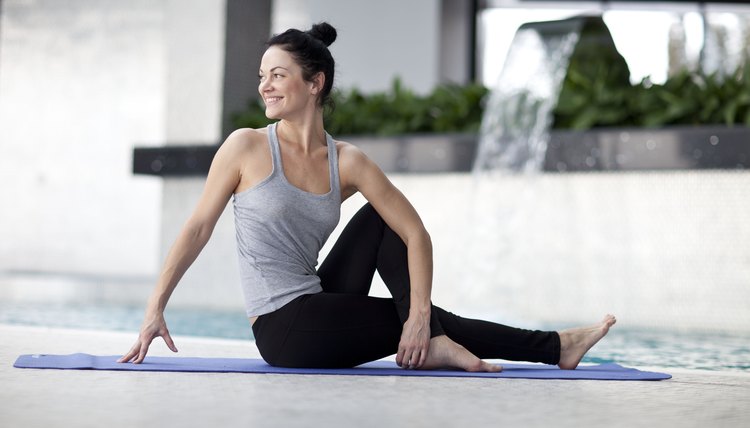
Similarly to yoga, stretching involves full-body movements that align with breathing techniques, too. “The inhale is expansive. When you lift arms overhead, it doesn’t make sense to exhale,” Marcum says. Marcum says to follow the concept of “root to rise.” “If you are not rooted, you are not going to rise,” she says. “Rooting is the exhale and rise is the inhale. You can feel that energy.”
Montenegro also says it’s very important to take deep, long breaths when stretching to avoid pulling anything. When you hold your breath, you are tightening the muscles and you could stretch something too hard.
Better Breathing, Better Workouts

Adobe Stock/bernardbodo
Whether your goal is to become faster, stronger or more flexible, there’s likely a proper way to breathe. “As you become better in whatever you are doing, proper breathing pattern can help you maximize what you are trying to improve,” Montenegro says. “If you are trying to improve strength when you are lifting weights, it will help you to lift heavier. If you keep rhythm in endurance every time better, that’s going to help with an endurance workout.”
Marcum says a final payoff to proper breathing other than physical benefits is a sense of serenity. “This deep-seated sense of contentment -- it lives within breath and within the moment. That’s what breath can remind us -- we only have this moment and we want to find sense of contentment with ourselves.” It may not have a direct correlation to six-pack abs or leaner legs, but a sense of calm is very beneficial to your overall wellbeing.
Writer Bio
Whitney D. Smith has a bachelor of science in journalism from the University of Florida and is currently a master's candidate of mass communication at UF, where she specializes in science and health communication. She has been writing health and fitness articles for more than six years and has been published in Women's Health Magazine Online, University of Florida publications, and New York Times Regional Media Group newspapers and magazines in Florida.