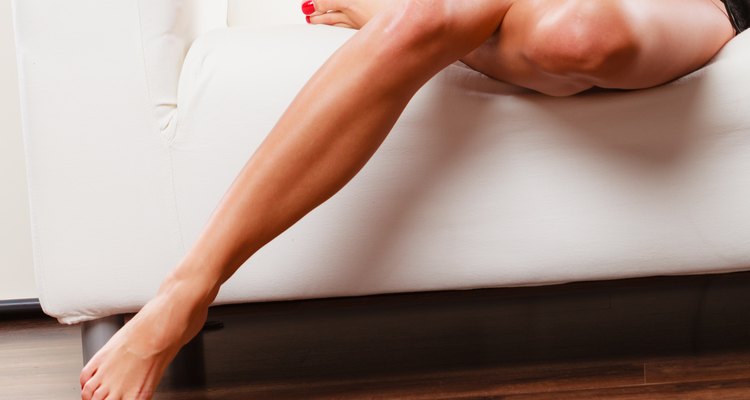
Anetlanda/iStock/Getty Images
Cellulite is the medical name for the fat with a dimpled appearance that is usually most prominent on the thighs, buttocks and upper arms. The fat collects in pockets just below the surface of the skin, giving it a bumpy appearance that can also be uneven to the touch. Though cellulite can occur in both men and women, it is most common in women. Acupuncture may provide a more holistic treatment alternative to surgery or additional help to those who have already tried diet and exercise. Although acupuncture has been gaining popularity for the treatment of cellulite, more research is needed to prove its efficacy.
Cellulite
Cellulite is considered a cosmetic condition rather than a serious medical problem. More than 85 percent of women, including thin women, have cellulite at some point in their life, though it is most common after 35 years of age. Adolescent girls and young women have been reported to have cellulite, as well. The reason cellulite affects almost everyone is because all people have layers of fat just below the skin's surface. Cellulite can be caused by weight gain or simply by the stretching of collagen fibers. These fibers, which connect fat to the skin, lose their elasticity. This causes the connective tissue to stretch in some areas and tighten in others, causing the fat cells to bulge out. It is this uneven distribution of fat under this skin that gives the outer layer a puckered or dimpled appearance.
Many topical creams and ointments on the market claim to help to fix cellulite, but these products only address the top layers of skin, not the underlying problem. Unfortunately, some people are more genetically predisposed to cellulite than others, regardless of diet and lifestyle, which is why even liposuction is not always successful. While for many cellulite cannot be prevented, there are several ways to reduce its appearance, which include eating a healthy and balanced diet, drinking plenty of water, regular exercise, maintaining a healthy and consistent weight, drinking alcohol in moderation and not smoking.
Acupuncture
Acupuncture, the insertion of needles into the body, has existed for more than 2,000 years. Though acupuncture has been popular in Asia and Europe for centuries, it has grown in popularity only recently in the United States. Due to this increased public interest, additional studies have been conducted to examine the validity of the claims of success by practitioners and their patients. According to a 2007 National Health Interview Survey, 3.1 million U.S. adults and 150,000 children had acupuncture in 1996.
Many types of acupuncture are used in the effort to treat cellulite, including traditional acupuncture and acupuncture with electronic stimulation. Electronic stimulation, often used in conjunction with acupuncture, was introduced in China in 1934. It was created to provide a substitute for hand manipulation normally performed by the acupuncturist by providing a stronger and more steady stimulation.
Treatment
Acupuncture treatments for cellulite are performed by inserting needles along specific meridians, which may vary based on the size, age and genetics of the patient. Individual needs will also determine whether the use of electronic stimulation is needed. In a traditional acupuncture treatment, needles may be inserted directly on the areas with cellulite or in areas distal, or further from the center of the body. Both methods are considered appropriate in the treatment of cellulite. If the practitioner determines that electronic stimulation is needed, small electrodes which send small micro-currents to the surrounding area will be attached to the needles. The average acupuncture treatment lasts between 20 and 40 minutes, depending on need.
An acupuncture treatment for cellulite will aim to improve blood circulation, reduce stress, and drain and detoxify the body by improving the metabolic functions of the cells in the body. Acupuncture will attempt to target the cellulite at its source, by nourishing connective skin tissues inside and out, according to the Cellulite Talk website.
Safety
Acupuncture treatments are considered safe with few risks when administered by a qualified practitioner. The proper use of acupuncture needles is regulated by the government, which states that practitioners must use sterile and single-use only needles. The U.S. Food and Drug Administration recognizes acupuncture needles as a Class II medical device. Acupuncture is never to be self-administered, as improper use can result in injury and infection.
Considerations
Ask your doctor if acupuncture is the right treatment option for you. Be sure to find a licensed acupuncturist or ask your general practitioner to suggest one for you. Your acupuncturist should be able to tell you how many sessions you'll need and whether your treatments are covered by your insurance. Remember, while acupuncture may be effective treatment for cellulite, it is not a substitute for the medical care provided by a physician.
Related Articles
L-Carnitine for Cellulite

Does Tanning Help Cellulite?

Does Tea Cause Cellulite?

Aesthetic Laser Requirements in Ohio
Photofacial Vs. Microdermabrasion

Mesotherapy & Weight Loss Results

The Average Prices for Laser Skin ...
Home Remedies to Permanently Remove ...

Qualifications to Enter a State-Run ...
Types of Piercing Needles
Fraxel Laser Treatment Dangers
Side Effects of Certain Dri

How to Write a Proposal for an ...

How to Write a Grant Proposal for a ...

Fraxel Repair Vs. Restore Results
Galvanic Cellulite Treatment
How to Get Rid of Aftershave Allergies

How to Find a Daycare's EIN

Preparation H & Cellulite

Epsom Salt for Bruises
References
Resources
Writer Bio
Gianina G. Knoth is a licensed acupuncture physician and has been writing professionally since 1995. Her work has been featured in national television and print campaigns, including the "The New York Post" and "Sun-Sentinel." She holds a Bachelor of Fine Arts from the School of Visual Arts and a Bachelor of Science and a Master of Oriental Medicine from the Atlantic Institute of Oriental Medicine.
Photo Credits
Anetlanda/iStock/Getty Images