Crunchy-yet-nutty quinoa hails from South America and has been quickly making a cameo on Americans' plates, and rightfully so. It is a wheat-free and gluten-free option that's chock-full of protein and many other body-benefitting nutrients.
Often thought to be a grain, quinoa is technically the seed of a plant. But it's also often referred to as a pseudo-cereal, which basically means that it looks and cooks like a grain.
Video of the Day
Video of the Day
There are three main types of quinoa: red, black and white. Of these, white quinoa, or regular quinoa, is the most familiar. All three are similar in nutritional content — all are high in protein and fiber — although red and black quinoa take slightly longer to cook. All different kinds of quinoa have that same nutty flavor when cooked, so choosing the variety of quinoa often depends on personal preference and availability.
Whatever quinoa varieties you choose, know that incorporating more into your diet is a smart way to get a boost of nutrients that pack in some impressive health benefits.
Quinoa Nutrition Facts
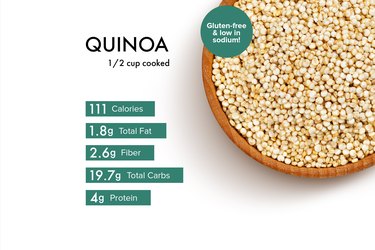
A half-cup of cooked quinoa is equal to a single serving. A half-cup of cooked quinoa contains:
- Calories: 111
- Total fat: 1.8 g
- Cholesterol: 0 mg
- Sodium: 6.5 mg
- Total carbs: 19.7 g
- Dietary fiber: 2.6 g
- Sugar: 0.8 g
- Added sugar: 0 g
- Protein: 4 g
Quinoa Macros
- Total fat: A half-cup of cooked quinoa has 1.8 grams of total fat, which includes 1.5 milligrams of unsaturated fat, 0.2 grams of saturated fat and 0 grams of trans fat.
- Carbohydrates: A half-cup of cooked quinoa has 19.7 grams of carbs, which includes 2.6 grams of fiber and 0.8 grams of natural sugars.
- Protein: A half-cup of cooked quinoa has 4 grams of protein.
Vitamins, Minerals and Other Micronutrients
- Manganese: 25.5% of your Daily Value (DV)
- Copper: 19.5% DV
- Magnesium: 14% DV
- Phosphorous: 11% DV
- Folate: 9.5% DV
- Zinc: 9% DV
- Iron: 7.5% DV
Is Quinoa Better for You Than Rice and Other Grains?
Quinoa packs in plenty of healthy nutrients like fiber and protein that keep you satiated. See how quinoa stacks up against other popular gluten-free grains. Note that all nutritionals denoted are per half-cup cooked.
Quinoa vs. Other Gluten-Free Grains
Calories | 111 | 102 | 109 | 83 | 125.5 |
Total Fat | 1.8 g | 0.2 g | 0.8 g | 1.8 g | 2 g |
Carbohydrates | 19.7 g | 22 g | 22.9 g | 14 g | 23 g |
Dietary Fiber | 2.6 g | 0.3 g | 1.75 g | 2 g | 2.6 g |
Protein | 4 g | 2.1 g | 2.2 g | 3 g | 4.6 g |
Health Benefits of Quinoa
Quinoa's known to be low-allergenic and has an excellent nutrient profile, not only because of its high plant-based protein content but also because it contains a wide variety of vitamins and minerals.
1. Eating Quinoa Is Linked to Good Heart Health
Quinoa is chock-full of lignans, which are compounds found in high-fiber foods that act as antioxidants and modulate hormone receptors. Eating foods rich in lignans is associated with a lower risk of developing heart disease, according to a March 2019 study in Molecules.
What's more, eating more dietary fiber boasts heart-protective benefits. An August 2015 meta-analysis in Clinical Nutrition found that those who eat more fiber were observed to have a lower risk of developing heart disease and hypertension (aka high blood pressure).
Quinoa is also an excellent source of magnesium, which is vital for heart health and maintaining a healthy blood pressure, according to the National Institutes of Health. The recommended daily allowance (RDA) for magnesium is 350 milligrams per day for adult men and 300 milligrams per day for adult women — yet a one-cup serving of cooked quinoa gets you more than one-third of the way there with 118 milligrams of magnesium.
2. Quinoa Can Help Keep You Regular
Clocking in at more than 5 grams per one-cup serving, quinoa is packed with dietary fiber — and getting enough of this nutrient is vital for a range of conditions, including healthy digestion, according to the Academy of Nutrition and Dietetics.
A diet rich in fiber helps reduce inflammation by promoting movement through your digestive system, adding bulk to your stool, lowering cholesterol levels and helping maintain a healthy gut microbiome. Research published in the June 2018 issue of BMJ found that overall dietary fiber influences the composition of your gut microbiome and is tied to better health. And, research points to a link between eating more fiber and fewer indications of systemic inflammation, according to a January 2013 study in Advances in Nutrition.
Adult men need 38 grams of fiber per day and adult women require 25 grams per day. However, only 5 percent of adults in the U.S. are actually getting the recommended amount, a January 2017 article published in the American Journal of Lifestyle Medicine found. In other words, the more fiber, the better! Adding quinoa to your diet will help get you to your daily fiber requirement in a simple, delicious way.
3. Quinoa Is Tied to Weight Loss
Quinoa's dietary fiber and protein combination is a great way to help you reach your weight-loss goals and maintain a healthy weight.
Simply increasing your daily fiber intake to 30 grams per day was found to be a more effective approach to weight loss than following a complicated diet regimen, a study published in the February 2015 Annals of Internal Medicine concluded. What's more, the above-mentioned Advances in Nutrition study also found a link between high-fiber intake and lower body weight.
Need another reason to spoon into some quinoa? A study of over 3,200 people found that a high-complex-carbohydrate, high-fiber, low-fat diet best supported overall weight loss, according to a September 2017 research published in the Journal of Nutrition. And quinoa exactly fits that bill, being high in carbs and fiber and low in fat.
4. Quinoa Can Help Preserve and Build Lean Muscle
Quinoa is high in protein and its diverse nutrient properties and gluten-free profile make it a stand-out food that fits most dietary patterns.
ICYMI: Protein is composed of amino acids, often referred to as the building blocks of protein. Our bodies require 20 different amino acids to function, with only nine of these being classified as essential amino acids, according to Harvard Health Publishing. These essential amino acids are "essential" because our bodies can't produce them on their own and they must be obtained via the foods we eat. While animal-based foods (like meat, eggs and dairy) contain all the essential amino acids, not all plant-based proteins do.
Here's why this matters: Quinoa is a good plant-based source of those nine essential amino acids. In fact, the amount of essential amino acids in quinoa is greater than many other grains, according to a July 2014 study in the Journal of Cereal Science. This is especially important for vegans and vegetarians who may have a more difficult time getting enough protein on a daily basis compared to omnivores.
So how much protein is in quinoa? Per cup cooked, you'll get 8 grams — the same as a cup of milk.
High-quality protein, such as that found in quinoa, helps to preserve and build lean muscle. And get this: Quinoa contains especially high amounts of lysine, an amino acid not often found in plant foods and actually highly concentrated in our muscles compared to most other amino acids, according to the National Library of Medicine. Lysine aids in muscle repair, so including it in your post-workout meal is a smart idea.
And besides protein, your muscles also need quality carbs to recover and grow, according to the Academy of Nutrition and Dietetics, and quinoa provides that one-two punch of both protein and healthy carbs.
Summary
Quinoa is a healthy source of fiber, a nutrient that's linked to good heart health, weight control and maintaining digestive regularity. Quinoa also contains plant-based protein, which can help preserve and build muscle while keeping you full for longer.
Quinoa Health Risks
Food Allergies
Quinoa is generally regarded as safe for most people to eat and is not known to be associated with any food allergies to date.
Saponins
Quinoa contains saponins, bitter-tasting plant compounds that work as anti-nutrients, reducing the absorption of certain nutrients in the body, according to Purdue University.
To thoroughly remove any saponins, place quinoa in a fine-meshed strainer and rinse with cold water prior to cooking. Gently rubbing the seeds with your fingers while washing can help further reduce the saponin content in your quinoa, too.
Drug Interactions
While quinoa is not known to interact with any medications, be sure to discuss any medication and food interactions with your medical professional.
How to Cook Quinoa
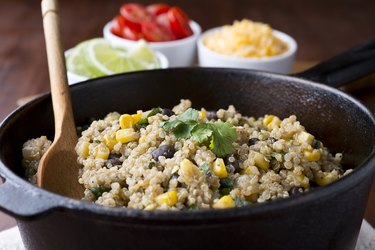
Cooked quinoa can be creamy and fluffy, have a slight al dente bite or served crunchy depending on the variety and way in which it is cooked. Try these tips for prepping your perfectly cooked side dish:
- Before prepping your quinoa, place it in a fine-meshed strainer and rinse with cold water.
- Next, add one part quinoa to 1.5 parts liquid to a pot. (For example, you'd cook one cup of dry quinoa in 1.5 cups of water.)
- Bring the mixture to a boil then reduce the heat to a simmer, cover and cook for about 15 minutes.
White quinoa looks translucent when it is cooked, while the other varieties retain their color, and the white germ partially detaches from the main body of the seed (it sort of looks like a white tail). Quinoa expands to several times its size when after it's cooked, so a half-cup of dry quinoa would at least double during cooking.
Both red and white quinoa cook quickly into fluffy grains. Most quinoa sold commercially is ready to cook as-is. Some less processed versions, however, require a quick rinse before cooking to eliminate a bitter taste.
Tip
Using vegetable, chicken or beef broth in place of water is a great way to add some flavor variation. And to get that nuttier flavor, sauté quinoa in a dry pot for three minutes before adding your liquid. Or, you can add a teaspoon of olive oil and sauté some onions and garlic before cooking the quinoa, adding vegetables and aromatics to the mix as you go.
Alternatives to Quinoa
If you're not a fan of the white quinoa and find it too bland or prefer a more al dente bite, try red or black quinoa. These darker varieties tend to hold up better to cooking and offer more texture.
If you're looking for other gluten-free grains, give brown rice, oats or amaranth a try. Amaranth and oats pack in a similar amount of protein as quinoa while providing 5.2 and 4 grams of fiber each, respectively.
If you're opting for oats on a gluten-free diet, make sure the package label notes that it's gluten-free, since some oat products can be exposed to gluten during the manufacturing process.
- My Food Data: "Quinoa"
- Molecules: "Naturally Lignan-Rich Foods: A Dietary Tool for Health Promotion"
- National Institutes of Health: "Magnesium"
- Academy of Nutrition and Dietetics: "Fiber"
- American Journal of Lifestyle Medicine: "Closing America’s Fiber Intake Gap"
- Harvard Health Publishing: "Getting your protein from plants"
- Purdue University: "Quinoa"
- Advances in Nutrition: "The Interplay Between Fiber and the Intestinal Microbiome in the Inflammatory Response"
- Clinical Nutrition: "Association between dietary fiber intake and risk of coronary heart disease: A meta-analysis"
- Journal of Cereal Science: "Amino acid profile of the quinoa (Chenopodium quinoa Willd.) using near infrared spectroscopy and chemometric techniques"
- Nutrients: "The Role of the Anabolic Properties of Plant- versus Animal-Based Protein Sources in Supporting Muscle Mass Maintenance: A Critical Review"
- The BMJ: "Role of the gut microbiota in nutrition and health"
- Annals of Internal Medicine: "Single-Component Versus Multicomponent Dietary Goals for the Metabolic Syndrome: A Randomized Trial"
- Journal of Nutrition: "A High-Carbohydrate, High-Fiber, Low-Fat Diet Results in Weight Loss among Adults at High Risk of Type 2 Diabetes"
- Academy of Nutrition and Dietetics: "4 Keys to Strength Building and Muscle Mass"