
How to Do Splits in a Week
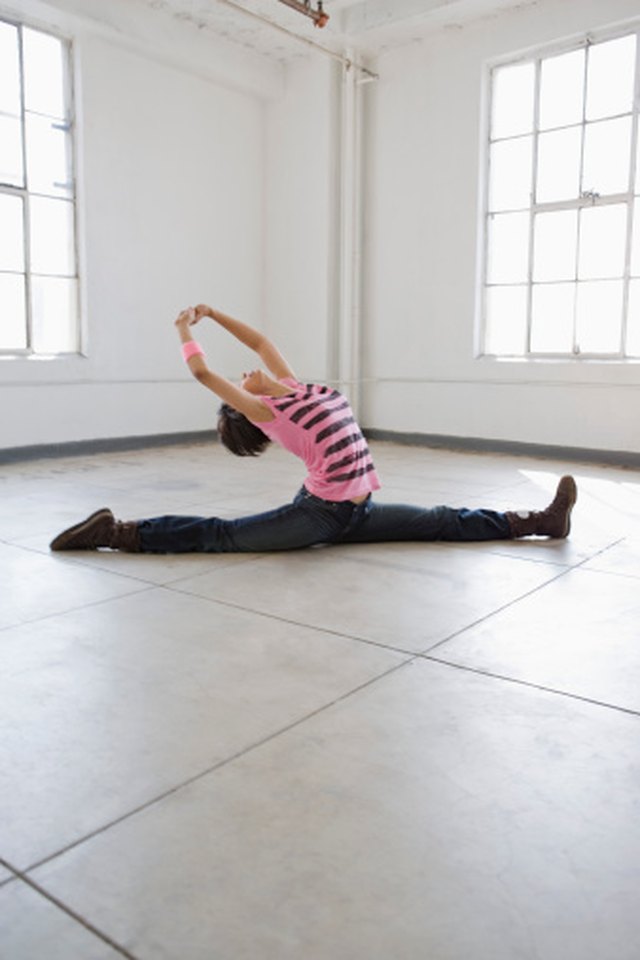
Learning how to do splits can be difficult and physically demanding, especially if you have a specific goal. Depending on your starting point, doing splits in a week can be achieved if you concentrate and have the time to dedicate to stretching on a daily basis. Although learning how to do splits can be challenging, there are benefits to the flexibility offered. Stretching has many positive benefits for your overall physical health and, paired with deep breathing, can work to calm anxieties.
Stretch out your legs for at least 15 minutes. You can do sitting and standing leg stretches such as butterfly, forward leg stretches and toe touches.
Kneel upright on the floor. Place your right foot in front of your left knee and lean forward, letting your fingertips touch the floor on both sides of your right foot.
Stretch your right leg out forward while your left leg begins to straighten out behind you. Keep your chin pointing toward your right foot and your right kneecap pointing up.
Hold this pose for one minute trying to sink your hips as close to the floor as possible.
Repeat this pose at least five times for the first two days, allowing your hips to get closer to the floor while straightening your legs.
Increase your practice splits to five times in the morning and five times in afternoon or evening for the next four days. Continue to do other leg stretches for 15 minutes prior to practicing your splits.
Continue to practice your splits daily. Practicing splits several times a day should help you achieve a full split within a week. If the progress is slow, add more stretches and splits to your routine.
Tips
This works best on a bare floor.
Keep your front foot's toes pointed upward.
Warnings
Do not stretch until you feel extreme pain. If you start to feel pain, you are going too far and could hurt your groin or hamstring.
Don't be discouraged if you can't do a full split in a week. It may take some people a little longer.
References
Tips
- This works best on a bare floor.
- Keep your front foot's toes pointed upward.
Warnings
- Do not stretch until you feel extreme pain. If you start to feel pain, you are going too far and could hurt your groin or hamstring.
- Don't be discouraged if you can't do a full split in a week. It may take some people a little longer.
Writer Bio
Ireland Wolfe has been writing professionally since 2009, contributing to Toonari Post, Africana Online and Winzer Insurance. She obtained her Bachelor of Arts in psychology and Master of Arts in mental health counseling. She is also a licensed mental health counselor, registered nutritionist and yoga teacher.