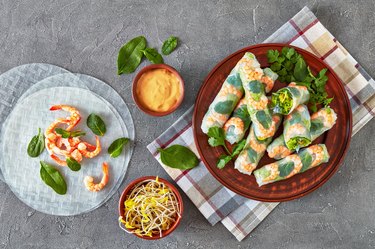
Rice paper, also known as rice wrappers or as Banh Trang, is a type of thin, paper-like circular sheet. It is made from a simple recipe of salt, water and rice. Rice paper's calorie count is quite low.
All it takes is a dip in some lukewarm water, and rice paper transforms into a translucent, flavorless skin that's only slightly chewy. You can then use it to wrap different foods in, most notably when making Thai spring rolls. A Sweet Peach Chef recommends dipping the rice paper in warm water for only three to four seconds.
Video of the Day
Video of the Day
While the description of this food may not be so appetizing, it is quite accurate. Rice paper is about as bland as food can get. It is never the main attraction of any food, more the edible vessel that wraps it up in a pretty package for delivery into our mouths.
Nutritionists seem to agree: Rachel Fine of The Pointe Nutrition maintains that rice paper is a poor source of important nutrients, such as dietary fiber, even though it's not such a significant source of carbohydrates. Kendra Payne, a clinical nutritionist at St. Joseph Hospital, Lake St. Louis, maintains that rice-based products don't work well with a keto diet, unless severely limited.
Ariane Resnick, a certified nutritionist, points out that each sheet of rice paper contains between 6 grams and 10 grams of carbohydrates. This can vary, depending on the specific brand of rice paper used.
Rice Paper and Weight Loss
How much of an impact rice paper has on your weight loss journey depends on how you use the rice paper. Strictly speaking, rice paper isn't your typical health food. It contains nothing but starch and a very small amount of protein. It doesn't have fiber or other important nutrients.
Despite all that, it's highly unlikely that you'll find anyone sitting with a box of rice paper and eating it as a snack. With that in mind, rice paper calories aren't really something to worry about. Rice paper can be compared to a tortilla. It's a vessel in which you put something else.
So if the rice paper wraps up lots of vegetables for you to eat, then it's perfect for your weight loss journey, rice paper carbs notwithstanding. If, on the other hand, the rice paper wraps up fatty meats, fried foods, and lots of sugary sauce, then it's only exacerbating the problem, not solving it.
According to the USDA Food Composition Databases, three pieces of rice paper contain 90 calories, 22 grams of carbohydrates, 10 milligrams of calcium, 0.54 milligrams of iron and 143 milligrams of sodium.
Rice Paper and Keto Diet
Whether or not rice paper can be included in a keto diet depends on your definition of keto. Since there aren't too many rice paper carbs, it can be a great option, especially when it's stuffed with vegetables and other low-carb foods.
That said, it is recommended to be careful about consuming rice paper as part of a keto diet. The original keto diet consists of high fat content and a moderate amount of protein. It can be very restrictive on what one should eat. Your body needs a variety of nutrients to function properly, so the restrictiveness of a keto diet may be detrimental to your well-being.
Even if you're trying to lose weight, make sure you eat a balanced diet while you're at it, and get all the necessary nutrients your body needs. Rice paper can help you get that balanced diet, by wrapping up delicious, healthy foods for you to consume in a fun and engaging way.