










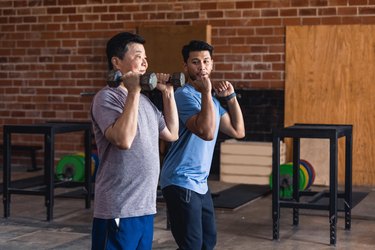













































Kettlebells are phenomenal training tools. Their versatility and portability make them ideal for home gyms and training while on the go. Numerous strength and conditioning exercises can be performed with traditional kettlebells, and supplementing those exercises with a towel increases the demand for grip strength and core stability. Most kettlebell exercises have towel variations that can easily be substituted in and out of your workout program. Always consult a physician before taking part in any exercise plan.
Basic Exercises
Pavel Tsatsouline, a kettlebell expert and former Soviet Special Forces instructor, outlines the swing, clean, snatch and overhead press as key movement patterns to learn and develop. Towel training can be dangerous and is not advised for novice lifters. Become confident with basic kettlebell movement patterns before adding the additional challenge of towel training.
Wrapping
Wrapping a towel around the handle of a kettlebell increases its diameter and places added emphasis on the muscles of the fingers, hand and wrist. Jim Smith, CSCS, CFT, USAW, and Jedd Johnson, CSCS, make it clear that thicker the towel used, or the more wraps placed around the handle, the harder the kettlebell will be to hold and control.
Looping
Looping is similar to threading a needle: Pass one end of the towel through the handle of the kettlebell and grasp both ends with one hand. Looping changes the orientation of the hand during movement and places emphasis on the muscles of the hand and wrist. Smith and Johnson say the age and length of the towel will determine the final size and thickness of the gripping surface: older, thinner towels will produce a smaller-diameter gripping surface; newer, thicker towels will produce a larger one; and smaller towels create a small gripping surface ideal for training individual fingers.
Draping
Unlike wrapping and looping, which increase the diameter of the handle, draping reduces friction, making it harder for your fingers to maintain a solid grip on the kettlebell. This places tremendous emphasis on the muscles of the fingers, hand, wrist and forearm. Smith and Johnson advise staying clear of mirrors and other easily damaged equipment while performing any movement with a draped towel.
Modified Towel Training
If a towel is unavailable, any cloth of adequate size can be utilized. Duct tape can also make a great, albeit more permanent, alternative to towels. Taping the handle in duct tape not only increases its diameter, but it also makes dynamic support of the kettlebell during movement critical. When looping, less experienced lifters can thread the towel through the kettlebell and grab one end in each hand, spreading the load across multiple limbs.
References
- Diesel Crew: 3 Ways to Use Towels for a Monster Grip
- Dragon Door: Advanced Kettlebell Techniques: Part 1
- "The Russian Kettlebell Challenge"; Pavel Tsatsouline; 2001
- "Anatomy Of Movement"; Blandine Calais-Germain; 1993


Member Comments