
Light Weight Training Exercises
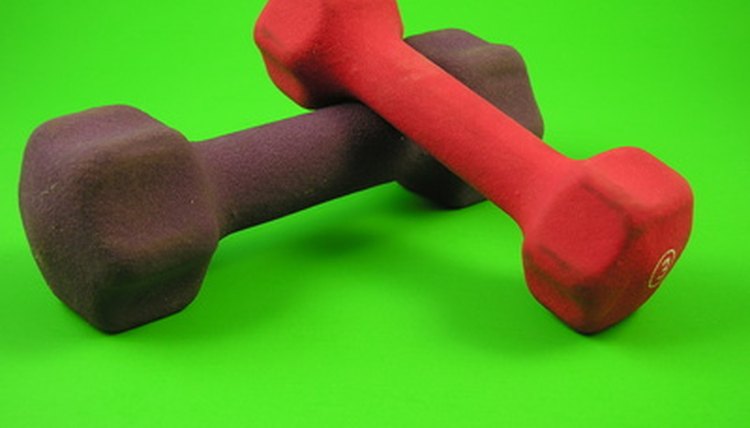
Not everyone who lifts weights does so in order to get huge muscles. Some people are just looking for an alternative or a complementary exercise to cardiovascular workouts. That’s where light weight training comes in. Using lighter weights can help you burn calories while not bulking up with muscle. There are some simple exercises you can do to have a great light weight training routine.
Bicep Curls
One of the most basic light weight training exercises is the bicep curl. Select a light weight that won’t require much effort, and sit on a weight bench with your elbow resting on your knee or upper leg. Extend your arm towards the floor with your palm face up and wrapped around the dumbbell weight. Curl your arm up until it touches your shoulder, then bring it back down to the starting position. Do 10 to 15 repetitions, then switch the dumbbell to the other hand for another set.
Chest Press
The chest press can be a great way to work the muscles in your chest and arms at the same time. Lie on your back on a weight bench with a rack. You may just want to use a barbell without any weights since you’re shooting for light weight. A barbell by itself can weigh up to 10 or 15 lbs. Extend your arms, grasp the barbell and lift it off the rack and forward a few inches. While concentrating on using your chest muscles, lower the barbell so that your elbows are bending toward the outside of your body. Lower the barbell to your chest, then slowly raise it back up until your arms are fully extended. Repeat 10 to 15 times, then re-rack the barbell. You may want to do this exercise with a friend who can spot you in case you’re not able to perform a full set before muscle fatigue sets in.
Squats
Squats using light weights are a great way to work the leg muscles without bulking them up. Grab a light dumbbell and hold it in both hands in front of you with your arms extended. Stand with your legs more than shoulder-width apart and bend your knees. Keep your back straight and squat to the ground until your legs are parallel to the ground. Hold at the bottom of your squat for five seconds, then use your leg muscles to stand up straight again. Repeat 10 to 15 times.
References
Writer Bio
James Patterson specializes in health and wellness topics, having written and produced material for the National Institutes of Health, the President's Cancer Panel and an Inc. 500 Hall of Fame company. He is also a former sportswriter with writing experience in basketball, baseball, softball, golf and other popular sports.