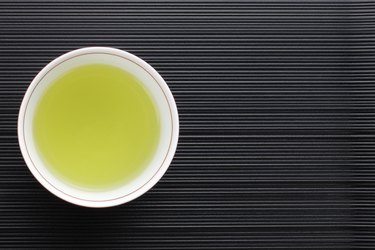
Many people swear by sipping a cup of decaffeinated green tea to soothe headaches and shed pounds. And as it turns out, there's science to back up these decaf green tea benefits.
Green tea comes from a plant called Camellia sinensis, and is brewed by steaming, frying and drying the plant's leaves, per the National Center for Complementary and Integrative Health (NCCIH).
Video of the Day
Video of the Day
You're probably familiar with drinking green tea as a beverage or taking it as a supplement. But the tea dates back thousands of years in China and Japan, where it was often used for medicinal purposes, according to the NCCIH.
And you can still harness some of those healing properties today. To help, here are the health perks of the brew (and whether decaffeinated green tea is good for you).
How Much Green Tea Should You Drink?
Though decaf green tea is healthy, you should stick to the recommended daily upper limit of 400 milligrams of caffeine, according to the Cleveland Clinic.
Luckily, this limit will be hard to reach if you're drinking decaf tea, which averages about 2 milligrams a cup, per the Harvard T.H. Chan School of Public Health. In other words, you can drink about 200 cups of decaf green tea per day.
1. It Has Antioxidant Properties
Green tea is packed with polyphenols, which are naturally occurring compounds found in plants, according to the Harvard T.H. Chan School of Public Health. Decaf tea can contain less of these beneficial compounds due to the processing it undergoes to remove caffeine, however.
Nonetheless, the polyphenols in tea have an antioxidant effect, meaning they can help prevent cell damage, fight inflammation and support your immune function, per Tufts University.
Does Decaf Green Tea Have the Same Benefits as Regular Green Tea?
Well, it depends — decaf green tea may or may not have the same health benefits as its more caffeinated counterpart, depending on how it's processed.
Chemical oxidation of tea can strip leaves of some health-supporting nutrients in addition to caffeine, whereas steaming, drying or frying techniques preserve the beneficial antioxidant content, per the University of Florida Diabetes Institute.
2. It May Support Weight Loss
The antioxidants in this brew may also help you shed pounds — indeed, decaf green tea is good for weight loss.
A December 2018 study in the European Journal of Nutrition found that decaffeinated green tea polyphenols prevented weight gain in mice with obesity, suggesting that decaf green tea may play a role in maintaining weight.
However, more research is needed in humans to better understand the link between decaffeinated green tea and weight loss.
That said, there is some science to suggest that decaffeinated green tea does still burn fat in humans.
For instance, March 2021 research in Nutrients studied 27 people with overweight and found that taking a daily dose of decaf green tea extract improved fat breakdown compared to a placebo. In simpler terms, the tea speeds up fat metabolism.
And a January 2015 study of 14 people in the Journal of the International Society of Sports Nutrition found that those who were given a decaffeinated green tea supplement over a month-long period had a decrease in body fat compared to the placebo group.
However, this decrease was slight — only about 1.6 percent (for instance, a person with 20 percent body fat would decrease their body fat to 19.68 percent).
And these studies didn't include many people, so larger-scale research is needed to better establish these correlations and understand how green tea boosts your fat metabolism.
Does Drinking Green Tea at Night Support Weight Loss?
Drinking water before bed (and staying hydrated in general) supports weight loss, per Johns Hopkins University, and unsweetened tea is a good alternative to plain water.
That said, drinking water or tea before bed won't magically help you shed pounds — rather, hydration is one component of a well-rounded weight-loss plan that includes a nutritious diet and regular exercise.
You'll also need to mind the caffeine in tea, as even small amounts can get in the way of solid shut-eye for some people, according to UC Davis Health.
3. It May Help Protect Against Certain Diseases
The antioxidant-related decaffeinated green tea benefits don't stop there — the polyphenols may also help lower your risk for certain diseases.
For instance, drinking tea regularly has been linked to lower rates of conditions like cancer and heart disease, according to an October 2016 review in the British Journal of Pharmacology.
Antioxidants in decaffeinated tea (and otherwise) can also battle oxidative stress, which can contribute to the development of conditions like kidney disease, heart disease and age-related issues like cognitive impairment, dementia and frailty, per an April 2018 review in Clinical Interventions in Aging.
4. It's Better for People With Caffeine Sensitivity
For those that are very sensitive to caffeine, it might be best to skip green tea (and other caffeinated beverages like coffee) altogether. But if you're moderately sensitive to caffeine, drinking decaf may work better with your system than a fully caffeinated brew.
First and foremost, you won't necessarily experience caffeine-related side effects. According to the Cleveland Clinic, these can include:
- Nausea or upset stomach
- Headaches
- Insomnia
- Jitters
- Rapid heart rate
- Anxiety
You'll also avoid the risk of a caffeine overdose, which can sometimes cause dangerous heart rhythm problems (though this is typically only the case with extreme doses of caffeine, like those in energy drinks or shots), per the Cleveland Clinic.
Tip
"Decaf" doesn’t necessarily mean a beverage is completely free of caffeine, per the U.S. Food and Drug Administration. For example, an 8-ounce cup of decaf coffee could contain up to 15 milligrams of caffeine.
5. It May Ease Headaches
Even the small amount of caffeine in decaf green tea benefits your noggin: According to UC Davis Health, it may help ease headaches.
That's because caffeine can help decrease inflammation and narrow your blood vessels, all of which may lessen head pain, per the Harvard T.H. Chan School of Public Health.
6. It May Improve Your Memory
Another decaf green tea benefit is that it may enhance your memory.
Indeed, a small March 2018 study in the Journal of Nutrition, Health and Aging found that decaffeinated green tea extract improved the working memory capacity of 20 people assigned female at birth between the ages of 50 and 63.
However, more and larger-scale studies are needed to better establish whether decaf green tea is good for your memory.
Decaffeinated Green Tea Side Effects
While many studies indicate that decaf green tea is good for you, some other research has raised safety concerns beyond caffeine sensitivity. Per the NCCIH, here are some potential side effects:
- In rare cases, you may experience liver problems, typically from taking green tea extract.
- High doses of green tea may interact poorly with certain high blood pressure and heart medications, like beta-blockers.
So while decaffeinated green tea is not bad for you, it's helpful to be aware of these safety considerations before you start sipping.
- National Center for Complementary and Integrative Health: "Green Tea"
- Journal of the International Society of Sports Nutrition: "The Effect of a Decaffeinated Green Tea Extract Formula on Fat Oxidation, Body Composition And Exercise Performance"
- Journal of Nutrition, Health and Aging: "The Effects of Green Tea Extract on Working Memory in Healthy Women"
- FDA: "Spilling the Beans: How Much Caffeine is Too Much?"
- Cleveland Clinic: "Caffeine: How to Hack It and How to Quit It"
- Cleveland Clinic: "Can You Really Have Too Much Caffeine?"
- UC Davis Health: "Does decaf coffee actually have caffeine? UC Davis Health specialist explains"
- Harvard T.H. Chan School of Public Health: "Caffeine"
- Tufts University: "Does Decaffeinated Black Tea Have the Same Benefits?"
- British Journal of Pharmacology: "Antioxidants from black and green tea: from dietary modulation of oxidative stress to pharmacological mechanisms"
- Clinical Interventions in Aging: "Oxidative stress, aging, and diseases"
- University of Florida Diabetes Institute: "At a Glance: Potential role of green tea in diabetes management"
- European Journal of Nutrition: "Decaffeinated green and black tea polyphenols decrease weight gain and alter microbiome populations and function in diet-induced obese mice"
- Nutrients: "The Impact of Decaffeinated Green Tea Extract on Fat Oxidation, Body Composition and Cardio-Metabolic Health in Overweight, Recreationally Active Individuals"
- Johns Hopkins University: "Yes, drinking more water may help you lose weight"