What does fact checked mean?
At Healthfully, we strive to deliver objective content that is accurate and up-to-date. Our team periodically reviews articles in order to ensure content quality. The sources cited below consist of evidence from peer-reviewed journals, prominent medical organizations, academic associations, and government data.
- International Journal of Obesity: The Effects of Green Tea on Weight Loss and Weight Maintenance: A Meta-Analysis
- International Journal of Obesity: The Effects of Green Tea on Weight Loss and Weight Maintenance: A Meta-Analysis
- Scientific Reports: Green Tea Extract Decreases Starch Digestion and Absorption From a Test Meal in Humans: A Randomized, Placebo-Controlled Crossover Study
- Scientific Reports: Green Tea Extract Decreases Starch Digestion and Absorption From a Test Meal in Humans: A Randomized, Placebo-Controlled Crossover Study
The information contained on this site is for informational purposes only, and should not be used as a substitute for the advice of a professional health care provider. Please check with the appropriate physician regarding health questions and concerns. Although we strive to deliver accurate and up-to-date information, no guarantee to that effect is made.
Can Green Tea Be Used in a Low-Carb Diet?
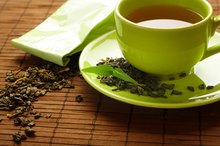
Some like it hot, some like it iced, but no matter which you prefer, green tea works well in a low-carb diet. Plain green tea is virtually carb-free -- and it's also free of calories to help with weight loss. However, not everything labeled "green tea" is low-carb. If you're drinking sweetened green tea or specialty green tea drinks, you're likely getting more carbs and calories than you planned on.
Green Tea: Naturally Low in Carbs
If you're following a restrictive low-carb diet -- one that might limit your carb intake to 20 grams of digestible carbs each day -- you have no wiggle room to drink carb-containing beverages. Thankfully, plain green tea has zero calories and zero grams of carbohydrates, so it wont contribute to your daily carb intake.
That carb-free tea can turn discouragingly carb-laden if you start adding sugar or honey, though. Each sugar packet has about 3 grams of carbs, and if you're adding two or three packets to your tea -- or drinking a few cups of green tea throughout the day -- you'll take up most of your daily carb budget from green tea alone. Honey is even higher in carbs, with about 6 grams of carbs per teaspoon.
- If you're following a restrictive low-carb diet -- one that might limit your carb intake to 20 grams of digestible carbs each day -- you have no wiggle room to drink carb-containing beverages.
- Each sugar packet has about 3 grams of carbs, and if you're adding two or three packets to your tea -- or drinking a few cups of green tea throughout the day -- you'll take up most of your daily carb budget from green tea alone.
Benefits of Green Tea on a Low-Carb Diet
How Many Carbohydrates in a 6-Ounce Glass of Tea?
Learn More
On top of being naturally free of carbs, green tea can help you lose weight -- a common goal for people following a low-carb diet. While green tea won't magically make you shed pounds, people who drink green tea tend to lose slightly more weight and fare a bit better at keeping that weight off, according to a study published in the International Journal of Obesity 2.
Green tea might even affect how your body absorbs starch, which might offer specific benefits if you're going low-carb. One study, published in Scientific Reports in 2015, found that green tea extract both reduced starch digestion and absorption in the study subjects -- essentially making it so some of the carbs in a carb-heavy meal didn't "count." How well this works in practice for people eating low-carb is still not known, though, and it's not clear if just drinking green tea offers the same level of benefits 3.
- On top of being naturally free of carbs, green tea can help you lose weight -- a common goal for people following a low-carb diet.
- While green tea won't magically make you shed pounds, people who drink green tea tend to lose slightly more weight and fare a bit better at keeping that weight off, according to a study published in the International Journal of Obesity 2.
Beware of Packaged Green Tea Products
Not everything labeled "green tea" fits into a low-carb diet. Many packaged green tea beverages have added sweeteners used to counteract the tea's natural bitterness. One commercially available honey and ginseng green tea beverage has 19 grams of carbs per cup -- and a bottle may contain several servings.
Those green tea lattes come with a generous amount of carbs, too -- more than you can likely drink on a low-carb diet. A 16-ounce green tea latte from one cafe, for example, has 34 grams of carbs, which is more than your entire daily carb budget on some types of low-carb diets 1.
- Not everything labeled "green tea" fits into a low-carb diet.
- Those green tea lattes come with a generous amount of carbs, too -- more than you can likely drink on a low-carb diet.
Serving Green Tea for a Low-Carb Diet
Does Unsweetened Tea Elevate Blood Sugar?
Learn More
Following a low-carb diet doesn't mean you're stuck drinking plain green tea. You can also make delicious and low-carb foods and drinks that pack in plenty of green tea flavor. Try adding cinnamon, cardamom and star anise to your green tea as it brews -- these warming spices impart a "chai"-like flavor that offers a departure from regular green tea. Flavor iced green tea with a muddled raspberry or two for fruity flavor without lots of carbs. Add powdered green tea -- called matcha -- to a vanilla protein shake, or stir it into Greek yogurt or quark for a low-carb treat.
- Following a low-carb diet doesn't mean you're stuck drinking plain green tea.
- Add powdered green tea -- called matcha -- to a vanilla protein shake, or stir it into Greek yogurt or quark for a low-carb treat.
Related Articles

How Many Carbohydrates in a 6-Ounce Glass of Tea?
Learn More
Does Unsweetened Tea Elevate Blood Sugar?
Learn More
Can You Eat Crackers on a Low-Carb Diet?
Learn More

Is Pod Coffee as Healthy as Filtered Coffee?
Learn More

Is Crystal Light Bad for You?
Learn More

Does Liquor Have Carbs?
Learn More

Manuka Honey Side Effects
Learn More

The Best Weight-Loss Drink Mixes
Learn More

How Many Calories Does a Chai Tea Latte Have?
Learn More

The Carbohydrates in Glazed Doughnuts
Learn More
References
- Starbucks: Green Tea Latte
- International Journal of Obesity: The Effects of Green Tea on Weight Loss and Weight Maintenance: A Meta-Analysis
- Scientific Reports: Green Tea Extract Decreases Starch Digestion and Absorption From a Test Meal in Humans: A Randomized, Placebo-Controlled Crossover Study
- Chacko SM, Thambi PT, Kuttan R, Nishigaki I. Beneficial effects of green tea: a literature review. Chin Med. 2010;5:13.
- Chacko SM, Thambi PT, Kuttan R, Nishigaki I. Beneficial effects of green tea: a literature review. Chin Med. 2010;5:13. Published 2010 Apr 6. doi:10.1186/1749-8546-5-13
- Khan N, Mukhtar H. Tea and health: studies in humans. Curr Pharm Des. 2013;19(34):6141–6147. doi:10.2174/1381612811319340008
- Pervin M, Unno K, Ohishi T, Tanabe H, Miyoshi N, Nakamura Y. Beneficial Effects of Green Tea Catechins on Neurodegenerative Diseases. Molecules. 2018;23(6):1297. 2018. doi:10.3390/molecules23061297
- Prasanth MI, Sivamaruthi BS, Chaiyasut C, Tencomnao T. A Review of the Role of Green Tea (Camellia sinensis) in Antiphotoaging, Stress Resistance, Neuroprotection, and Autophagy. Nutrients. 2019;11(2):474. doi:10.3390/nu11020474
- Singhal K, Raj N, Gupta K, Singh S. Probable benefits of green tea with genetic implications. J Oral Maxillofac Pathol. 2017;21(1):107–114. doi:10.4103/0973-029X.203758
- Suzuki T, Pervin M, Goto S, Isemura M, Nakamura Y. Beneficial Effects of Tea and the Green Tea Catechin Epigallocatechin-3-gallate on Obesity. Molecules. 2016;21(10):1305. 2016. doi:10.3390/molecules21101305
- Unno K. et al., Anti-stress Effect of Green Tea with Lowered Caffeine on Humans: A Pilot Study. Biol Pharm Bull. 2017;40(6):902-909. doi: 10.1248/bpb.b17-00141.
- Xing L, Zhang H, Qi R, Tsao R, Mine Y. Recent Advances in the Understanding of the Health Benefits and Molecular Mechanisms Associated with Green Tea Polyphenols. J Agric Food Chem. 2019;67(4):1029-1043. doi:10.1021/acs.jafc.8b06146
Writer Bio
Sylvie Tremblay holds a Master of Science in molecular and cellular biology and has years of experience as a cancer researcher and neuroscientist. Based in Ontario, Canada, Tremblay is an experienced journalist and blogger specializing in nutrition, fitness, lifestyle, health and biotechnology, as well as real estate, agriculture and clean tech.