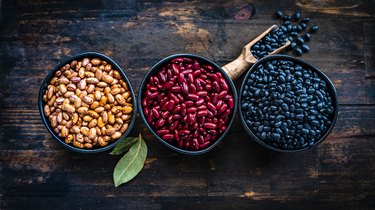
When planning the right diet to manage diabetes, whether beans raise blood sugar is a question that likely comes to mind. Most beans are high in carbs, but they're also a healthy food loaded with fiber and protein. Here's what to know about beans and which beans are good for diabetes.
Read more: The Best Beans for Protein
Video of the Day
Video of the Day
Beans and Diabetes Nutrition
According to the USDA, 1 cup of beans cooked from dry (think: pinto beans, black beans, navy beans, kidney beans or Great Northern beans, among others) contains:
- Calories: 256.
- Protein: 16 grams.
- Fat: 1.2 grams.
- Carbs: 47 grams.
- Fiber: 16 grams.
While beans are rich in carbs, there is a lot more to their nutrition profile. "They're full of fiber, which slows digestion," says Julie Cunningham, RD, CDE, a private practice dietitian and certified diabetes educator in Hendersonville, North Carolina. "Because of the high fiber content, the carbs in beans enter your bloodstream more slowly than low-fiber carbs would, and that's a plus."
Fiber is actually a type of carb, but because it isn't absorbed, it doesn't contribute to blood sugar and instead helps to slow down how quickly and sharply those other carbs in beans increase your levels, she says.
The protein in beans also helps to slow down how quickly your blood sugar rises, according to a January 2016 article in Diabetes, Obesity & Metabolism. So you get a double benefit.
Best Beans for Diabetes
According to the American Diabetes Association (ADA), these beans are excellent choices to include in your diet if you have diabetes:
- Kidney beans.
- Pinto beans.
- Navy beans.
- Black beans.
This is because they're rich in protein, fiber, and vitamins and minerals, and they're also low in fat, unlike many animal-based protein sources. Because their fiber and protein help slow down the beans' effect on your blood sugar levels, having about 1/2 cup of beans at a meal provides a rich source of plant-based protein that won't cause a rapid spike in your blood sugar levels.
It's easy and quite inexpensive to cook your own beans from scratch (after an overnight soak in water), but you can also use canned beans. If you go the canned route, the ADA recommends draining and rinsing them to reduce the salt content. (And look for low-sodium versions in your supermarket.)
For all their sweet goodness, there is one category of canned beans to beware of — baked beans. These are traditionally made with added ketchup, brown sugar and/or barbecue sauce, all of which are added sugars. Americans are consuming too much added sugar as it is, says the CDC.
While you should always try to choose beans and bean recipes that don't contain added sugars, if you do choose to eat baked beans on occasion, make sure to limit your portion size to avoid a drastic blood sugar spike. "Start with a small serving, such as half a cup," Cunningham recommends, "and test your blood sugar about two hours after eating to see how your body reacts."
Legumes Alternative: Black Soybeans
Black soybeans might be something you want to consider as a bean alternative. These legumes are in a different category than true beans, and the majority of their carbs come from fiber, which slows digestion and reduces glucose. According to the USDA, 1 cup of cooked soybeans contains 14 grams of carbs, with 10 of those grams from fiber, or 4 net carbs. That's a very high carb-to-fiber ratio compared to other legumes.
Black soybeans have garnered some interest in early animal research studies for their high fiber and rich seed coat. In a May 2017 Nutrients review, researchers note that black soybeans contain compounds that may promote weight loss and insulin resistance but that more human research is necessary to confirm any effects. And in regards to fiber content: while the average soybean contains 10 grams of fiber per cup, Nutrients notes that black soybeans contain 15 grams of fiber in every cup.
- Diabetes, Obesity & Metabolism: “Mixed Meal Ingestion Diminishes Glucose Excursion in Comparison With Glucose Ingestion via Several Adaptive Mechanisms in People With and Without Type 2 Diabetes”
- Julie Cunningham, MPH, RD, LDN, private practice dietitian, certified diabetes educator, Hendersonville, North Carolina
- USDA: “Beans Dry Cooked Ns As To Type Fat Not Added In Cooking”
- USDA: “Soybeans, Dry, Cooked, Fat Not Added in Cooking”
- American Diabetes Association: “Diabetes Superfoods”
- Nutrients: “A Critical Review on Polyphenols and Health Benefits of Black Soybeans”
- CDC: "Get the Facts: Added Sugars and Consumption"