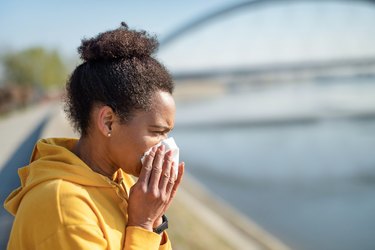
Does your nose start dripping like a leaky faucet whenever you work up a sweat? A runny nose, sneezing, congestion and nasal itchiness and irritation during physical activity can all point to exercise-induced rhinitis.
A runny nose during exercise may sound like NBD, but it can take a serious toll on your mood and wellbeing. A September 2018 study in the Journal of Laryngology and Otology found that exercise-induced rhinitis significantly affects quality of life in athletes.
Video of the Day
Video of the Day
Unfortunately, while 27 to 74 percent of athletes experience rhinitis with exercise, according to a September 2019 European Medical Journal review, the condition remains somewhat of an enigma. "The root cause is unclear," says Carol Yan, MD, an otolaryngologist, head and neck surgeon and assistant professor of surgery at UC San Diego Health.
That said, researchers are beginning to identify some tell-tale contributors of exercise-induced rhinitis.
So if you start blowing snot rockets as soon as your heart rate gets going, check out these possible triggers — and take action to breathe easier.
Related Reading
1. You Have Allergies
In some people, exercise-induced rhinitis is related to underlying allergies, says Omid Mehdizadeh, MD, an otolaryngologist at the Eye, Ear & and Skull Base Center at the Pacific Neuroscience Institute.
If you have allergies (diagnosed or undiagnosed), performing moderate or vigorous physical activity can increase the risk of experiencing allergic symptoms, according to an August 2020 International Journal of Environmental Research and Public Health study. Meanwhile, lower-intensity activities such as walking are relatively unlikely to spur symptoms. (Unless, of course, you're walking by a tree that you're allergic to.)
That's because the harder and faster you breathe, the more air (and allergens) you inhale, Dr. Mehdizadeh says. FYI, your breathing increases from 15 breaths per minute (12 liters of air) at rest to 40 to 60 breaths per minute (100 liters of air) while exercising, according to a March 2016 study in Breathe.
Also, when you suck in air through your mouth instead of your nose, as you're apt to do during a tough workout, you expose your lower airways to greater levels of allergens, per the September 2019 European Medical Journal study.
Essentially, during exercise you get a bigger "hit" of allergens to your lower airways, which can trigger a reaction, granted you have allergies in the first place.
Fix It
“Exercise is another way of uncovering a baseline allergy,” Dr. Yan says.
So if you haven't recently been tested for allergies, talk to your primary care physician about being referred to an allergist and immunologist for examination.
The specialist may prescribe you both a nasal steroid and antihistamine spray, since they are most effective when used together, Dr. Yan says. Plus, if you only have nose-related allergy symptoms, using topical sprays is preferable to popping allergy pills like Benadryl, Claritin or Zyrtec, she says.
In extremely bothersome cases, when symptoms don’t improve with sprays, having an in-office or outpatient ENT procedure is an option for severe rhinitis.
One technique uses heat to shrink the turbinates, which can cause congestion and secrete mucous, Dr. Yan says. Others freeze or remove the nerve that produces mucous.
2. You're Working Out in Cold, Dry Air
When you get your cardio on in chilly, arid weather, your body's natural response is to secrete extra mucous to protect the lining of your nose. The European Medical Journal study cited above found that cold-weather sports like skiing, snowboarding and ice hockey induce nasal discharge in a phenomenon dubbed "skier's nose."
"The role of the nasal cavity is to moisten the air that comes in," Dr. Yan says. "Mucous coats the lining of the nose to protect your lungs from pathogens and irritants." Basically, the less humid the air, the more snot your nose needs to churn out to protect the rest of your airway.
Neurological factors can also cause a runny nose after exercise. "In response to cold, dry air, the neurotransmitter acetylcholine changes the signals that it sends to the parasympathetic nervous system [part of the nervous system that promotes relaxation], leading to congestion during or shortly after activity," Dr. Perera says.
Fix It
During winter months, performing your most intense workouts indoors (with a humidifier nearby) can help keep your nasal passages moist.
However, if you love snowy runs or skiing, that's not the most attractive or enjoyable strategy. Try humidifying the air you breathe by wearing a face mask or gaiter, Dr. Yan says. Every time you exhale, it can trap some of the warm, wet air from your mouth to minimize how dry your nose gets.
3. Your Nasal Blood Vessels Are Constricted
Taking deep breaths while working out can contribute to a runny nose after exercise, no matter what's in the air.
"To improve airflow during exercise, the blood vessels in your nose constrict, resulting in a decrease in nasal airway resistance," says Ekta Perera, MD, an allergist at ColumbiaDoctors and assistant professor of medicine at Columbia University Irving Medical Center.
Essentially, by shrinking the blood vessels, your body creates more breathing room in the nasal passageway. But the side effect of nasal vasoconstriction is snot so nice. "It can lead to inflammation, causing a clogged or runny nose during exercise and up to 15 minutes afterward," Dr. Perera says.
In fact, in some folks, the nasal waterworks only turn on right as they've wrapped up their workout. That's because, after exercise, the blood vessels dilate back to their pre-workout size to spur a sort of rebound effect, Dr. Yan says. The extra blood flow can cause inflammation and stuffiness.
Fix It
Unfortunately, you can't really prevent your nasal blood vessels from constricting and then dilating with exercise, Dr. Yan says.But if you rule out other causes of exercise-induced allergies, you can take a deep breath knowing that what you're experiencing is totally healthy, and it will ease up shortly after your workout.
4. You're Breathing in Dirty Air
Breathing in extra oxygen when exercising outside means greater exposure to pollutants like smoke and smog that can irritate your nose.
Plus, "people with rhinitis tend to shift from nasal breathing to mouth breathing because their nose is blocked up," Dr. Yan says. "But the nose valve protects your lungs by preventing irritants from getting into your lower airway."
Without that added barrier, you're more prone to not only bats in the cave, but throat irritation and asthmatic symptoms.
Fix It
“A saline rinse is a great first-line therapy,” Dr. Yan says. “Use it right after exercise to rinse out environmental irritants you’ve picked up along the way.”
Since you become more sensitive to pollutants as they build up in your body over time, this will help keep your irritation to a more manageable level.
5. You’re Sensitive to Something in the Environment
Do you get sniffly when you're working out in a specific location like the garage or basement? If so, your culprit could be a cleaning solution, fragrance or other indoor particles. These chemicals stimulate the glands in your nasal lining to secrete more mucous, Dr. Yan says.
Swimmers provide one classic example of non-allergic irritants in action: They're prone to experiencing exercise-induced rhinitis while doing laps across chlorinated pools, Dr. Mehdizadeh says.
Repeated exposure to chlorinated byproducts increases the permeability of the epithelial lining in your airway, a barrier that protects you from allergens and other particles, according to the American College of Allergy, Asthma & Immunology.
Fix It
To get to the root of the problem, Dr. Mehdizadeh suggests keeping a diary where you experience symptoms. If you notice that you only have a runny nose during exercise when you’re at, say, your yoga studio, don’t ignore it.
Make an appointment with an allergist for testing. “If untreated, exposure to certain irritants could lead to uncontrolled inflammation in your airways, which can cause asthma,” Dr. Perera says.
6. You Have Exercise-Induced Anaphylaxis
In a rare phenomenon called exercise-induced anaphylaxis, people develop a severe allergic response after physical activity, Dr. Mehdizadeh says.
"The body releases more inflammatory mediators, and the flood of histamine results in swelling and nasal drainage," he says. The disorder can also trigger hives, nausea and dizziness.
Fix It
If you experience an extreme nasal response after exercise, or it's paired with other allergic symptoms, nausea or faintness, talk to an allergist immediately. You may need to carry epinephrine with you to stay safe, he says.
Related Reading
- American Academy of Allergy, Asthma and Immunology: "Nonallergic Rhinitis (Vasomotor Rhinitis) Definition"
- American College of Allergy, Asthma & Immunology: "Chlorine Allergy"
- International Journal of Environmental Research and Public Health: "Association Between Allergic Rhinitis and Regular Physical Activity in Adults: A Nationwide Cross-Sectional Study"
- European Medical Journal: "Exercise and Rhinitis in Athletes"
- Journal of Laryngology and Otology: "Nasal Disease and Quality of Life in Athletes"
- Breathe: "Your Lungs and Exercise"