
SSR Pit Bike Specs
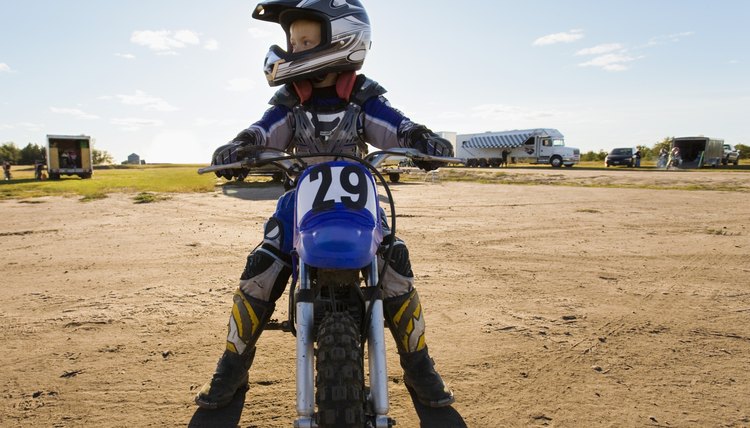
SSR Motorsports makes more than 30 models of pit bikes. While there are variations among models, the basic makeup of most bikes is similar. Learn where your controls are and how to operate your bike before riding. Always ride your bike both safely and defensively and with an approved helmet and eyewear.
Speed and Power
The power and speed of your SSR Pit bike will depend on the engine size. For example, the SSR 125 CC pit bike has 7.8 hp and a top speed of 50 mph. The SSR 110 CC pit bike has 7.0 hp and can go 40 mph.
Kick Start
Almost all SSR pit bikes are kick-start only. Your kick-start lever has a peg that will rotate 90 degrees. The SSR also has a spring-loaded throttle. That means it will return to the closed position in which the engine idles whenever you release it.
Engine
Your SSR pit bike will feature a single-cylinder, four-stroke, force-air-cooled engine. To assist cold starts, it will utilize carburetors with manual chokes. The choke lever has two positions, either fully on or fully off. On most SSR pit bikes, the choke lever is on the left side of the carburetor. If you have a choke on the right side of your SSR pit bike carburetor, it will have a halfway position in addition to the fully on and off positions.
Brakes
The SSR pit bikes have wave rotor hydraulic disc brakes on both the front and the back. Your front brake lever is on the right side of the handlebar. You operate your rear brake with the brake pedal located on the right side of the bike.
Transmission
The transmission for the SSR pit bike is a manual four-speed, one down and three up. You use your clutch and foot shifter to change gears. Your clutch lever is on the handlebar’s left end. Your gearshift lever is operated with your left foot. You must fully disengage your clutch before shifting gears or you will damage your bike. Avoid downshifting if the engine is running at a high speed, as this will also cause damage.
Frames and Tires
The frames for the SSI pit bikes are made of heavy-duty steel. The recommended tire pressure for SSI pit bikes is 25 psi for both front and rear tires. Always check the tire pressure when your bike is cold.
Writer Bio
Linda Tarr Kent is a reporter and editor with more than 20 years experience at Gannett Company Inc., The McClatchy Company, Sound Publishing Inc., Mach Publishing, MomFit The Movement and other companies. Her area of expertise is health and fitness. She is a Bosu fitness and stand-up paddle surfing instructor. Kent holds a bachelor's degree in journalism from Washington State University.