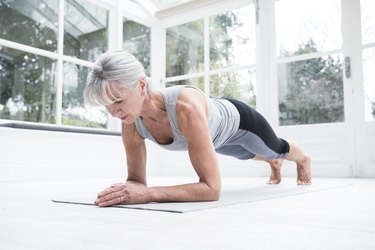
Some say 60 is the new 40, and one way to accomplish that younger look and feel is through a challenging workout for a 60-year-old female. Even though people are living longer, the human body goes through changes every decade. A 60-year-old woman no longer has as much of the protective effects of estrogen she once had, and estrogen appears to influence where body fat is stored.
Tip
Once you hit 60, your body slowly replaces muscle mass with fat. There are ways to counteract that, however. One way is to lift weights. You don't have to lift a lot, just enough to challenge your muscles.
Video of the Day
Lifestyle Changes Work
There's clinical evidence that people can make lifestyle changes after menopause that result in better fitness and weight loss. An August 2012 study in Obesity followed postmenopausal women (the language used in the primary source) who had overweight or obesity for a year.
Video of the Day
The study found that 60 percent of women who ate 500 to 1,000 calories per day less than they had been eating, along with 45 minutes of moderate exercise five days a week, lost nearly 11 percent of their total body weight after that year.
Women who focused only on diet or exercise but not both also lost weight, but not as much. Those who only dieted lost an average of 8.5 percent of their body weight, while those who only exercised lost just an average of 2.4 percent of their body weight. So the biggest bang for your buck clearly comes from doing both.
More Likely to Gain Weight
The likelihood of gaining weight increases as women age, according to a March 2014 study in BioMed Research International. The prevalence of obesity is 65 percent for women between 40 and 59, and 74 percent for women over 60. Lack of estrogen may have a role in women gaining weight, although the study, which focused on estrogen replacement treatment, didn't draw any definite conclusions.
The Office on Women's Health says women after menopause gain an average of 5 pounds. The cause, the article says, may be lower estrogen levels and a slower metabolism. Losing muscle mass, which happens as you age, will cause your metabolism to slow down.
Other reasons may be genetics. If your parents carry weight around the midsection, you're more likely to gain fat around your belly, also. Then, there's the body's basal metabolic rate (BMR). Your BMR is the rate at which you burn calories. This starts to slow down at age 20, and continues to decrease at a rate of 1 to 2 percent per decade, according to a December 2012 study in the journal Obesity.
How Many Calories
The average number of calories a 60-year-old woman needs depends on her activity level. If you're inactive, 1,600 calories a day is a good number to aim for, according to the U.S. government's Dietary Guidelines for Americans, 2015-2020. These guidelines use an average woman, who is 5 feet, 4 inches and weighs 126 pounds.
For a woman who is moderately active, the guidelines suggest that 60-year-old women consume 1,800 calories a day. A moderately active woman is one who walks 1.5 to 3 miles a day, at a rate of 3 to 4 miles per hour, in addition to daily living activities. An active woman, or one who walks more than 3 miles a day at a rate of 3 to 4 miles per hour, should take in about 2,200 calories per day.
The guidelines for your calorie intake fall as you get older. So, if you're moderately active at age 46 to 50, you should consume about 2,000 calories per day. That guideline decreases to 1,800 calories at age 51, and remains there for women ages 51 and up.
Read more: Daily Recommended Caloric Intake for Women
A Good Diet Plan
As you age, focus on eating well, according to the folks at Harvard Health Publishing. Eat whole grains, fruits and vegetables, lean protein and low-fat dairy products. Practice portion control, and eat foods in moderation.
Eat 45 to 60 grams of protein a day, focusing on high-quality proteins. A 3-ounce serving of chicken provides 21 grams of protein, while 8 ounces of nonfat or low-fat milk provides 8 grams of protein. One cup of cooked lentils includes 18 grams of protein. Other good protein choices are legumes, eggs, fish and lean meat.
The Mayo Clinic suggests women 60 and over try to keep their waist measurement below 35 inches around. A higher waist measurement means more belly fat, leading to more health problems. Achieve this by emphasizing a plant-based diet of fruits, vegetables and whole grains, along with the lean protein and low-fat dairy foods suggested above. Get your fat from fish, nuts and olive oil. Also, replace sugary beverages with water.
If you're trying to lose weight, do not attempt to lose a lot of weight at once. Try for 1 to 2 pounds a week, and check with your doctor before starting a weight loss program.
Read more: A Healthy Diet for a 60-Year-Old Woman
Exercise for 60-Year-Old Females
Getting older doesn't mean you need to slow down. Once you hit 60, it's more important than ever to exercise most days of the week, according to the American Council on Exercise, (ACE). For optimal recovery between workouts, a good workout for a 60-year-old female is a high-intensity interval workout two days a week.
When you're in your 60s, it's a good time to do resistance training. Moving away from free weights and using weight training machines allows you to use heavy resistance with less stress on your joints. That's especially good if you have arthritis. The Mayo Clinic suggests doing weight training that challenges your major muscle groups: your chest, back, arms and legs.
This is also a good time to try interval training. Instead of a steady run or bike ride, alternate short bursts of activity that makes you breathe hard for one to two minutes with one to two minutes of easier activity. This is a great type of exercise for a 60-year-old female. Do this one to two times a week, along with your weight training.
Exercise classes, including water aerobics and other fitness classes, allow you to combine socializing with physical activity. Water aerobics is easy on the joints and allows you to get an excellent low-impact workout for a 60-year-old female. Try different cardio, weights, interval training, yoga and leisure sports activities. Whatever you do, keep adding challenge and variety to your workouts. This will help your body stave off age-related declines.
Read more: How to Do a HIIT Workout at Home
More Is Better
Try to get at least 150 minutes of moderate intensity exercise each week to stave off belly fat as you grow older. That's 30 minutes a day, five days a week. If you exercise at a higher intensity, try to get 75 minutes of exercise a week, or 15 minutes per day, five days a week.
Interval training is an efficient workout, not only for the time crunched, but for anyone who is getting older. The Mayo Clinic researchers investigated the effects of high-intensity interval training (HIIT). The researchers found that age-related decline in muscle cells actually reversed. HIIT appeared to improve the muscle's ability to produce energy and triggered the growth of new muscle. Changes were most dramatic in people over 65, so this is an excellent type of fitness test for a 60-year-old female.
The Mayo Clinic reports that intervals appear to be safe for people with heart disease, diabetes and other chronic conditions, although it's best to check with your doctor before beginning a new exercise routine.
And for those of you who've exercised since you were young? You're already ahead of the game. Researchers at Ball State University's Human Performance Laboratory published a study in November 2018 reporting that, at age 75, those who have exercised since young adulthood have heart health similar to a 40 to 45-year-old.
- Obesity: "Effect of Diet and Exercise, Alone or Combined, on Weight and Body Composition in Overweight-to-Obese Post-Menopausal Women"
- Health.gov.: "Dietary Guidelines for Americans, 2015-2020: Appendix 2. Estimated Calorie Needs per Day, by Age, Sex, and Physical Activity Level"
- American Council on Exercise: "Exercise for Each Decade of the Adult Lifespan"
- Mayo Clinic: "Belly Fat in Women: Taking and Keeping It Off"
- Ball State University: "Study: Regular, Lifelong Exercise Keeps the Body Young"
- Office on Women's Health: "Menopause and Your Health"
- Mayo Clinic: "Menopause Weight Gain: Stop the Middle Age Spread"
- Harvard Health Publishing: "Nutrition and Aging"