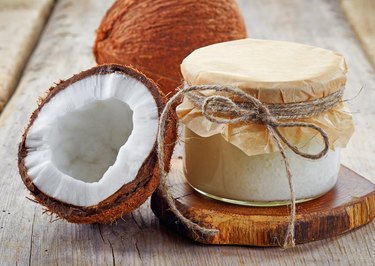
Omega-3 fatty acids are commonly known for their heart-healthy benefits. If you would like to incorporate more Omega-3 fatty acids into your diet, try consuming low mercury fish, like wild caught salmon or light canned tuna, into your diet two times a week. Coconut oil is another highly beneficial healthy fat, but does not actually contain Omega-3 fatty acids. Coconut oil is, rather, one of the best sources of medium chain fatty acids.
Medium Chain Fatty Acids
Video of the Day
You may have heard that coconut oil is high in saturated fats, artery clogging and dangerous. The truth is, the medium chain fatty acids (MCFA) found in coconut oil are rare in nature and highly health beneficial. MCFA are digested by the body in a different way than the common long chain fatty acids (LCFA) found in most other foods. MCFA are quickly digested, producing energy instead of body fat and arterial plaque like LCFA. About 50 percent of the MFCA in coconut oil is lauric acid, which strengthens the immune system and is also found in human breast milk. Caprylic acid and capric acid are also present, contributing to coconut oil's antifungal, antiviral and antibacterial properties.
Video of the Day
Purchasing Coconut Oil
Not all coconut oil is created equally. Always purchase virgin coconut oil. Virgin coconut oil is produced with minimal processing. Quality virgin coconut oil will have a clean, fresh, coconut smell and taste, with a translucent, almost mother of pearl coloring. Do not purchase bleached or refined, deodorized, hydrogenated or partially hydrogenated coconut oil, which is stripped of the beneficial MCFA and may contain trans fatty acids.
Internal Health Benefits of Coconut Oil
The health benefits are vast. Bruce Fife, ND, CN, author of "The Coconut Oil Miracle" has said "(Coconut oil) increases absorption of some of the B vitamins, the fat-soluble vitamins: A, D, E, K, beta-carotene, and some amino acids. Research has shown it can be useful in the treatment and prevention of obesity. A lot of research is current being done in this area. Studies show it may be helpful in preventing liver disease, kidney disease, Crohn's disease, cancer and many infectious illnesses, such as the flu, herpes, bladder infections, and candida, to mention just a few. Studies are now being done to test it effectiveness against serious illness such as AIDS and SARS. Preliminary results have been very promising."
How to Consume Coconut Oil
Although some people simply eat coconut oil by the spoonful, it is an excellent addition to almost any recipe. Coconut oil has a very mild coconut flavor. Coconut oil is in a soft, solid form at room temperature, but will melt to a clear oil when heated. The beneficial fats will not be compromised by heat. Try replacing oil or butter with an equal amount of coconut oil in baking. Saute anything from stir fry, to eggs, or try some coconut oil in a smoothie.
External Uses for Coconut Oil
Coconut oil is an inexpensive, versatile beauty miracle. Try a tsp. of coconut oil in your bath, or on the skin as a moisturizer. Not only will coconut oil moisturize skin and help prevent wrinkles, the anti-fungal properties can improve issues like and athletes foot and thrush. As a conditioner, apply coconut oil liberally before washing the hair. Wrap the hair with a towel and let the oil penetrate for around an hour before shampooing. Hair will be smooth and shiny, and scalp issues like dandruff will improve. For curly, thick hair, use a small amount of coconut oil as a replacement for hair grease or leave in conditioners.