
What Muscles Are Involved in Prone Row Exercise?
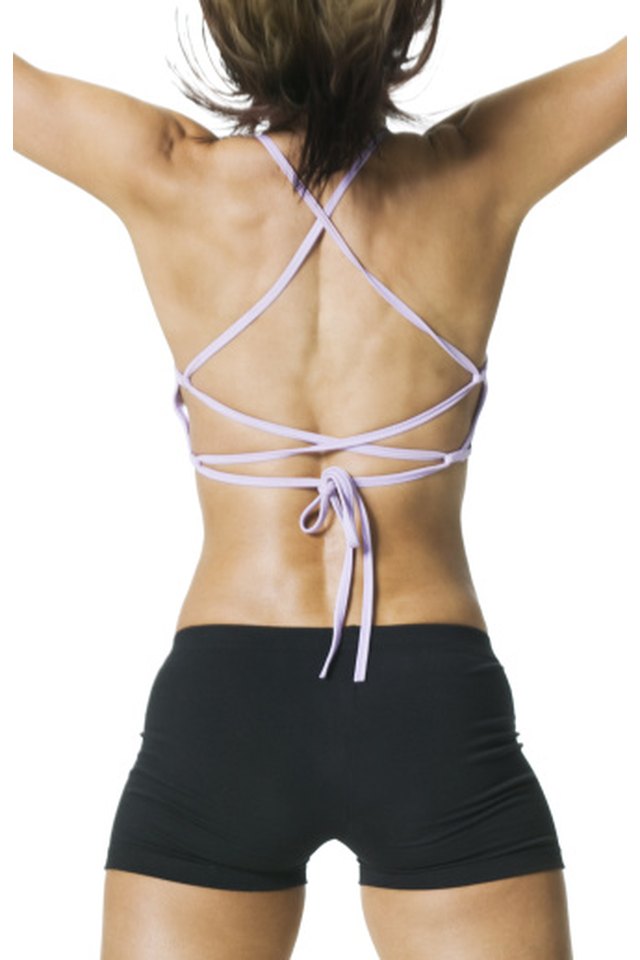
The prone row exercise is effective for strengthening the muscles that pull your shoulder blades together, preventing Dowager’s hump -- more commonly referred to as a hunched back. This exercise is easily done on a flat bench with dumbbells, especially when a seated row machine is unavailable. Prone rows are done lying flat on your abdomen. If you have large breasts or a large tummy, do one-arm dumbbell rows, because this exercise involves the same muscles.
Considerations
The actions produced by contracting muscles may change depending on the position of your body and the number of joints involved. For instance, while the primary function of your triceps muscle is to extend your elbow, it is also slightly activated when you are in the position to do prone rows. The long head of the triceps muscle crosses the shoulder joint such that when the long head contracts, it assists in pulling your arm toward your body.
Shoulder Extension
In a prone row, drawing the weight toward you until your upper arm is along the side of your rib cage is called shoulder extension. This aspect is performed by muscles that terminate on the upper end of your arm bone, crossing your shoulder joint. These include the latissimus dorsi, posterior head of your deltoid muscle, teres major and the long head of your triceps.
Scapular Retraction
Squeezing your shoulder blades together is called scapular retraction. This movement is performed primarily by your rhomboid major, rhomboid minor and the middle fibers of your trapezius muscle. The rhomboid muscles extend in a diagonal manner from the last two neck or cervical spinal bones and the first four upper-back or thoracic spinal bones to the inner border of each shoulder blade. Once your upper arm is alongside your rib cage, these muscles become the more active muscles compared to the lats, deltoid, teres major and the long head of the triceps.
Shoulder Stabilization
Four muscles press your arm bone or humerus into the shoulder joint cavity as your arm moves, and they are collectively referred to as the rotator cuff muscles. These muscles play an assisting role in moving your humerus. The three muscles engaged during a prone row include the teres minor, infraspinatus and supraspinatus muscles.
References
- “Anatomy & Physiology”; Gary Thibodeau, Ph.D., and Kevin Patton, Ph.D.; 2007
- “Personal Trainer Manual”; American Council on Exercise; 1997
Writer Bio
Paula Quinene is an Expert/Talent, Writer and Content Evaluator for Demand Media, with more than 1,500 articles published primarily in health, fitness and nutrition. She has been an avid weight trainer and runner since 1988. She has worked in the fitness industry since 1990. She graduated with a Bachelor's in exercise science from the University of Oregon and continues to train clients as an ACSM-Certified Health Fitness Specialist.