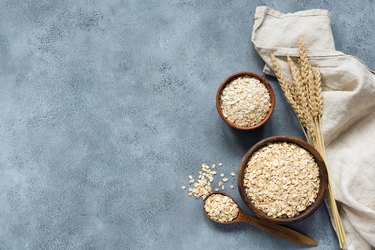
One of the Quaker Oats Company's classic products is Old-Fashioned Oatmeal, made from rolled oats. Quaker rolled oats are a source of whole grains and offer multiple nutritional benefits.
This form of oatmeal is made by cleaning the husk from the oat grain, steaming it and then rolling it flat between heavy metal rollers.
Video of the Day
Video of the Day
Read more: Is Oatmeal a Good Breakfast for Weight Loss?
Rolled Oats Nutrition
In a half-cup serving of dry oatmeal — which expands to roughly 1 cup once cooked — there are 150 rolled oats calories and 3 grams of fat, according to the USDA. Quaker rolled oats provide 27 grams of carbohydrates and 5 grams of protein. Quaker rolled oats contain no cholesterol and just 1 gram of naturally occurring sugar in a serving of oats.
Quaker rolled oats are naturally sodium-free. According to the American Heart Association, healthy adults should consume no more than 2,300 milligrams of sodium per day — if you have high blood pressure or other risks of heart disease, that recommendation drops to 1,500 milligrams.
Get Your Vitamins and Fiber
Quaker oats nutrition facts include 8 percent of the recommended daily allowance for iron, according to quakeroats.com. It is also a good source of the B vitamin thiamin, which means that it provides more than 10 percent of your daily needs. Quaker rolled oats also provide 2 percent of daily potassium needs, and 10 percent for phosphorus and magnesium.
One serving of Quaker rolled oats has 4 grams of fiber. Fiber are carbohydrates that are indigestible, explains the Harvard School of Public Health. There are two types of fiber found in food: soluble fiber, which partially dissolves in water, and insoluble fiber, which does not dissolve in water.
Two grams of the fiber found in Quaker oats is soluble, which can help lower cholesterol, and the other 2 grams are insoluble, which helps with digestion. According to the National Academies of Sciences, women aged 19 to 50 need a minimum of 25 grams of fiber daily while men need 38 grams per day.
Read more: What is the Nutritional Value of Oatmeal?
Know the Difference
The process of removing the husk and steaming rolled oats affects oatmeal nutrition data — it removes some of the protein, bran and B vitamins available in whole or steel cut groats. Rolled oats have a longer shelf-life, so they can be stored in paper packaging rather than in vacuum-packed containers. Old-fashioned oats differ from quick oats in their size alone. Quick oats are cut smaller, so they cook faster.
Add Some Variety
Avoid monotony by topping your oatmeal with a variety of healthful toppings. Use honey as a natural sweetener, and top your bowl with chopped raw almonds and sliced strawberries.
Stir mashed banana into your oatmeal and top with walnuts for "banana bread" oatmeal, or cook blueberries and peaches into your oatmeal for a cobbler-inspired breakfast. If you want to avoid added sugar, try sweetening your oatmeal with Stevia instead of honey or maple syrup.