
How to Improve a 100-Meter Sprint
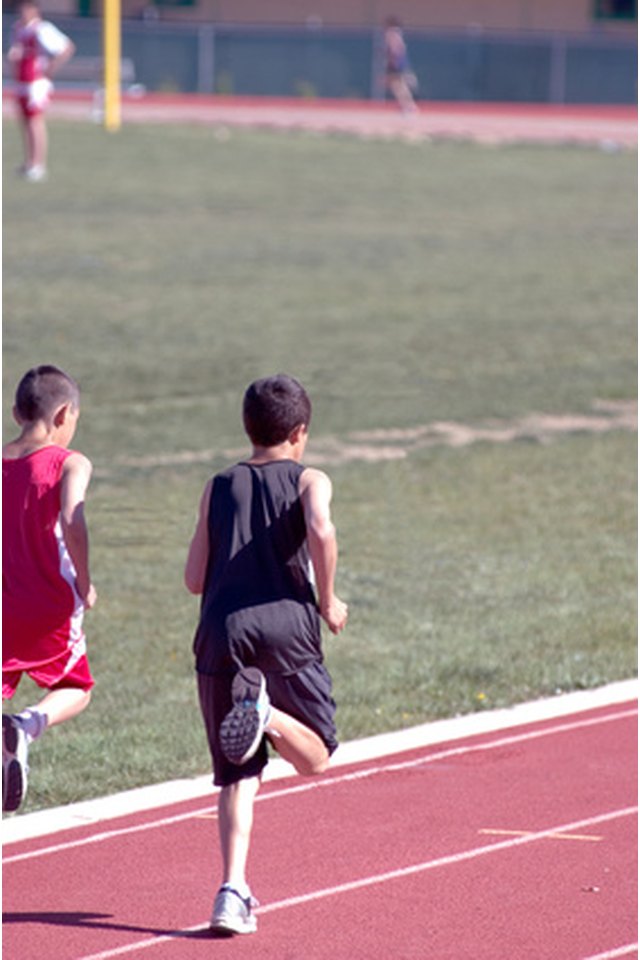
The 100-meter sprint is a highly competitive event and athletes are always looking to beat their competitors' times. Some college and professional athletes train year round to run just a few races per year. If you are a youth or amateur athlete you may not have the time or resources to train in this manner, but if you are willing to put in time and effort, you can improve your times for the 100-meter sprint.
Begin a strength training program in the off-season designed to improve basic strength. Improving basic strength can improve your time, and it will allow you to train with other techniques that may have a greater effect on improving your 100-meter sprint time. Focus the program around core lifts such as Olympic lifts (the power clean, snatch, and their variations), squats and variations, the deadlift, and the bench press. At this stage you should focus on training basic strength for the whole body.
Gain a moderate level of conditioning during the off season. This can be done with interval training (high intensity effort mixed with low intensity effort during rest periods), running multiple repetitions of sprints with a 1:2 work to rest ratio, or paced distance running, which should not exceed 1 mile. A properly conditioned sprinter should be able to run the 100-meter dash just below race pace for 10 repetitions with a 1:3 work to rest ratio. Having a level of conditioning allows for training during the season and the ability to run multiple races in the same day. This will be needed if you have to run heats prior to a final race.
Add plyometrics to your off-season strength program. Once you have basic strength, plyometric exercises increase explosive muscle power and decrease the time the muscles take to respond to a stimulus, both of which will improve your sprint times. Great plyometric exercises for sprinters include bounding, box jumps (depth jumps for the advanced athlete), split squat jumps, and single leg tuck jumps.
Adjust your strength program to your sport in preseason training. This does not mean to eliminate upper body lifts altogether, but instead the focus should be placed primarily on the goal of your sport. In this case, increasing leg power output is the goal. To accomplish this goal, limit time spent on upper body lifts. Use this added time to increase rest between lower body exercises. This will limit fatigue as you begin seasonal practice.
Train for your event during the preseason. Building your sprinting power by running should begin the first day of preseason practice. The 100-meter sprint uses anaerobic pathways to produce energy, so train using exercises that increase anaerobic capacity. Good exercises include sprints (40 to 200 meters), resisted running (by parachute, partner, or weight sled), or flying start sprints (a trotting start with full speed for the given distance). The other factor to train preseason is stride length. Increasing stride length will decrease your 100-meter sprint time. Stride length can be trained by up-hill running and running stairs.
Focus on your running technique. Work on lifting your knees and driving your foot through your center of gravity. Keep your toe pointed upward on the recovery step (when your foot is cycling after each step) and also use your arms. Your arms should be in motion with the opposite leg and move from the shoulder.
Practice your starts coming out of the block, starting two weeks prior to the season. Remember that track meets early in the season provide additional practice leading to your peak race. Focus on coming low out of the block and building height to the 40 meter mark while driving your legs into the ground. Act as if you are breaking a board beneath your feet and also make sure to drive your opposite arm at the same time as your leg.
Warm up using a dynamic warm-up with minimal static stretching. You want to warm your muscles, but over-stretching a muscle can decrease power output.
Monitor yourself throughout the season. Times should decrease each week during track meets, but you do not want to peak too soon. By monitoring your rest, sleep, nutrition, and training you can prevent overtraining and peaking too early. A good indicator of overtraining is an increase in your heart rate or blood pressure during rest, exercise or recovery. Symptoms of overtraining also include decreased motivation, increased irritability, insomnia, a decrease in body mass, a decrease in lean body mass, a decrease in appetite, and chronic fatigue. If an athlete is being overtrained they should decrease the volume of training. The intensity of the training may stay the same, but for every one week of overtraining, three weeks of recovery are required to reach maximum potential.
Tips
Training for this event as any other sport is optimized by having a set plan with goals. If your goal is to win an area race or a state championship, then you want to run your fastest race at that particular time (this is termed peaking). By having a well designed training regimen combined with a strength and conditioning routine, peaking can be controlled to a specific time.
Warnings
Improving your times for the 100-meter sprint can take time. Like most training regimens results may not be seen immediately, and the more time you place into the effort and work, the more you will see in return (better times).
References
Resources
Tips
- Training for this event as any other sport is optimized by having a set plan with goals. If your goal is to win an area race or a state championship, then you want to run your fastest race at that particular time (this is termed peaking). By having a well designed training regimen combined with a strength and conditioning routine, peaking can be controlled to a specific time.
Warnings
- Improving your times for the 100-meter sprint can take time. Like most training regimens results may not be seen immediately, and the more time you place into the effort and work, the more you will see in return (better times).
Writer Bio
Chris DeMaria is a health and fitness writer and has written for various online publications. In addition to writing, he has also coached college football. DeMaria graduated with the highest honors from West Virginia University with a degree in exercise physiology.