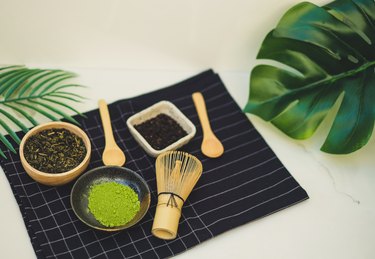
Whether you order a matcha latte on the daily or have never tried the Japanese green tea, you've likely heard all the buzz around it. In addition to its full-bodied taste and texture, matcha is known for its myriad health benefits, from boosting energy to preventing inflammation and certain diseases.
But how does it differ from traditional green tea? First off, tencha tea bushes are shaded from sunlight 20 to 30 days before harvesting their leaves. This prevents the plant from undergoing photosynthesis, which thereby increases the leaves' chlorophyll and L-theanine amino acid content (more on that later). After harvesting, matcha is ground into a fine powder and whisked into boiling water until it dissolves. It's then enjoyed as a tea or in baked goods and smoothies.
Video of the Day
Video of the Day
Read more: All-Natural Teas That Flatten the Stomach
1. Matcha Tea May Give You an Energy Boost
Matcha is a naturally occurring source of caffeine, and just one teaspoon of matcha provides anywhere from 60 to 70 milligrams of caffeine — roughly the same as a shot of espresso, Jill Galligher, RD, tells us.
But the energy boost you get from drinking matcha doesn't come with the jitters or energy crash that usually accompanies a cup of Joe. The reason for this is because matcha contains L-theanine, which offsets the negative effects of caffeine and gives drinkers a gentle increase in energy rather than a sudden spike. A 2017 review published in the journal Current Pharmaceutical Design also found that L-theanine helped improve attention and memory.
2. It's Tied to Lowering Anxiety
Even though matcha contains caffeine, human and animal studies have shown that consuming matcha powder or matcha extract can reduce anxiety, thanks to the presence of L-theanine and other phytochemicals.
Matcha may also boast stress-reducing properties, an October 2018 study published in the journal Nutrients found. One July 2019 study published in the Journal of Functional Foods out of Kumamoto University in Japan found that mice who consumed matcha spent less time navigating a test maze during an experiment, indicating decreased anxiety and improved concentration.
In addition to containing L-theanine, which produces a calming effect along with increased alertness and concentration, researchers say that matcha also activates the dopamine and serotonin receptors in the brain — two neurotransmitters that influence anxiety and mood.
3. Matcha Is Linked to Better Skin
People who suffer from acne or other skin problems may see an improvement in their complexion after drinking matcha regularly. Matcha contains chlorophyll, a phytochemical that has been shown to reduce facial wrinkles and skin elasticity in women over age 45 who take a supplement regularly, according to a March 2014 study in the Journal of Lifestyle Medicine.
In fact, chlorophyll applied directly to the face over a period of three weeks reduced pore visibility and even improved mild to moderate acne by the end of the study period, one small June 2015 study published in the Journal of Drugs in Dermatology found_._ What's more, matcha contains an antioxidant called epigallocatechin gallate, better known as EGCG, which prevents collagen breakdown, an October 2016 study in Materials Science & Engineering found.
4. Matcha Tea May Aid Weight Loss
Although more studies are needed to prove the connection between green tea and weight loss, there's some potential that there is — at the very least — a correlation between the two.
When EGCG and caffeine are combined (like in matcha tea), the mixture significantly helped people lose weight and manage their weight-loss success, a September 2009 meta-analysis published in the International Journal of Obesity found.
Read more: The Best Green Tea to Lose Weight
5. Matcha May Give Your Immune System a Boost
EGCG doesn't just help you lose weight and clear your skin — studies show that its antioxidants may help boost the immune system as well. EGCG may help destroy toxic free radicals in the blood that result in inflammation and cell damage.
When free radicals overwhelm the body, it results in what's called oxidative stress, which has been linked to inflammatory diseases like arthritis, ischemic diseases like stroke, and even neurological disorders like Alzheimer's and Parkinson's Disease.
Although there is no evidence that matcha can cure or prevent these diseases directly, green tea has some of the highest antioxidant amounts of any food, according to a 2010 study in Nutrition Journal. While the benefits of drinking matcha have been well-documented, consult a physician or dietitian before using matcha to treat a medical condition.
6. It's Tied to a Healthy Heart
Who knew that sipping a few cups of the green stuff a day might actually help protect your ticker? A January 2020 study looked at more than 100,900 people over the course of about seven years and observed that those who drank green tea three times a week or more had a lower risk of heart disease and stroke, per the European Journal of Preventive Cardiology study. Researchers chalk it up to green tea's epicatechin, catechin and EGCG.
- Current Pharmaceutical Design: "Effect of Green Tea Phytochemicals on Mood and Cognition"
- Nutrients: "Stress-Reducing Function of Matcha Green Tea in Animal Experiments and Clinical Trials"
- Journal of Functional Foods: "Anxiolytic Activities of Matcha Tea Powder, Extracts, and Fractions in Mice: Contribution of Dopamine D1 Receptor- and Serotonin 5-HT1A Receptor-Mediated Mechanisms"
- Journal of Lifestyle Medicine: "The Role of Functional Foods in Cutaneous Anti-Aging"
- Journal of Drugs in Dermatology: "Pilot Study of Topical Copper Chlorophyllin Complex in Subjects With Facial Acne and Large Pores"
- Materials Science & Engineering: "Evaluation of Epigallocatechin-3-gallate (EGCG) Cross-linked Collagen Membranes and Concerns on Osteoblasts"
- International Journal of Obesity: "The Effects of Green Tea on Weight Loss and Weight Maintenance: a Meta-Analysis"
- Nutrition Journal: "The Total Antioxidant Content of More Than 3100 Foods, Beverages, Spices, Herbs and Supplements Used Worldwide"
- European Journal of Preventive Cardiology: "Tea Consumption and the Risk of Atherosclerotic Cardiovascular Disease and All-Cause Mortality: The China-PAR Project"