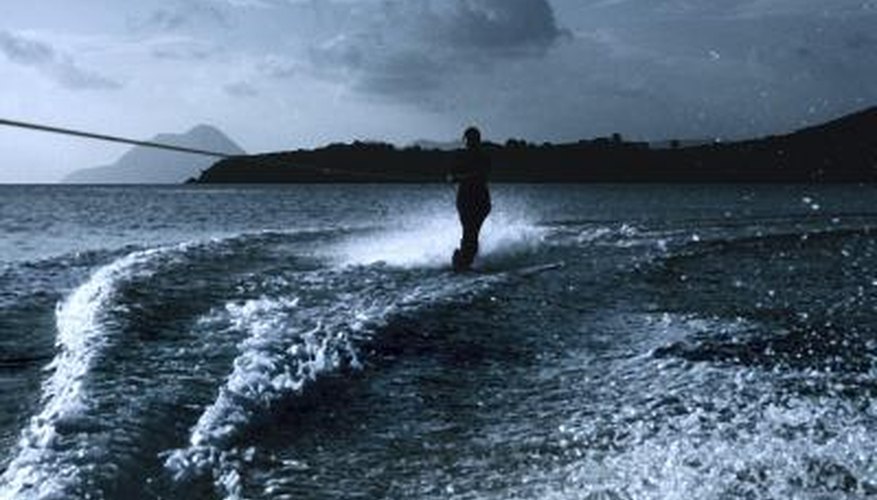


One of the most important factors in a water skier's experience is the performance of the boat driver. There are several things a boat driver you can do to make the skier's ride as enjoyable, and as safe, as possible.
Step 1
Start the engine only after the water skier is in the water and clear of the propeller. Put the boat in and out of neutral, slowly moving away from the skier and tightening the tow rope.
Step 2
Wait for the skier's signal to start before you begin pulling him. He should be holding the towline securely and have his skis in the proper position for take-off. Begin accelerating slowly, increasing the throttle smoothly to get the skier up. Generally, if the skier is getting up on one ski, you want to give the boat more gas than if he's skiing on two.
Step 3
Once the water skier is out of the water, maintain her preferred cruising speed. A beginner should ski at about 20 miles per hour.
Step 4
Make a turn in the shape of a skeleton keyhole. Begin with a slight turn to the left, then back to the right, forming a circle as you turn. The boat will slow during the turn, so compensate by giving it more gas. Once the circle is completed, follow your boat's original path. Look for bubbles as a guide to keep you on the previous path and ensure the smoothest and most wave-free ride.
Step 5
Avoid making sharp turns, particularly when the skier is outside of the boat's wake. If you have to make a sharp turn to avoid an obstacle, reduce the throttle.
Step 6
If the skier falls, circle back to her as quickly as possible. Always pass the skier on the driver's side of the ski boat to ensure you can see the skier at all times. Never back up your boat to a skier. Get close to her, keeping her on your right, and turn off the engine.
Warnings
- Always turn the engine off when a skier is entering or leaving the boat.
Tips
- Agree on hand signals before skiing. Generally, thumbs up means faster and thumbs down means slower. A hand in the air in a circular motion signals a turn while a pat on the head by the skier indicates he's done.
- By law, you must always have a spotter in the boat to watch the skier; however, it is a good idea to purchase a rear-view mirror for the windshield so you can see the skier as well. Never turn around to watch the skier and keep your focus on the direction you are traveling.
Tips
- Agree on hand signals before skiing. Generally, thumbs up means faster and thumbs down means slower. A hand in the air in a circular motion signals a turn while a pat on the head by the skier indicates he's done.
- By law, you must always have a spotter in the boat to watch the skier; however, it is a good idea to purchase a rear-view mirror for the windshield so you can see the skier as well. Never turn around to watch the skier and keep your focus on the direction you are traveling.
Warnings
- Always turn the engine off when a skier is entering or leaving the boat.
Writer Bio
This article was written by the CareerTrend team, copy edited and fact checked through a multi-point auditing system, in efforts to ensure our readers only receive the best information. To submit your questions or ideas, or to simply learn more about CareerTrend, contact us [here](http://careertrend.com/about-us).