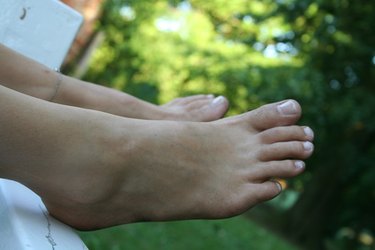
Spider veins are most common in the legs and thighs, but can develop in the feet, ankles or anywhere in the body. Spider veins, or telangiectasias, are fine, dark-looking veins that develop in clusters like a spider's web on the surface of your skin. It is important to reduce spider veins before they develop into varicose veins. Spider veins are the most common in women after their childbearing years. The Cleveland Clinic estimates up to 60 percent of the adult population has spider veins. Risk factors include a family history, sedentary life style, weight gain, pregnancy and prolonged standing. Spider veins develop because of weaknesses in the vein walls. The weak vein walls cause pools of blood, which lead to spider veins. Spider veins can be treated on your feet and ankles with the right combination of a daily routine of resting and massaging, and a more aggressive treatment of laser therapy.
Step 1
Wear compression stockings. The Cleveland Clinic says the easiest form of treatment to get rid of spider veins on your feet and ankles are compression stockings. Compression stockings are basically strong support hoses that compress your dilated spider veins. The hoses squeeze your ankles and get the blood moving back up your legs and into your heart. Compression hoses can improve your blood circulation and decrease pressure in your veins, helping reduce foot swelling, which causes spider veins in your feet and ankles. The compression stockings can be found in most drug stores.
Video of the Day
Step 2
Elevate your legs. When you are sitting or relaxing, elevate your feet above your heart level. This will cause your heart to pump faster and increase the circulation in your spider veins, which will reduce them in size. Use a recliner if possible, otherwise sit on the couch sideways or sit in bed and elevate your feet with pillows and cushions.
Step 3
Avoid standing for prolonged periods of time. Try to stand as little as possible. Standing increases the pressure on your valves and causes them to swell and create spider veins. If you can't sit, get on the tips of your toes by lifting your heels off the floor. This action will strengthen your calf muscle and help increase circulation in your spider veins. Do this exercise 20 to 30 times, then relax for two minutes. Repeat again three to four times.
Step 4
Massage feet with lotion. Rubbing your legs with lotion that contains St. John's wort oil or massage oil will relax your legs, which will help improve your circulation. Massage the oil into your legs and ankles, then rub in a circular motion. Squeeze your feet and ankles hard every once in a while to force the blood out of your spider veins. This will reduce the blood in your ankles and feet and help the blood back up into your heart, reducing the spider veins in your feet and ankles.
Step 5
Undergo laser therapy. Laser therapy is the most effective way to get rid of spider veins because the laser can shrink, even totally get rid of spider veins. The American Academy of Dermatology says lasers have been around for more than 20 years.There are two kinds of laser therapy. Light therapy and endovenous laser treatment. During light therapy, a doctor puts a concentrated pulsed light on the spider veins below your skin's surface. The beam of light heats the blood vessel and closes it off, making it smaller, and in many cases, making it disappear completely. In endovenous laser treatment, a laser fiber is inserted into the surface of your skin and into the spider vein. The laser heats up the lining of the spider vein. The intense heat of the laser will cause the spider vein to collapse and disappear from the skin.
Step 6
Undergo sclerotherapy. Sclerotherapy is an injection of sodium chloride that is put with a needle directly into the spider vein. The sodium chloride irritates the lining of your blood vessel and cases it to swell up and stick together. Over a period of a few weeks, the blood vessel turns into scar tissue and then fades from the surface of the skin. The procedure is fairly simple and inexpensive.
Video of the Day
Is this an emergency? If you are experiencing serious medical symptoms, please see the National Library of Medicine’s list of signs you need emergency medical attention or call 911.