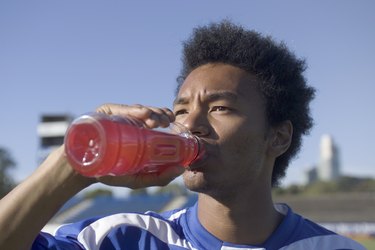
We know that Gatorade quenches our thirst and that it is used by many athletes, but what's in Gatorade? What are the ingredients that make it an ideal beverage before and during physical activity?
What Ingredients Are in Gatorade?
Video of the Day
Gatorade ($14.99 for 24, Amazon.com) has become a household name, hydrating athletes and non-athletes alike. Gatorade's origins trace back to one football team's desires to keep its players extra hydrated. According to Harvard Health Publishing, the sports drink was created in the 1960s for the University of Florida Gators football team. What began as a simple homemade mixture of salt, sugar and lemon flavoring has evolved into a more complex beverage.
Video of the Day
Generally, sports drinks contain carbohydrates (often sugar) along with minerals, such as sodium and potassium. According to the Gatorade website, Gatorade ingredients (Thirst Quencher Original Pack) include water, sugar, dextrose, citric acid, salt, sodium citrate, monopotassium phosphate, gum arabic, glycerol ester of rosin along with flavorings.
The sugar in Gatorade products, labeled as carbohydrates, helps increase the speed of water absorption in the intestines while making the drink taste sweet, according to the American Chemical Society. Electrolytes, mostly sodium and potassium, also compose a large portion of the Gatorade makeup. It should be noted that, like soda, Gatorade can contain quite a lot of sugar with 34 grams in 20 ounces.
Related Reading
The Benefits of Gatorade
Gatorade's popularity is due, at least in part, to the health benefits it provides to athletes. For starters, the sodium in Gatorade helps your body retain fluids that may have been lost during physical activity, explains the Cleveland Clinic. Moreover, the calories in Gatorade can help replace energy expended during exercise.
That said, Gatorade is best consumed after sweating a great deal from intense physical activity. Cleveland Clinic recommends drinking Gatorade in a high-temperature environment or high-intensity sport session.
A cyclist or runner who has gone long distances, for instance, might use Gatorade to replace electrolytes, says the University of Michigan. Otherwise, too much Gatorade consumption can be unhealthy, leading to weight gain and dental issues.
Teens and children should be especially wary of sports drinks, as the extra carbohydrates and electrolytes from Gatorade aren't needed. Children get plenty of nutrients from a balanced diet and extra carbohydrates and electrolytes are not necessary.
Related Reading
Water vs. Sports Drinks
Water has been the longstanding beverage choice when it comes to hydration. But is water a better choice than Gatorade before, during or after physical activity? The answer: yes, it generally is. The University of Michigan advises against using sports drinks to replace water, especially during meals.
Sports drinks can deliver extra, unneeded calories, says Harvard Health Publishing. Some can contain up to 150 calories, which is equal to about 10 teaspoons of sugar. Water, on the other hand, does not add calories to your diet. Rather, water keeps the body hydrated and balanced. It removes waste products, transports nutrients to cells and regulates body temperature, says Cleveland Clinic.
Unless you're performing rigorous physical activity during which you will produce a lot of sweat, you won't need the electrolytes and carbohydrates that are in Gatorade. Water is likely the best choice for anyone performing moderate to light physical activity and for children and teens in many cases.